Know Any Literary Animal Lovers?

Hi there PureJeevan readers! We wanted to let you know that Jim's new novel CHROO is available on Amazon. It's a crazy adventure involving a billionaire heiress, her Chihuahua BFF ("Chroo") and a host of human and animal characters. Find out more on Amazon! Here are some links:
EXCITING ANNOUNCEMENT!
Kevin Gianni Wants to Meet
Pittsburgh Raw Foodists This Saturday!
UPDATE: Location is set for my home in the South Hills
Kevin and Annmarie Gianni will be in Pittsburgh for the Steeler's game on Sunday. They'd love to meet Pittsburgh raw foodies while they're here! So, if you can make it to meet up with them, let Wendi Dee know as soon as possible. We'll either be meeting at the East End Food Coop (if I can reserve the space at the last minute) or at my home (South Hills/Brentwood). Please respond by Friday at 5:00 p.m. about your availablity.
Jim here... It's been nearly half a year since we posted a long meditation on living patiently, noting the unique, sometimes-at-odds dovetail that exists between (1) experiencing the zen of patience and (2) living the electrically charged life of raw foods. While we're STILL living with the same patience we talked about, I have to admit there have been times when we've been in not-so pleasant touch with some real frustration about getting our home sold and finally moving on to all of the exciting stuff we have planned for us and for you.
Wendi and I are absolutely ecstatic about taking our raw foods message to the next level -- and not just "next level" meaning more a few more blog posts and videos, but a true quantum leap in terms of our immersion into this world and commitment to advocating the lifestyle. It just gets a little tough, even when practicing patience, to be kind of stuck in the starting gate.
Read more: Pure Jeevan Heads Out of Town: Raw Roadtripping Vids to Come!
This is my version of a beanless hummus. One of my close friends adores the taste of Israeli Hummus and she thinks this tastes just like it. So, try it for yourself and let me know! Jim will eat this if he doesn't see me using the zucchini (he doesn't like the idea of eating zucchini for some reason). :-P
Hummus
3 cups of zucchini (peeled and chopped)
Wow, what a stressful weekend! We spent pretty much the entire past two days going through the dozens and dozens of suggestions we received in response to our July 30 post concerning our move (in which we asked for help in finding the perfect new place to live). We listed every city suggested to us, as well as a number of cities we specifically wanted to consider. Then we attempted to gather data from the Internet to rank these cities. Here's a HUGE snapshot to show our progress. (I'll explain a few things below.)
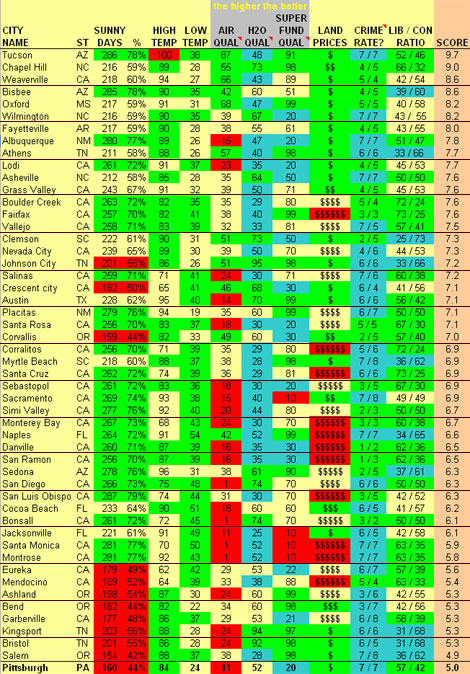
As you can see, we ranked each city according to many criteria. These included the number of sunny days per year, average high and low temperatures, air quality (higher #s better), water quality (higher #s better), Superfund statistics (an indication of the general toxicity of an area -- higher #s better), land prices, crime rate (the numbers "x / x" indicating scores from 1 to 10, lower #s being better, for "personal" crimes and "property" crimes), and finally a "liberal / conservative" ratio based on voting records for that town.
-

- The Lovely Rhio
Original Comments
Below, we have included the original comments from this blog post. Additional comments may be made via Facebook, below.
On January 21, 2009, wrote:
Can't wait to hear your interview on iTunes!
Read more: Wendi and Jim Interviewed by Rhio on NY Talk Radio
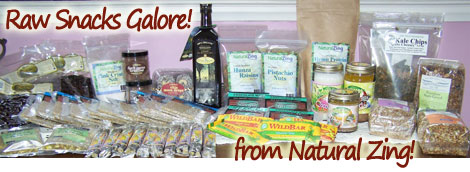
Well, Wendi and our daughter, KDcat, are headed out this evening on a train for their cross-country tour. They didn't seem so sad to leave ... maybe it's because of the bounty they're taking with them! Check it out in the banner above as well as the snapshots below! (I've included a list at the end of many of the products.)
Natural Zing has been Pure Jeevan's favorite online source for all of our raw food supplies. They have been very supportive of Pure Jeevan for over a year, and they continue to amaze us with their love and generosity. You'll be hearing more about Natural Zing during the tour, because they're Wendi and KDcat's official snack sponsors for the trip!

While I was growing up in the Midwest, I had a rich uncle who lived out East in Philadelphia. I didn't know him very well at the time, but would often glean stories via the family grape vines of his business successes. After high school, I attended college in Northeastern Pennsylvania -- Wilkes University -- where, incidentally, I first met Wendi! :-)
Being out there, I got to visit my uncle from time to time, and dine with him and his family. ?Among other things, he was quite the gourmand. I'm not so sure what he'd have thought of raw foods, although I suspect he'd have appreciated the many gourmet efforts.

It's always a journey.
That's basically my post today, boiled down into four words. From all I've read, from all of those I've talked with / emailed / interviewed, and certainly from all I've personally experienced, this is a key concept that, in my view, it's best to come to terms with as soon as you can.
Over the next few months and the coming year, you'll be witnessing the continued growth of Wendi Dee and Pure Jeevan in ways you might not ever have imagined! So, stay connected and let us know your thoughts about the changes that are (and will be!) taking place. We're not here for ourselves, we're here for all of you and for those who don't know about us (yet!). We have a mission: to share our stories and inspire others to fully embrace their lives and be all that they could ever desire (including healthy, happy, and vibrant)!
This is a long post, even though I tried to keep it brief. It's mostly a personal entry, but I wanted to share things so that you know a bit about what's going on with me and Pure Jeevan, now and in the near future. I'll break it up a bit with some more photos from Raw Spirit, the most therapeutic and life-changing event of my life.
======Wendi Dee's Growth======

Many of you know some of my story of healing. I suffered with Polycystic Ovarian Syndrome (PCOS) since I was a young teenager. Over the years, I began putting on more and more weight until I was nearly morbidly obese. I learned a lot about PCOS and how there is always an accompanying issue with Insulin Resistance.
Countless overweight women search the Internet looking for help in dealing with PCOS, hoping to find a natural cure to the harsh medications often prescribed that tend to cause other health concerns in our bodies. One of the most often asked questions is from women who have a pretty good understanding of PCOS. They want to know if they need to be careful with fruit consumption if they have PCOS and are trying to lose weight.
Read more: Fruit Consumption with PCOS and Insulin Resistance
We're heading out of town again! This time we'll be visiting Leela Mata at her Peaceful Valley Ashram, the location of the first raw food spiritual retreat I held last year.
Here's a video I took of Leela Mata last year:
?