Know Any Literary Animal Lovers?

Hi there PureJeevan readers! We wanted to let you know that Jim's new novel CHROO is available on Amazon. It's a crazy adventure involving a billionaire heiress, her Chihuahua BFF ("Chroo") and a host of human and animal characters. Find out more on Amazon! Here are some links:

Today we wanted to do something fun and a bit unusual. We raw foodies are a creative bunch, so we? thought, "Why not profile a handful of raw musicians !" Sounded like an interesting project, as we've all heard of at least a few raw foodist musicians out there. So, here are a dozen raw musicians to get you started -- that's right, FOURTEEN wonderful raw musicians!? (Since when does a dozen equal fourteen? Well, we figure that cooked foodies have their "baker's dozen," which everyone knows is thirteen.We figure: Why be outdone by the cooked food world, eh? So, we're redefining things a bit!)
Anyway, some of these bands/musicians are internationally famous; others are names you may not have heard before. We asked some of our friends to suggest raw musicians for today's post and we were surprised with the number of musicians mentioned! All those listed below are reportedly raw (or, in the case of whole bands, at least one or more of the members are raw foodists).Please note that this is by no means a complete list.

As I write this, Wendi and KDcat have been en route to Portland for 39+ hours so far (including a long layover in Chicago)! Looks like they still have another 22 or so hours to go. What a monumental trip, eh ! Cross-country travel by rail really gives you a better appreciation for the distance, as compared with air travel or even highway travel. Imagine what it must have been like in the covered-wagon days!
 So far, reports from the train have been not so wonderful. KDcat seems to be having a good time roaming around socializing. But, Wendi's experiencing some major motion sickness. Oddly, we never anticipated this problem -- which is incredible, as we spent more than a month planning this trip! But, it just goes to show you that you cannot anticipate everything in life!
 After leaving Salem, Oregon, Wendi and KDcat drove less than an hour to the city of Corvallis where they met up with their hosts the Zander's -- Joni, Steve, Bekka, and Stephanie -- a fellow unschooling family Wendi had come to know in an online forum. It was great to be in their company and we loved them right away,? Wendi wrote. ?Their home is absolutely beautiful on a really cute lot with plenty of plants and trees around ? including the most delightful flowers that smelled divine (I think they were called Daphne).
Corvallis is the city we ve mentioned multiple times -- the city that feels like it s the right fit for us. Well, it lived up to our dreams in just about every way. It s a progressive, hip town with a lot going on. The people are friendly, the weather is beautiful, the land is gorgeous, and there are lots of unschoolers. Access to fresh, ogranic, raw foods doesn't seem to be an issue anywhere in Oregon, according to reports from the road so far. While they've been away, we've talked quite a bit each night about what they're finding -- and fresh organic produce seems pretty much everywhere out west. "The west," wrote Jim Morrison, "is the best." (Surely he was a raw foodie.)
Jon Gold, owner of the Sunny Side Up Cafe (a vegan and vegetarian restaurant there) and an unschool father, put together a little gathering of unschoolers for KDcat and Wendi. They were able to meet some local unschoolers and ask questions. There was also a gathering one day at the cafe where KDcat was able to do some art at a table with some other unschool teens. It's definitely a creative, easy-going town with some fantastic people in it!


When we found out that there was a raw foods restaurant in Key West, we knew we'd visit for sure. So, after a wonderful lunch of some of their raw staples (raw tacos and peanut noodles), it was no surprise to us that we found ourselves drifting back toward Help Yourself after the sunset celebration at Mallory Square (the main nightly Key West sunset viewing celebration). When we arrived, we asked to interview the owner, Charlie Wilson. She'd just left after working a very long day at the restaurant. But, an emplyee called her anyway and she graciously agreed to come talk with us! So, here's a bit of that conversation:
Read more: The Key West Raw Scene: Pure Jeevan Gets Up-Close and Personal with Charlie Wilson!

Jim here... A few months ago, I was in our local food co-op's juice bar. I'd ordered an apple juice and had cringed when I saw the barista chop up four Granny Smiths and nonchalantly toss the whole lot, seeds and all, into the juicer. That juice was for someone else. So, when my order came up, I politely requested that he cut the seeds out -- a request he reluctantly granted, although not without showing considerable annoyance. My thinking was: Hey, those seeds contain cyanide! Why would I want to consume that, even in small amounts
 But then... Have you ever known anyone who died from eating apple seeds? ?I know I haven't. Also, after mentioning this to a few people I know, I found that a number of them regularly ingest apple seeds. And, well, they're still living. So, is there any truth to the rumors? And, should we be concerned at all about this?
Read more: Should You Juice the *Whole* Apple, Seeds and All?
Jim here... I'd like to mainly talk about organics today, but thought I'd wrap that subject into a longer, rather quirky piece on ranking produce on some sort of a scale that would indicate how awesome (or awful) it is. See what you think...
Have you ever thought of arranging produce into a sort of "heirarchy of quality"? Well, I'm not going to attempt to do that here, but I would like to discuss the concept for a moment in order to at least explain what I'm getting at. While I've not yet attempted to do this exercise, I nonetheless occasionally envision a large chart or something that conveys my feelings about how I personally rank the quality of fruits and vegetables I put into my body. This all probably sounds vague, so let me share some examples.
Read more: Pure Jeevan's "Produce Buying Tips" Series, #2: Buying Organics
Let's take a quick look at a few dessert pictures, then compare and contrast, shall we First up is a small slice of some normal pastry:
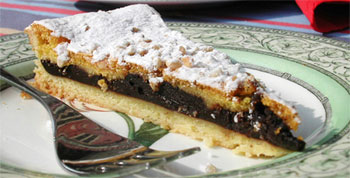
Looks sinful, right It seems to proudly display its bready crust, its gooey chocolate center, some sort of butter-rich top layer coated with lovable little bits and bobs, and a liberal sprinkling of confectioner's sugar to make the whole thing cute as a wintry scene from one of those holiday specials hosted by the claymation likeness of Burl Ives. I'm sure it's delightfully rich, too. A tad small, though, eh ? It's probably all anyone can take of such decadence without worrying about clogged arteries or putting in extra time on the tread mill for the next three days.

Today, we thought we'd share another non-diet-oriented explanation of obesity. It's from Rhonda Byrne, author of the international multi-media phenomenon known as "The Secret," which provides readers with in-depth philosophical explanation and instruction with respect to the Law of Attraction.
Wendi and I have The Secret on CD, and often enjoy listening to it. I think, in fairness, we both have a few legitimate criticisms about certain aspects of it (and I'll share one or two, below). However, on the whole, many of the ideas within resonate deeply for us and we find much of the underlying message profoundly uplifting and empowering -- especially (for me) much of the discussion regarding maintaining a healthy, positive, optimistic attitude and practicing gratitude.

To keep all of you inspired while we are away, we've asked some
remarkable individuals to share their raw food stories with you. Enjoy!

Many of our visitors go directly to our raw food recipes section of the blog. They must be terribly disappointed to find only a few recipes there. We ll continually add more, but for now there are only a handful. So, it is with extreme pleasure that we introduce you to someone you are going to love!
Take the time to meet...
 Well, after three long days of train travel, Wendi and KDcat arrived in Portland. I knew they'd had a rough trip (as I'd posted, Wendi experienced some serious motion sickness!), so I booked them into an awesome Bed & Breakfast, literally across the street from the raw restaurant they were planning to visit. That B&B is called the Lion and the Rose Victorian Bed & Breakfast Inn. Wendi said everyone there was super-nice. (There was a neat synchronicity about it, too, which I'll post in the comments section.)
Thanks to everyone for the motion sickness tips! Wendi's feeling better, but after such a long train ride, she and KDcat still feel the effects on their balance (feeling like they're still moving, slightly dizzy, ears blocked a bit etc.). I suppose train travel takes a little getting used to. But, again, they're feeling much better.
Even though it was a short stay in Portland, they managed to squeeze in a meetup with two Pure Jeevan family members, Ann Chatterton and Tracy Partridge Johnson (as well as Ann's children, Zoe and Zack, and Tracy's son Brandon). They met up at the Blossoming Lotus, an organic/vegan venue that offers some gourmet raw dishes. Here's a slideshow!
Read more: Wendi and KDcat Wonderfully Welcomed to the West (See Slide Show!)