Know Any Literary Animal Lovers?

Hi there PureJeevan readers! We wanted to let you know that Jim's new novel CHROO is available on Amazon. It's a crazy adventure involving a billionaire heiress, her Chihuahua BFF ("Chroo") and a host of human and animal characters. Find out more on Amazon! Here are some links:

I was just thinking about a particular phenomenon, but don't know what to call it. This is something I used to notice mostly after watching movies, although it's something that happens all the time in life -- and I think it does in fact relate to diet, so I'll share. Here it is:
Ever leave a theater after viewing a particularly uplifting film Recall what it's like for a moment. You walk outside, maybe with friends or family, still filled with that magical feeling of having visited another world, or having been moved beyond words, or being filled with inspiration. There's a glow about you, and the air seems sweeter as you stroll out to your car, absolutely care-free. You spin around as you walk, laughing with your friends, joking and hugging each other, engaging in imaginative conversation all the way home -- and the spell lasts for a good long time thereafter. Oh, I love, love, love great movies!!!
Read more: Pure Jeevan Adds Depth to the Phrase "Watch What You Eat"
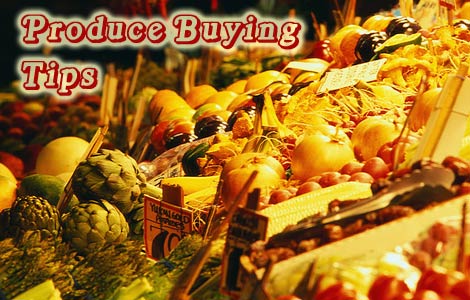
Jim here... I'd like to mainly talk about organics today, but thought I'd wrap that subject into a longer, rather quirky piece on ranking produce on some sort of a scale that would indicate how awesome (or awful) it is. See what you think...
Have you ever thought of arranging produce into a sort of "heirarchy of quality"? Well, I'm not going to attempt to do that here, but I would like to discuss the concept for a moment in order to at least explain what I'm getting at. While I've not yet attempted to do this exercise, I nonetheless occasionally envision a large chart or something that conveys my feelings about how I personally rank the quality of fruits and vegetables I put into my body. This all probably sounds vague, so let me share some examples.
Read more: Pure Jeevan's "Produce Buying Tips" Series, #2: Buying Organics

As this is a holistic web site, it's important that we take time every so often to feature pieces on other aspects of human health besides diet. So, today's subject is unrelated to raw foods, but is directly related to your health. (Don't worry: We'll get back to raw foods on Monday!)
Today I want to share a super-valuable lesson I learned when I was just 21 years old. Back then, Wendi worked within the advertising department of a large newspaper. She helped me meet the paper's photography editor who, in turn, approved an internship for me during my senior year of college. So, several days per week for one semester, I hung out with professional newspaper photographers. It was a lot of fun -- and with real darkrooms, too (as this was way before the age of digital cameras).
Recently, we were asked how to balance meals when one individual is an under-weight-open-to-raw-semi-carnivore and the other is overweight and feels the need to be on a raw food diet to lose weight and regain health.
Many of you reading this will agree: It's wonderful that the partner is open to the raw food diet! That's going to make life so much easier. Many on the raw food path lack a supportive partner, and that's an issue we've discussed in the past here on the blog and will continue to address in the future.
This experiment isn't looking so great, right now. I'm gaining weight.

I've cut fat out of my diet until my evening meal. Here's what I've eaten over the past few days:

Here it is, the new year. I've never been excited about the end of one year and the beginning of the next, but this time it's different.So many things have changed in our lives here at Pure Jeevan, bringing us to this point in time--a time that we are ready for and fully embrace. This year is going to be RAWmazing!
Many plans and projects have been started over the past few years, and this is the year that will see many of them fully blossom. The beauty of these projects is that they are about so much more than just us, or just you, our lovely readers. Our mission is to help as many people as possible to wake up from a life that's only partially being lived.We believe there are many tools that can be used to fully wake up and embrace life; one of them is eating a raw food diet. We raw foodists know that there is a lot more to life than what we've been taught to believe and expect, and many of us are helping others learn this beautiful fact. We are shaking up many of the core beliefs on which most of us have based our lives. I strongly believe that many of us in the raw food movement can say: We Are The Ones! We are the ones who are here to make positive changes, to help others fully embrace life, and to have fun, fun, fun! Why waste even one more day of your precious life doing something you don't enjoy doing? It's time to have fun, to feel the love that exists within and all around us, and to help others experience the same! So, are you in ?Do you want to join us on this grand adventure of creating a blissful life for not only ourselves, but for the rest of the world, as well?
Read more: Acknowledging Changes and Growth: 2008 / 2009, Part 3
Wow, could this really mark 800 raw food blog posts ! ?We must be obsessive orthorexic raw foodies to have achieved that level of focused health editorial journalism! Post #800 deserves to be something really useful (not that the others aren't or do not deserve this), so we'd like to pass along a fun idea. I guess all of that talk of Donald Trump yesterday got me thinking about making deals. We make deals with others, of course, but I think we also sometimes can make them with ourselves.
I'm so glad to be out of the corporate business world these days, but I did pay attention while there, and perhaps even learned a thing or two. Today's post is related to that in a way. You see, I was once at a sales training seminar when the speaker advised following a "this job / next job" strategy with clients. What that means in business is that, when you're in the middle of one job working for someone -- say, for example, you're a printer working on a brochure for a company -- you would make a point of saying something like, "Hey, this brochure is going great. I was wondering what else is coming in the near term so that we can make sure to be ready for it."
Well, we've finally done it -- made the move westward to our new hometown, Portland, Oregon! It's been nothing but the kind of high adventure befitting such a move, not the least of which was a wheel literally flying off of our car while driving (don't worry, no one was hurt) just days before we were scheduled to leave. And, of course, everything during the past few weeks wound up costing about 10x what we'd planned. ?But, we're here! ?And, we're beginning to get settled.
As always, we've got some great things on deck for this blog in the coming near term, including many interesting articles and some fun video experiments we did involving live blood and electrical grounding. We also have some new exciting web site features to roll out, one completely new raw food site to unleash upon the raw foods community, and a whole new Pure Jeevan web site design to launch. For now, though, we'll probably remain off-line for a bit longer, as we organize and unpack things.
Our Pittsburgh home remains for sale. Naturally, we'd hoped to have sold it before making this move. But, we realized that we didn't necessarily have to wait for it to sell in order to move to Portland. So, we took the great leap of faith and moved here without that step completed. (It'll certainly be a happy day when that lovely home finds its new owners and caretakers!).
Read more: Greetings from PDX, Pure Jeevan's New HQ!! (Post #756)

Jim here... We're at an interesting juncture here at Pure Jeevan. For the moment, we're still living a little more "in the box" than we plan to in the near future. One example of this is my personal excitement about Fridays. Oh, I suppose Fridays will always seem special to me somehow. But after years of the corporate routine, Friday remains the most welcome weekday.
Friday signifies the end of the five-day stretch during which most people do whatever they happen to do to pay the bills, to keep (raw!) food on the table, and a roof over their heads. While I know of and admire many people for whom the work week is generally meaningful and rewarding, I suspect that the majority of people go through it simply for the money. Sure, many "like" their job (or, perhaps more aptly, "don't hate it"), but I have met too few who absolutely love their jobs. (Come to think of it, I've met quite a number who actually do hate their work!)
Read more: TGIF!, and a Recap of Major Pure Jeevan Activities

Today we welcome Shea Lynn Baird from Monday Night Live. As you may recall from a few weeks ago, Wendi and KDcat visited with Shea and her husband Stephen during their 2010 Trip. While there, they all attended a raw food meetup, and Shea brought a wonderful Thai salad. She shared this delicious creation with all of you in this special guest raw chef edition of Makin' It Monday, below:
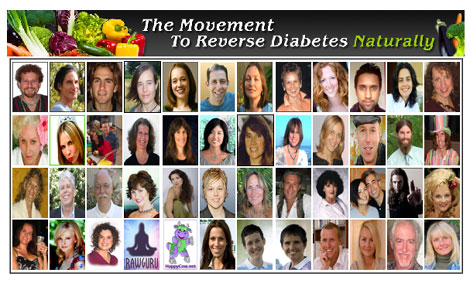
A few weeks ago, we hosted a Diabetes Awareness week here at Pure Jeevan. This was our contribution to the larger Reversing Diabetes Naturally movement that we blogged about. We wanted to let you know that the package of bonus materials offered to people who purchase the Simply Raw DVD is quite amazing! (See this post for details.) We reviewed all of the materials ourselves, and it's just a ton of great information.
The original deadline for receiving the free bonus materials was the end of April. However, the deadline has been extended through Friday, May 8. So, if you know anyone who has diabetes who could benefit from either the ?Simply Raw? documentary and/or the companion film, ?The Ultimate Enyclopedia of the Raw Food Listyle," simply point them to http://tinyurl.com/pj-diabetes.
Read more: Two Days Left for Raw Food Bonus Materials for RDN Movement