Know Any Literary Animal Lovers?

Hi there PureJeevan readers! We wanted to let you know that Jim's new novel CHROO is available on Amazon. It's a crazy adventure involving a billionaire heiress, her Chihuahua BFF ("Chroo") and a host of human and animal characters. Find out more on Amazon! Here are some links:
Here's part two of Wendi's travelogue from Sedona:
After leaving ChocolaTree Cafe, and interviewing the lovely Kelly, we went to the famous Sedona Airport vortex spot, but there was no parking, so we drove to the top of the rock/mountain and there was a farmer's market going on. We took a quick video of what was happening up there, to share on the blog. There was a cool musician playing: Vighas Kendzia, who plays piano, native flutes, sax, and more. He's from musicfromthegarden.com and I told him he'd be on our site. So, if you made it here to check out the video, welcome, Vighas! :-)
From there, we headed out to find a vortex spot that Kelly described. I'm not sure if we found the exact spot, but we really enjoyed the place we found. We ate our lunch there and it was DELICIOUS! The water, the trees, the large boulders, the fresh air...it was a very special place. We then drove to one of the more well-known hiking/vortex spots: Bell Rock.The hike in is a bit over a mile, then there is the climbing (which isn't really recommended by the park officials, but it's absolutely necessary to fully experience Sedona!). I gave KDcat some space to explore the area a bit on her own, as this was a very special time for me a few years ago. There is a certain energy and cleansing that happens when visiting Sedona. If any of you are going through changes in your lives, or feel like there is a shift that needs to happen, I highly recommend visiting Sedona for a few days. KDcat felt some powerful personal healing, which didn't surprise me at all. It's a place I'd love to visit every few years, or so, as it definitely holds some sort of healing energy. Maybe it's just the views, or the peacefulness of being away from everything. Whatever it is, I highly recommend visiting Sedona and climbing around on the rocks!
Some of you know about my love of Sedona, AZ, especially those who were following the Pure Jeevan blog a few years ago. It was a visit to Sedona in 2008, for a Raw Spirit Festival, that my life dramatically changed once again. This time it wasn't the food that was healing me, but it was related to the raw food lifestyle. I felt healed on many levels while there in Sedona, surrounded by the beautiful red rocks, cool and sandy earth beneath my bare feet in contrast to the warm sun on my skin, and embraced by a vibrant, loving community of like-minded individuals.
There's a certain magic to Sedona, if you believe in such things (well, I suppose it's there even if you don't believe). ;-) ?For me, I believe that we can many times find scientific reasons to explain much of the magic in this beautiful world, but that doesn't have to diminsh the experiences we have. Sedona is known for its powerful vortex energy, which has a way of stirring up our own energy systems and bringing about healing, balance, awakenings, etc. ?Is this energy measurable through science, or is it more metaphysical in nature? I don't know and to be honest, it doesn't matter to me. There were life-altering changes that took place while I was in Sedona in 2008 which rippled out beyond me and touched the lives of those very close to me, as well.Here's a quick video of a Sedona Farmer's Market and a clip of KDcat and I at an area we claimed to be flowing with vortex energy, even though it wasn't necessarily one of the more touristy vortex destinations.
Read more: Sedona Farmer's Market and Lunch at a Vortex with KDcat
Jim here... Wow, we haven't posted in a few days. That calls for some action! Hmmm... how about taking a look at some delicious mini pizzas Wendi whipped up the other day:
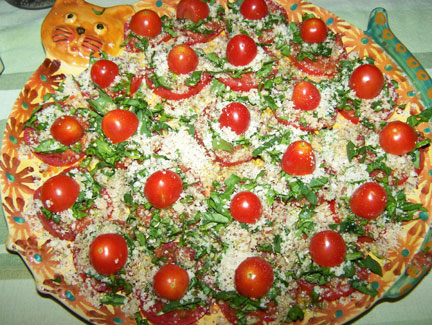
We went absolutely nuts for these little "pizzas." They were both tasty and fun. If memory serves, I believe she made them by taking slices of firm roma tomatoes, spooning on some improvised pesto sauce that she whipped up, sprinkling on some chopped basil leaves, sprinkling on some "cheese" that she made with ground Brazil nuts, garlic, and salt, and then topping each "pizza slice" off with a half cherry tomato. No recipes necessary here; just take a look at the picture & go try it!

It's time for another "Makin' It Monday" installment!? This time, Pittsburgh raw foodies Joe Prostko and Tracey Anne Miller (along with videographer Heather) demonstrate their "Turbo Tornado Superfood Solution," which has (as you'll see) a *ton* of superfood ingredients. Take a look:
Read more: Makin' It Monday: Turbo Tornado Superfood Solution


When we found out that there was a raw foods restaurant in Key West, we knew we'd visit for sure. So, after a wonderful lunch of some of their raw staples (raw tacos and peanut noodles), it was no surprise to us that we found ourselves drifting back toward Help Yourself after the sunset celebration at Mallory Square (the main nightly Key West sunset viewing celebration). When we arrived, we asked to interview the owner, Charlie Wilson. She'd just left after working a very long day at the restaurant. But, an emplyee called her anyway and she graciously agreed to come talk with us! So, here's a bit of that conversation:
Read more: The Key West Raw Scene: Pure Jeevan Gets Up-Close and Personal with Charlie Wilson!
I have a need for hot food in winter to feel warm.
We hear this comment a lot from those trying to lose weight. Some joke that they thought their excess body fat would be keeping them warm, but they're still feeling cold and needing hot food in the winter months.
In the past, we've talked about reasons what's going on in the body when hot foods are consumed. Understanding this will help you realize that hot foods are actually not very good for our bodies. When we consume very hot foods, that heat is then inside our bodies, next to vital organs, while the body needs to maintain a temperature around 98.6 degrees. When we have temperatures higher than that right next to our vital organs, it must quickly work to remove that excess heat. It's the removal of this excess heat that causes us to feel warm. It's our bodies trying to stay in a healthy state. We are actually putting our bodies under stress when we do this (the same holds true for eating overly cold foods, like frozen desserts and icy drinks).
It is with heartfelt gratitude that I reach out to say thank you for all of the lovely birthday wishes from all over the world.
As many of you know, I've been working on all aspects of myself---continuing to grow healthier in all ways (body, mind, spirit, and emotions). After a lifetime of feeling that I wasn't worthy of my own attention and affection, I learned to love myself. That was a huge thing for me and I am still overjoyed to acknowledge who I am and proudly proclaim that I love myself.
I'm not perfect, but I'm perfectly me---allowing myself to blossom more fully into who I am as the days go by. I've been openly sharing my journey because I know that I'm not the only person who has lived a life without self love.I receive emails from so many of you saying that you can relate to what I've been through, the pain I've suffered on all levels. You've shed tears and thanked me for my story because it has helped you see more clearly your own self. With open arms, and an open heart, I love all of you. It brings me great joy to know that through sharing I am able to help you grow and blossom more into your own beautiful selves. Imagine a world where we all know and love ourselves for the lovely individuals that we all are! What a beautiful and fragrant garden there would be!
Do you know the saying about freely giving out love because you never run out of it? Well, that's definitely true! There's something else that happens, however, the more you share love: it comes back multiplied more than you ever could have imagined! That's what happened to me on my birthday--I was overwhelmed with a flooding of love coming in from all over the world!
One of our readers, Julie, asked me to update her on what kind of diet I'm doing and why I'm doing it. The last time I publicly made changes with my diet, I received many similar questions. So, I figured maybe it would be a good idea to respond to her question here on the blog for anyone else wondering the same thing.
I did explain, in a long post, about experimenting with my diet being important to me.If you didn't read that entry, it will answer a lot of your questions. For many of you, I think I know what you are thinking: "Wendi was pretty much morbidly obese, her health was horrible, but she's now healthy. Why would she change anything with her diet when she has already found what works "?
Well, it's true. I am extremely healthy compared to how I was before I started consuming raw foods. Here are some pictures to show the changes, to motivate some of you currently struggling with eating more raw foods...

Mistakes are bad, right Well, not always. Here's an example of a great one, and it's something that demonstrates a conviction I have about raw foods! You see, in all of this talk of moving to Portland, I made a huge gaffe recently in my thinking about finances.
You see, I was pondering the terms of a home loan one afternoon -- percentage rates, down payments, monthly payments, tax escrows, etc. It was all really dry, boring material. Suddenly, I thought to myself, "Wow, here we are about to buy another house, after owning this one for so many years. In less than 10 years, we would have owned this one outright, but now we'll be starting over again with a 30-year mortgage."

Jim here... A little over a month ago, we couldn't contain our excitement about an online contest to win the best job EVER -- living as caretaker of a tropical island in Queensland, Australia, on the Great Barrier Reef for 6 months (and being paid $100k for the task!).
The deadline has come for this and, as we promised, we BOTH applied. My video was the first to be processed. So, we posted a screenshot above, which you can click to go view it (or just click here) -- and also please vote and rate it a 5!!! (I've heard that the rating system can get a little screwy on that site -- that you need to wait for it to load and maybe mouse over the rating part first. But, a 5-star rating would really help, as would the traffic, even if you don't watch the entire video.

 Here it is: Putting it all together. Here you'll see what we use for our taco shells and how we build up our taco. Quite often, we also make a raw sour creme using cashew nuts and lemon juice. But, for these tacos, it'll just be meat, salsa, and guac. Enjoy!

We're loosley going to be picking up some of the ongoing themes we used to cover here on the blog. For the Take the Time Tuesday theme, we asked our readers to take the time to meet or learn about an individual, product, company, etc., that we think may be of interest to you. For today's entry, I'd like you to:
Take the time to meet...