Know Any Literary Animal Lovers?

Hi there PureJeevan readers! We wanted to let you know that Jim's new novel CHROO is available on Amazon. It's a crazy adventure involving a billionaire heiress, her Chihuahua BFF ("Chroo") and a host of human and animal characters. Find out more on Amazon! Here are some links:

In this video, Wendi talks with Leela Mata, spiritual leader of the Peaceful Valley Ashram, about her experiences with the raw food diet and a bit about a cob oven structure that was built on the ashram property. This is part 2 of a 5-part series featuring Peaceful Valley Ashram.
Read more: Leela Mata Discusses Her Experiences with Raw Foods

"I sent out over 100 emails, now, and have been corresponding with the chair of the almond board. He s an ass."~Wendi, writing a few years ago in her "Almond Frustration" blog post.
Jim here again... Wow, that's an excerpt from a very fired-up Wendi, writing a few years ago about her frustration over the USDA's absolutely insane regulation that nearly all almonds sold in the United States must be treated with chemicals or heat prior to sale. I'm sure you know the story by now, so I won't rehash it here. (In case you do not, you can read about it in our original post, Wendi's Almond Frustration post (which even recounts a disturbing, related dream she had about this issue), or our last update post. It's an issue we've been following for years here.)
Read more: One Step Closer to the Return of Truly Raw Almonds!
Jim here... I have about 3 free minutes this afternoon to post here, so please bear with me as I type this post as fast as humanly possible. Okay, here's a fascinating video we shot last night. For anyone unfamiliar with live blood cell analysis, definitely check out this video. What they do is take a small drop of your blood (via a painless finger prick) and magnify it like 80 kajillion times. Then, they show you a real-time picture of what's going on in your blood.
Two main points from this:?
We at Pure Jeevan are making MAJOR life changes!
Did you think our lives solely revolved around raw foods---that once we went raw, there were no more major life changes to be experienced? Well, maybe it's true that our lives do, in a way, revolve around raw foods---they give us the health and vitality necessary for living a truly vibrant life! However, we are each (Jim, KDcat, and Wendi) unique and interested in many different things. Somehow, we pull all of our differences together and stand united as a loving family. It will be together, as a family, that we embark on an amazing MAJOR life change.
A few of you may already know what I'm talking about, but the rest of you are about to find out all about it, too! You may have noticed that we've temporarily discontinued many of our raw food services---for those of you who have written to ask for help, I am still responding to your emails. If I can't help you at this time, I'll do everything I can to assist you in finding the help you need. This was a necessary part of preparing for the change that is about to take place. In addition to cutting back on our services, we may not always be consistent here with our blog postings, and our email responses may not be very timely (as some of you may have already noticed). We will answer your emails, however, so please don't stop sending them to us. Hearing from all of you makes my heart fill with love and happiness!

A few days ago, we'd mentioned that Wendi had done a five-day water fast as part of her early dealings with Lyme disease. This was the first time I can recall in our household anyone fasting for more than a day or so, although there may have been the odd juice fast now and again for a few days.
Thinking back, I can tell you that, all while I kew Wendi (and especially during her cooked years), such an extended fasting would never have happened because she used to get wicked headaches any time she went without food for more than a normal time period between meals. This makes perfect sense, of course, as you really do have to be in fairly good health to successfully fast -- and, during those "cooked" years, we were both extremely unhealthy! (More on the reasons for all that later, as Wendi will likely do a write-up on fasting at some point.)
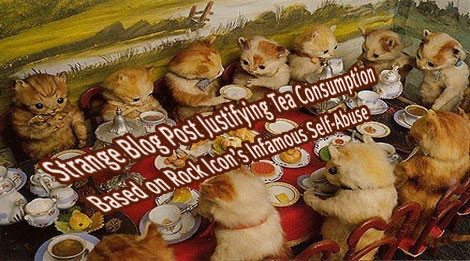
Jim here... Okay, the title and graphic, above, may be a bit silly, as are a few of the remarks I made in the video, below. But, within this rather odd piece a few hopefully noble and economical ideas exist -- especially the ridiculously simple and obvious notion about reusing glass beverage bottles. I'm embarrassed to have lived on this planet for so long and not to have adopted this fun and environmentally friendly practice much sooner.
 We really do take things like glass containers for granted, when we probably shouldn't. Their ubiquity aside, it still takes a fair amount of energy and resources to make a single glass bottle. On the mass scale that they're made, they're obviously super cheap. But, if you had to start from scratch, it would take ages to make a single one, so we should at least appreciate them more and do all we can to make their continued existence as sustainable as possible.
Read more: If Keith Richards Is Still Alive, Then Can I Have a Little Tea?

Since Pure Jeevan specializes in raw food weight loss, we receive a lot of questions about what is required in order to lose excess weight. Many individuals want to know if they need to go on a 100% raw food diet in order to release excess weight.
The answer is, "No, you do not need to switch to a 100% raw food diet in order to lose weight." If you're asking if a 100% raw food diet works better for losing weight than slowly transitioning and increasing your raw food intake, the answer is still, "No."
Note: This entry is not meant for our regular readers. Search engines are directing people to our page when they enter "mono and headaches" and I want to take this opportunity to reach out to those who may not know about this amazing lifestyle the rest of you already know about! ;-) Plus, I want to help them with their headaches.
Mono and Headaches: Looking for Help
Mononucleosis (Mono) is a common viral illness. When children develop mono, it is usually not obvious since it seems like a normal cold. When teens and adults develop mono, however, the symptoms are much more severe. Most individuals will feel better within about three weeks, but fatigue can continue on for about three months! Who wants to feel ill that long? Who wants to feel tired for MONTHS ! Who wants to suffer from such severe headaches ! Not me, that's for sure.

Read more: Mono and Headaches: This Entry is Not For Our Regular Readers

Do you know how sometimes you meet somebody new and they tell you their name and it just doesn't seem to fit for some reason? Well, that's just not the case for the person that we'd like to introduce to you today. This person's name describes the individual she is as well as the community that she creates.
Take the Time to Meet? Happy Oasis!

As some of you already know, along with regaining my physical health I've also been working on every other aspect of my overall health and being. I don't just want a healthy body---I want the whole package (vibrancy and bliss inside and out, in every way possible).
One area of my mental health that has been slow to heal is my self confidence. I continue to work on it in many ways and have made some tremendous progress over the past year, or so. I feel worthy of so much more than I ever did before.Many people never doubt their self worth---they have a good sense of who they are and assume that others see them as they are, as well.
Read more: Thankful Thursday: We Like It Raw and Dhrumil Purohit

Day 9: It's the final day of Navratri, often the largest day of celebration. On this day in India new businesses are started, children begin their formal education if they are at the right age, and past regrets (and many times debts) are left behind. It's a new beginning, fresh start, and is celebrated as such. Today, Pure Jeevan is celebrating in a big way, too!
 Yesterday, Jim handed in his resignation where he works. He was closing old books, imagining new ones, and today markes his first step of his new life. He gave the office one month's notice, after which he'll be here in Portland. Our new life has officially begun!