Know Any Literary Animal Lovers?

Hi there PureJeevan readers! We wanted to let you know that Jim's new novel CHROO is available on Amazon. It's a crazy adventure involving a billionaire heiress, her Chihuahua BFF ("Chroo") and a host of human and animal characters. Find out more on Amazon! Here are some links:
I started writing on a raw food forum about the oranges coming in today. But, I was on my way out the door and I had more to say about them than I realized, so, I figured I'd paste what I wrote, so far, and add to it here in our blog. ;-)
?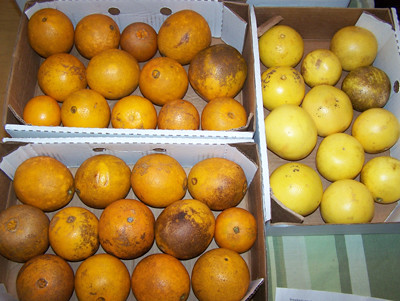
(organic oranges and grapefruits)
Wow, what a strange episode we have for you tonight! As you'll see, it was a really bizarre day here at Pure Jeevan. Wendi's out of town with her friends Rawbin and Jeff (owner of NaturalZing) helping NaturalZing with their booth at the Green Festival in Washington, DC. Too bad she's away; she missed opening the mail today and seeing a highly unusual letter from the Department of Homeland Security! The topic? Well, it turns out Pure Jeevan is under governmental surveillance -- and our chief surveillor, one "Larry Ferguson," actually decided to introduce himself and make some comments about our Bananas episode (which we hadn't even released yet!). Sounds highly unusual, I know. But, he was actually doing us a favor. Take a look (vid shows me reading part of his letter, then the banana episode proper):
As you heard, Larry writes: "I believe your viewers deserve to know, for example, that bananas have roughly 100 calories each, are high in Vitamin C, and fiber. You might also want to mention that they contain considerable levels of B6, which is good for metabolic functions as well as nervous and immune systems. B6 also helps you produce antibodies to fight diseases and plays a strong role in brain function and even maintaining hormonal balance. Your body can't store B6, btw, so you need to get it every day. Of course, most people will know already about the great potassium levels in bananas. Potassium is great for controlling blood pressure and certainly reduces risks of heart problems. Bananas also contain manganese, which your viewers probably already know about after your persimmons video."

I'm excited about something that one of my friends has been working on. Melissa is gifted in so many areas, one of which is wild edible identification. She recently told me she was working on something that would help a lot of people and I was excited about her new project. Well, now it's ready to be shared with everyone!
Take the time to meet...
In yesterday's installment, we talked a bit about Salem, Oregon. I inadvertently missed this video in Wendi's batch of uploads. So, here's Wendi interviewing Kerry Matson on her path to raw and some of her favorite raw foods!
Once again, we thank our trip snack sponsor, Natural Zing, for helping us to make this possible on our budget!

Let's have a bit of fun today here on the blog. All week long we've been focusing on brain health and minimizing our chances of developing memory loss as we age. So, how sharp is *your* brain right now? What can you remember as the key highlights of ways to increase memory, ways to eliminate memory loss? What else can you remember reading over the past week here on Pure Jeevan's blog about having a sharp mind?
Share your resp0nses in the comments (and don't read those left by others until you've left your own!).

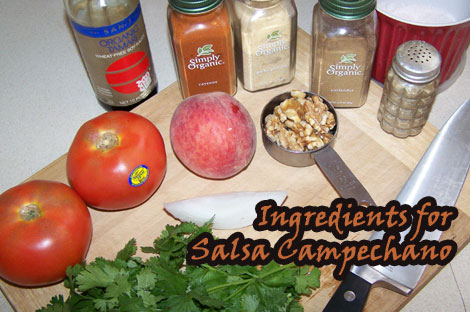
For today's Makin' It Monday feature, we'd like to present "Salsa Campechano." We'll have to admit, though, that we do not speak Spanish. So, we have to give some credit to Google's online language translator. When we went to name this recipe, Wendi suggested that this is a "manly" dish (since I created it). However, we didn't find the perfect Spanish word to fit the recipe.Then, considering the walnuts in the recipe, Wendi suggested that perhaps "hearty" was a better adjective. Google returned the Spanish word campechano for this, and we immediately thought: Yes!, that sounds just perfect!? So, here's an amazing recipe for you. It's a hearty salsa recipe, but I actually like to eat it as a soup.
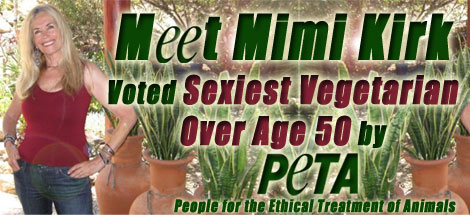
Today for "Take the Time Tuesday," we'd like you to take the time to meet Mimi Kirk, whom many of you may know as the winner of PETA's "Sexiest Vegetarian Over 50" contest last fall. If you're interested in longevity, and how diet influences the way we look, act, think, and exist, then you'll definitely want to listen closely to what this vibrant woman, who is 71 years young, has to say. We spoke with Mimi for nearly an hour this weekend, and are happy to share her inspiring interview with all of you. Below, you can listen right here, or download a podcast MP3 version.
We're heading out of town again! This time we'll be visiting Leela Mata at her Peaceful Valley Ashram, the location of the first raw food spiritual retreat I held last year.
Here's a video I took of Leela Mata last year:
?

Here's another brief video from our travels. Since time for editing is limited, I think I'll just run some more of the shorter vids this week and then get into the longer, more in-depth interviews next week. So, this is a short, fun conversation I had with Steve, who tends the raw juice and smoothie bar at Cousin's Incredible Vitality raw restaurant in Chicago. Here's the vid:
Read more: Pure Jeevan Interviews Steve from Cousins Raw Restaurant in Chicago


Every Autumn I proclaim that it is surely the best season of all. Then, without fail, every Spring I find myself feeling and saying the same thing. How can any season be better than this time of renewal, rebirth, and unlimited potential for beauty to spring up in front of your eyes with every glance?
Welcome to Episode 4 of Know Your Food. Wow, the PEAR episode is here at last! Aren't you thrilled to know that? Of ALL of the fruits, veggies, nuts, seeds, herbs, etc. in the knon world, we finally got to the wonderful pear. Well, it's no surprise, when you think about it. After all, sweet, mild pears are usually among the first fruits fed to babies. So, chances are, you were fed them, too, as a toddler. So, let's dig in, shall we?
Pears contain water-soluable fiber (pectin), Vitamin A, Vitamin B1, Vitamin B2, Vitamin C, Vitamin E, Copper, Potassium, Posphorous, Folic Acid, Niacin, Iron, Magnesium, Sodium, Sulphur, Calcium, and more! They lower your blood pressure, releive inflammation, lower cholesterol via pectin, calm the stomach, cool the body, prevent cancer via anti-oxidants, boost your energy via the fructose/glucose, reduce inflammation, help your bones/calcium levels, aid in pregnancies via the folate, and much more. Pears are GREAT for you, so eat them regularly!