Know Any Literary Animal Lovers?

Hi there PureJeevan readers! We wanted to let you know that Jim's new novel CHROO is available on Amazon. It's a crazy adventure involving a billionaire heiress, her Chihuahua BFF ("Chroo") and a host of human and animal characters. Find out more on Amazon! Here are some links:

For today's Makin' It Monday, we're not really making something, but rather sprouting something! We tend to go through periods of time when we are sprouting a lot, consuming sprouts on salads, sandwiches, and inside whatever dishes we can add them to at the time. It seems appropriate for this time of year to start sprouting, again.
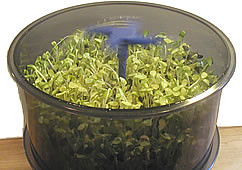
Have you ever sprouted seeds? The first time I ever sprouted, I used a nut milk bag that I kept dangling over the kitchen sink. I put some seeds into it, let them soak overnight in a bowl of water, and then rinsed them in the morning. Every time I was in the kitchen, I rinsed them again and let them drip into the sink until the next rinsing. It's important to keep the seeds moist and rinsed. It was thrilling to see the tiny little sprouts when they first began emerging from the seeds!
Hey Everyone- Just a quick note, in case you're reading our blog and thinking, "Wow, Wendi and Jim usually update daily! What's up ?!!" We'll get back to it pronto, I promse -- maybe even later today! Turns out it's just a TON of work orchestrating a tour like this, especially across a three-hour time zone. But, now that we're getting used to it, I think we can look for some more timely updates. The latest is from Corvallis, Oregon. But, we're also going to talk about Portland a lot more soon! So, stay tuned! -Jim
Original Comments
Below, we have included the original comments from this blog post. Additional comments may be made via Facebook, below.
On March 4, 2010, wrote:
I hear ya. I do keep checking in though, and I'm looking forward to when you get your groove.
I really feel for you, Jim. Your girls gone, having to keep track of their movement, run a household on your own and still work that stupid job. Poor baby. Just know that I am thinking of you, and sending you love from New Mexico.
And Wendi, AAAaaaaaaaaaaaaaah! I can hardly wait 'til you get here!
Terri
On March 5, 2010, wrote:
We are getting all ready here for W and K! so far we have the following guests for Cru:
Bueller of Bueller's Kitchen, Lori of Inspire2Act, Ingrid of Raw Epicurean, Dianna Harrelson, LA Raw meetup organizer and raw teacher, Puki (friend of Courtney Pool), and a few other folks .. and ME!
xoxoxo deb
In some wonderfully literary sense, there must be some kind of unique metaphor that could be constructed around the process by which cabbage turns to kimchi. Personal growth is not always easy, as any success technologist will surely tell you; ?there's a lot of doubt and oozing and off-gassing involved -- and yet, the final product is surprisingly pleasing to the palate.
Yes, it's time for us to update you on our first-ever kimchi experiment. If you want the short version:? I believe we have been successful! For those of you with a few more minutes, I'll share some of the lurid details. Highlights of our experiment included:
This past weekend we had the pleasure of Rhio and her partner, Leigh, visiting with us. Rhio was in town for a presentation on Genetically Engineered foods (more about that here) and she took the opportunity to spend some time with us. It was a lovely weekend and we talked about all kinds of things (yes, even non-raw food things!), laughed a lot, enjoyed delicious raw foods, and got to know each other better.
While they were here, Rhio and Leigh agreed to allow us to interview each of them for this blog. Since we needed to keep the interview under ten minutes (the maximum time allowed on most video sites), we decided to ask questions about topics we had already touched on with Rhio and Leigh during their stay--things we thought might be interesting for all of you to hear about.

I'm posting this at the end of a busy day, but let's see what I can call fun in just an ordinary day.
It was fun singing at the top of my lungs with KDcat in the car today--both of us over exaggerating the vocals and giggling a lot.
We all know what "greens" are in general. For example, no one questions whether lettuce, kale, spinach, or chard are greens. But on the other hand, all of those items *are* also clearly green in color. With that in mind, what would you make of the following two questions I (Jim) recently pondered -- tagged as "reader questions" so they're easily found in the future by other equally inquisitive people ;-) -- that seem bizarre, but are really quite interesting?
1. Are non-green greens (e.g., purple kale) still considered greens2. Are vegetables with green skins (e.g., cukes, zucchini) considered greens? (After all, they're green!)

Today is Wendi's Birthday, so please join me in wishing her all the best for the coming year! Since this was our first year in Portland, just an hour-and-a-half's drive to the Pacific, I'd known for ages what we were going to do to celebrate Wendi's birthday -- a picnic at the beach, of course!
A few days ago, the weather reports for the central Oregon coast cities unanimously agreed: Rain! ?But, after living here for a few months, one learns that a forecast of rain *never* means that it's going to rain all day long. Rather, it just means that it'll likely rain at some point, or at many points, in a given day. The rest of the time, it could very well be perfectly sunny outside!
Read more: What Are Negative Ions, And Are They Beneficial to Human Health?
Want to have a little bit of fun today here on the blog? We'd love to hear your list of favorite foods for each color of the rainbow! I wonder how many of us will have similar fruits and vegetables on our lists, and how many of us will come up with vegetables and fruits that others have overlooked?
I received an email from one of our lovely Pure Jeevan family members. Joanne is subscribed to our mailings and she received the ice cream cake recipe I had created for Jim back in January. Well, take a look at what she did with the recipe! It's LOVEly!

Hi Wendi!I took Jim's birthday cake recipe to the next level.
You're in for a treat with this recipe. Our Guest Raw Chef this week is Shivie Kaur, half of "The Cook and Butler" duo of TeamRaw. Wendi shot this video a few weeks back in San Francisco during Pure Jeevan's recent cross-country tour! While there, Shivie and her partner Cemaaj created and served a delicious gourmet meal for Wendi and KDcat. The blog post from that visit was here. So, here's Shivie sharing with you how to make an easy and delicious raw salad dressing!
Read more: Makin' It Monday Guest Raw Chef Edition: Shivie Kaur Makes Salad Dressing

Jim here... I'm back from Raw Spirit Festival East with roughly 4 Gigs of pictures and videos to sort through, as well as 17 pages of handwritten notes about my rawsome experiences. So, tomorrow, I'll begin the task of sorting through it all and posting all sorts of fun stuff (photos, videos, and tales of adventures).
For now, all I'll say is that Rawbin Anderson, RSF East Manager, did a spectacular job in orchestrating the whole event. Here's Rawbin: