Know Any Literary Animal Lovers?

Hi there PureJeevan readers! We wanted to let you know that Jim's new novel CHROO is available on Amazon. It's a crazy adventure involving a billionaire heiress, her Chihuahua BFF ("Chroo") and a host of human and animal characters. Find out more on Amazon! Here are some links:

Who's been making small changes and feeling a bit brighter lately, since we've been talking about brain health? Today, let's continue focusing on some things we can actively do to minimize our chances of developing memory problems like Dementia or Alzheimer's in the future.
Yesterday we focused on heart-healthy tips to increase brain function (since heart disease seems to be linked with Alzheimer's) and I shared a heart-healthy recipe with you. Today, we'll focus on inflammation.
Read more: Extinguish Inflammation: Anti-Inflammatory Recipe
Within the raw food community, a controversy seems to have been brewing for the better part of a year! The topic: Agave nectar (also called agave syrup). Surely by now most people know what agave nectar is. For anyone who doesn't, it's a thick liquid sweetener made from, you guessed it, the agave plant.
In general, the production of tasty agave nectar involves heating the plant to a certain temperature (which varies widely according to which manufacturer is making it and which species of agave is used). The extent of this heating constitutes a significant part of the controversy (as most raw foodists believe that heating any food over a certain temperature, usually somewhere between 105 and 118 degrees fahrenheit, renders it "dead").
Read more: Pure Jeevan Explores the Raw Food Community's Agave Nectar Controversy

How does the following menu* sound for your Thanksgiving meal
Nut Loaf, Apple un-stuffing, Mac Mushroom gravy,

"I sent out over 100 emails, now, and have been corresponding with the chair of the almond board. He s an ass."~Wendi, writing a few years ago in her "Almond Frustration" blog post.
Jim here again... Wow, that's an excerpt from a very fired-up Wendi, writing a few years ago about her frustration over the USDA's absolutely insane regulation that nearly all almonds sold in the United States must be treated with chemicals or heat prior to sale. I'm sure you know the story by now, so I won't rehash it here. (In case you do not, you can read about it in our original post, Wendi's Almond Frustration post (which even recounts a disturbing, related dream she had about this issue), or our last update post. It's an issue we've been following for years here.)
Read more: One Step Closer to the Return of Truly Raw Almonds!

In the comedy film, L.A. Story, there's a scene in which weatherman Harris K. Telemacher (Steve Martin) visits a friend and is asked to taste a *very* green-looking juice. He does, and then proclaims it's "exactly like licking a shag carpet." ?Funny how some people adore intense greens while others experience the polar-opposite reaction. (There are numerous funny food- and health-related jokes in that movie, by the way!)
Yesterday, we discussed some unusual considerations with respect to greens, ultimately leading to a brief discussion of chlorophyll (the green pigment within almost all plants that plays a key role in photosynthesis).

Jim here... Since we posted Wendi's two-part series on pasta-making techniques (part 1, part 2) last week, I thought I'd follow up with an additional novel use for the spiralizer -- super-delicious, blazingly fast, ultra-low-fat sweet potato chips! We've done some really great things with sweet potatoes before. (Anyone signed up as a member of the Pure Jeevan family has likely already received our prized sweet potato pancake recipe.) But, these chips are amazing because they satisfy that unmistakable urge for crunchy, healthy snacks -- and in record time. Friends, if you have a dehydrator and sweet potato on hand, you could literally be enjoying these things in under three hours. So let's get going!
As Wendi demonstrated in the videos last week, you can easily make "rounds" using the spiralizer by simply making a vertical slice throughout your vegetable prior to placing it on the spiralizer. So, if we were looking down at the sweet potato, the cut (which goes all the way down the length of the vegetable) would look like this:
Read more: Super-Delicious, Blazingly Fast, Ultra-Low-Fat Sweet Potato Chips!
***** DISCLAIMER: As with all of our posts here at Pure Jeevan, and particularly those coming up over the next week and a half (which will all be tagged with a new term, "Nadi Balance"), please refer to the disclaimer that runs at the bottom of all Pure Jeevan Pages. Wendi and Jim are health researchers, educators, and extreme self-experimenters -- not doctors. ******
Nadi Balance: Part II
Even though this ground-breaking information we're sharing is not necessarily about Lyme disease, the story of Wendi's contracting, suffering, and healing from it is essential background information. So, we're going to talk about Lyme disease frequently here and in the next few posts, but know that the real, underlying story is about so much more than Lyme disease. (In fact, it's about overall health for everyone!)
This past weekend we had the pleasure of Rhio and her partner, Leigh, visiting with us. Rhio was in town for a presentation on Genetically Engineered foods (more about that here) and she took the opportunity to spend some time with us. It was a lovely weekend and we talked about all kinds of things (yes, even non-raw food things!), laughed a lot, enjoyed delicious raw foods, and got to know each other better.
While they were here, Rhio and Leigh agreed to allow us to interview each of them for this blog. Since we needed to keep the interview under ten minutes (the maximum time allowed on most video sites), we decided to ask questions about topics we had already touched on with Rhio and Leigh during their stay--things we thought might be interesting for all of you to hear about.
Over the weekend, we visited the spectacular Oregon Country Fair in Eugene and, once again, experienced a joyful and overwhelming sense of recognition that we're living in a place where people are much more accustomed to just being themselves.
Personal expression and nonconformity are so valued here that one becomes quickly enamored of the whole ambiance, which could well explain why more people come to Oregon than leave. The region seems to represent, to many, a chance to finally discover and explore an identity perhaps not completely free from outside influence, but at least free from the undesirable influences that society elsewhere seems to insist upon. Or maybe I'm misreading it all and providing just one of many interpretations.

Every day I receive countless emails filled with questions about the raw food diet, my own success with reducing nearly 100 pounds and regaining health, and pleas for help by many who feel like they've hit bottom and there's no way up. Some emails have me in tears, because I can completely relate to what many of you are going through. I feel your pain, frustration, desperation.
One thing I've always been good at is listening, truly listening to what others are saying (and being an empath allows me to know what some are saying, even when they many times aren't verbalizing it). Another thing I've always been good at is intuitively knowing how to help others who are asking for advice. Jim used to joke that he wanted me to go into business running an advice column because ever since he's known me, I've been the person everyone comes to for help and advice. So, when I receive so many emails asking for help, it feels natural for me to reach out and connect with those needing help. It's what I do best well, that and spreading love!
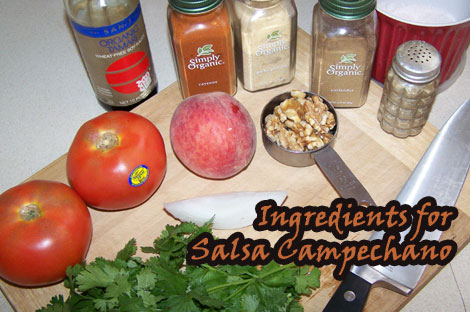
For today's Makin' It Monday feature, we'd like to present "Salsa Campechano." We'll have to admit, though, that we do not speak Spanish. So, we have to give some credit to Google's online language translator. When we went to name this recipe, Wendi suggested that this is a "manly" dish (since I created it). However, we didn't find the perfect Spanish word to fit the recipe.Then, considering the walnuts in the recipe, Wendi suggested that perhaps "hearty" was a better adjective. Google returned the Spanish word campechano for this, and we immediately thought: Yes!, that sounds just perfect!? So, here's an amazing recipe for you. It's a hearty salsa recipe, but I actually like to eat it as a soup.