Know Any Literary Animal Lovers?

Hi there PureJeevan readers! We wanted to let you know that Jim's new novel CHROO is available on Amazon. It's a crazy adventure involving a billionaire heiress, her Chihuahua BFF ("Chroo") and a host of human and animal characters. Find out more on Amazon! Here are some links:
Rawbin brings healing laughter and an unusual gift to unwell Wendi Dee.
Are raw foodists invincible to the common cold? I have to admit that I kind of assumed that was the case. If it's true, at what point does the invincibility kick in? I've been raw for over three years (over two at 100%) and yet the past few days have found me overcome with sneezing, sore throat, runny nose, and fatigue.
My first thought, once my throat started to hurt, was: "Did I eat anything different recently that I'm reacting to in a negative way " But, nothing had changed.My diet is relatively clean, with the exception of the times when I consume too much nut dip. So, when the sneezing and runny nose were added to the sore throat, I knew something else was going on. I had to admit it: "I'm not invincible."
In a recent post, I answered part of a message I received from Violet, one of our blog readers. Below is the continuation of my response to Violet (much briefer than my last one!).
Following my response to Violet is a response to Sarah, who has a fantastic raw food blog that I enjoy reading.
Violet's message continued:
Read more: Reader Questions: Raw Transition Support, Identify Peas
Hey, where the heck is Pure Jeevan this week ??? Sorry for the silence on our end; we're actually in Portland, Oregon, closing on our new digs -- the new HOME of Pure Jeevan!!! Exciting stuff, but we're SO busy that we may not be able to blog again until the week of June 7. But, we'll definitely return by then, and maybe even post a thing or two from here. It all depends on our internet situation. In any case, it's SO wonderful to be taking direct action on the future on Pure Jeevan. It's a huge leap of faith on our part, but it seems right by all accounts. So, see you soon when we return! -Jim & Wendi
Original Comments
Below, we have included the original comments from this blog post. Additional comments may be made via Facebook, below.
On May 28, 2010, wrote:

A while ago, I received an email asking whether I had any thoughts on how old or young a person needs to be in order to benefit from a raw food diet. Yes. Yes, I do have thoughts on that! Lots of thoughts! ... Here goes:
The easy answer, of course, is that people of ALL ages can (and should) benefit from raw foods. I can assert with confidence that, for most people, increasing your intake of raw fruits and vegetables will likely bring about positive changes to your health, regardless of your age, dietary habits, or current state of health. (Naturally, reducing or eliminating the "bad" things is also paramount.)

Let's have a bit of fun today here on the blog. All week long we've been focusing on brain health and minimizing our chances of developing memory loss as we age. So, how sharp is *your* brain right now? What can you remember as the key highlights of ways to increase memory, ways to eliminate memory loss? What else can you remember reading over the past week here on Pure Jeevan's blog about having a sharp mind?
Share your resp0nses in the comments (and don't read those left by others until you've left your own!).
Some of you who are new to raw foods may be happy to learn that there are festivals for individuals interested in the raw foods lifestyle! They are a fantastic opportunity to meet like-minded friends. For those of you who attended the Raw Spirit Festival in 2008, seeing images from that event may stir the magical memories you collected while there.
Below is part one of a two-part guest piece by Rawbin Anderson, in which she recounts her 2008 Raw Spirit Festival J.O.B. experiences of working in the kitchen. Rawbin is now the Raw Spirit Festival East Coast Manager and can be reached at Rawbin [at] rawspirit.com.
?
Read more: A J.O.B. (Joy of Being) at the Raw Spirit Festival (Part 1 of 2)
A worker at our local Food Co Op was talking about making his own dehydrator. I mentioned that I saw a link to a site that told about how to create one and I'd share it with him. When I found the link, just now, I thought maybe some of you might be interested in checking it out, as well.
?The page isn't vegan-friendly (there is ground meat in the one picture), but if you've been wanting a dehydrator and don't want to spend the money on the more expensive ones...this might be a great option.

Jim here... Just a brief, fun post for the weekend... We just saw the movie Scott Pilgrim vs. the World a few days ago. ?It's a great movie, for many reasons. But, vegans will get a real kick out of one scene involving a character named Todd Ingram, who has super powers. ?Why? ?... Because he's a vegan! ?We won't spoil the scene, though. But, if you're a vegan, or know a lot of vegans, you should get a pretty good laugh from this! I think they nearly had to throw Wendi and me out of the theater, as we were laughing so hard (especially Wendi). ?Enjoy. :-)

As you can see from yesterday's post, Pure Jeevan keeps extremely busy during the year. What's up for 2010? Let's just say... more amazing information, inspiration, education, motivation, and cutting-edge health features! This post will be considerably shorter than last year's counterpart. In January 2009, we ran a 3-part series on looking back and looking ahead. While that was super-productive from a planning perspective, a few important points come to mind as we ponder the same issues once again:
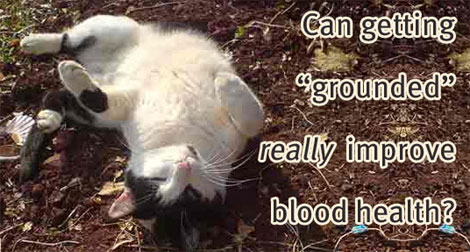
Jim here... A week or two ago, there were some videos floating around in raw food circles that seemed to indicate that one's blood health (and, by extension, one's overall health) can be quickly and dramatically improved through a practice known as grounding. I realize that, metaphorically, people commonly use the term "grounded" to indicate a kind of level-headedness -- e.g., a "down to earth" attitude. But, in the literal sense, it's an electrical term used to describe a physical connection to the earth. I'm no engineer, but my understanding is that these connections basically discharge things or people from any static electricity build-up (as in those bracelets that computer repair techs wear), or serve as a conduit through which other electricity may pass (as in lightning rods).
 That the idea of "grounding oneself" should take root so strongly in natural health circles is unsurprising. In theory, it seems to make a lot of sense. I'm just as intrigued by it as the next person, I suppose. If we spend most of our lives wearing rubber-souled shoes, walking on shag-carpeting, sitting suspended off the ground on static-filled things like couches and office chairs, often running various electrical equipment, basking in EMFs from radio waves and Dish-network signals and cell phone radiation... sure, it makes sense that we're probably all experiencing some heretofore unprecedented (evolutionarily speaking) human body exposure to significant electrical phenomena. My car reminds me of this daily with a (friggin' annoying!) shock each time I get out and close the door. But, as the "double-rainbow guy" so succinctly put it: ?What does it mean

Jim here... It's not often that we're able to recommend a movie that's perfectly relevant to the raw food lifestyle. But, if you're a raw vegan and haven't seen The Curious Case of Benjamin Button, we highly recommend this film. Not only is it wonderful, but it's also, for much of the film, a nice metaphor for living the raw foods lifestyle.