Know Any Literary Animal Lovers?

Hi there PureJeevan readers! We wanted to let you know that Jim's new novel CHROO is available on Amazon. It's a crazy adventure involving a billionaire heiress, her Chihuahua BFF ("Chroo") and a host of human and animal characters. Find out more on Amazon! Here are some links:

To keep all of you inspired while we are away, we've asked some
remarkable individuals to share their raw food stories with you. Enjoy!

We have something special for today s Makin? It Monday! Remember Terilynn, the brilliant chef behind The Daily Raw Caf , whom we introduced you to not long ago? Well, this weekend she posted a recipe challenge open to anyone willing to participate. We here at Pure Jeevan are always up for an adventure, so thanks for the challenge, Terilynn!
The rules were simple: Use the list of possible ingredients, create a raw vegan food dish, and send pictures and information about your dish to The Daily Raw Caf . Here s the list for the challenge, with the items we didn t have available crossed out:
 Here's the next component in our raw taco recipe -- the guacamole. This is Wendi's favorite component! Enjoy!!!
Wendi tells a funny story sometimes about a woman she'd met who was considering undergoing gastric bypass surgery to help her lose weight. When Wendi asked the woman whether she'd consider changing her diet to a raw foods regimen, she responded with something like, "Oh, no, that's too radical."
This is really what it's come to in society; having part of your digestive system surgically altered (in a profound, irreversible, dangerous, and invasive way) is no more than some nonchalant, consequence-free elective decision ... while eating more salads is viewed as "radical."
I receive many questions from our readers, and I am very happy to respond. I truly love helping others, but I don't do it just for them.When I was younger, many times I thought I was performing selfless acts of kindness whenever I'd help others. However, now I realize I am experiencing pleasure by helping others. I find it very rewarding, as though I am fulfilling my purpose in life.
Do you know what your life's purpose is? Do you believe there is such a thing These aren't rhetorical questions; I'm really interested in hearing your response. Well, I've known my life's purpose (actually, I have more than one) from a very young age, but it wasn't until recently that I began living it more fully. My purpose in life is to love others---to connect with others through an immensely deep and genuine love.One way I've found for spreading my love and realizing my purpose is by helping others.
When I answer questions for our readers, I speak from my heart. I think it's important to realize, however, that the answers we receive from others are *their* answers to similar questions. Maybe their answers will work for us, but maybe they won't.I've stressed this many times, but it never hurts to repeat it: Listen to others, hear what they have to share, but mostly listen to your own inner voice. We all have the answers deep within ourselves, even if we can't always hear them very well.
Read more: Life's Purpose and Reader Questions: Emotional Eating
in-tu-i-tion n. 1.a. The act or faculty of knowing or sensing without the use of rational processes; immediate cognition. b. Knowledge gained by the use of this faculty; a perceptive insight. 2. A sense of something not evident or deducible; an impression.
FASCINATING!? While out to dinner with our friend Debbie, she brought up the topic of intuitive food preparation. This is really amazing, groundbreaking stuff that probably few people have ever seriously attempted. Now, Wendi has discussed intuitive eating many times here on the blog in the past. Intuitive eating is basically when you get in touch with those "perceptive insights" mentioned above -- a kind of communication with your own body in which you just "know" that you should eat a certain food. Ever, say, walk past a large display of apples and simply know that eating one would make you feel good? That's intuition.
Let's take a quick look at a few dessert pictures, then compare and contrast, shall we First up is a small slice of some normal pastry:
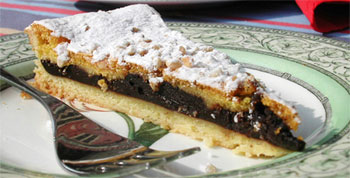
Looks sinful, right It seems to proudly display its bready crust, its gooey chocolate center, some sort of butter-rich top layer coated with lovable little bits and bobs, and a liberal sprinkling of confectioner's sugar to make the whole thing cute as a wintry scene from one of those holiday specials hosted by the claymation likeness of Burl Ives. I'm sure it's delightfully rich, too. A tad small, though, eh ? It's probably all anyone can take of such decadence without worrying about clogged arteries or putting in extra time on the tread mill for the next three days.
When you're young and learning the letters of the alphabet, anything that starts with the same letter as your name becomes really special. Well, ever since I was a child and saw a Winnebago RV with the giant "W" on the side, I've been enchanted with the idea of one day owning one and traveling the world (at that age, I didn't realize I'd have to cross oceans to see everything).
If you've been following us for a while, you'll know that I was bringing that vision to life. It took years of convincing, but Jim was finally ready for such an adventure and together we began making plans. For more than two years we've been preparing to tour the country, while teaching about raw foods along the way. Our lives changed so dramatically when we found a way to heal our bodies (and more), a way that can also help others, and we just couldn't sit still. We feel called to spread the word about the raw food diet so others can at least hear that there's another way, that there's something different to try in their quest for health. I knew that crossing the country in an RV, planting the seeds about a raw food diet along the way, would be an efficient way of spreading the word.
I'm makin' nothing today, or for the next eight days! Think of all the time I'm saving myself by consuming only mono meals for nine days. What will I end up doing with that extra time? So far, today, I've spent a long time outside soaking up the sun's beautiful rays that I've missed far too much this Winter. I have no idea what the rest of this mono journey is going to be like, but I'm up for the adventure!
I've started a little journal on my desktop to track my nine days of mono meals, so I'll share what I've written from time-to-time. Here's what I have, so far...
The other day I made a recipe from "Rainbow Green, Live-Food Cuisine" by Dr. Gabriel Cousens. I modified his recipe a bit and what resulted was amazing. Perhaps the original recipe tasted even better, but this is what I did with it.
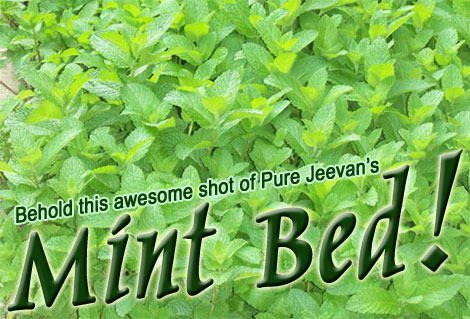
I wrote on Monday that today (Thursday), we would be discussing mint here -- specifically, harvesting some late-remaining mint from our mint bed (shown above in all its glory) and making something with it. I failed, however, to take into account that it's been getting darker earlier and earlier these days. By the time I was able to get outside and talk about mint, it was just too dark.
So, I thought I'd forego the video, and just write up some minty facts to freshen up your Thursday. To begin, I would highly encourage anyone who is new to gardening, and wants some early success, to experiment with mint (including spearmint, peppermint, and the various varietals available here and there). I can almost guarantee that you'll have some wild (and I do mean wild!) success, and will soon enjoy more mint than the law allows. It's so easily grown, and spreads around so easily (via its root system), that it would almost be considered invasive if it weren't so darned desirable and fragrant. (It's tough to walk past a mint bed without snatching up a leaf, rolling it between your fingers, and inhaling the scent deeply.)