Know Any Literary Animal Lovers?

Hi there PureJeevan readers! We wanted to let you know that Jim's new novel CHROO is available on Amazon. It's a crazy adventure involving a billionaire heiress, her Chihuahua BFF ("Chroo") and a host of human and animal characters. Find out more on Amazon! Here are some links:

Greetings, everyone! ?We've been away from regular blogging for what seems an *eternity*. When we left the airwaves, the raw food world was at total peace with itself -- bliss, harmony, sister- and brotherhood. Aside from rare, gentle disagreements among raw vegans on issues such as whether raw chocolate was mineral-rich or potentially taxing to your body's store of minerals, things were pretty much business as usual.
And then we moved away and took a little time off to regroup .. ?and NOW look at the state of the raw food zeitgeist: (1) long-term raw foodists just about everyhwere are now "eating a little bit of cooked food," (2) an enormous schism has emerged after the seemingly improbable development of many long-term vegans returning to meat eating, (3) informational summits and online meetings have been replaced by debates, and (4) let's face it, the supplements being discussed and sold are getting, well, much *weirder* than ever!

Thank you, thank you, thank you! Today for Thankful Thursday, we wanted to say a special THANK YOU to our readers. It means so much to us that you come to visit our blog. With every new comment (both here on the blog and through email) it fills us with great happiness!
Is there something you'd like to see more of here on our blog? Something you'd like us to discuss? We know you are looking for more recipes, since you've told us (be sure to check out our recent posts where we've linked to some fantastic sites offering recipes!). What else would you like to read about or have us share with you?

Today, and every day, I am thankful for lovely Mother Earth. Where would we be without Mother? May we always care for her in a gentle and loving way.
====================

Have you ever heard about mono meals? When I first did, it sounded like such a great idea. When you eat a mono meal, you eat one item (and only one item) for the entire meal. Eating that way is supposed to be very cleansing and it gives your digestive system a rest from processing different types of foods at the same time. Supposedly there is a boost in energy, as well, since your digestion isn't taking up so much energy.
I recently received an email asking for advice from one of our Hindu readers, asking what I could recommend as far as light eating during the nine-day Indian festival of Navratri. Navratri is traditionally a time of fasting for nine days, however in modern society most Hindus no longer fast. Many do, however, pay more attention to their diets, and they try to eat lighter meals that do not contain animal products. Since our reader is just starting his exploration into raw foods, I didn't want to offer him advice that would make his nine days of Navratri difficult.He recently purchased a Vitamix, so I suggested that he make a lot of smoothies, since he has been enjoying them so much.

It's day three and all is going okay. I seem to have a bit more energy since it's not all being sapped trying to digest complex meals. The last time I did mono mealing, I received countless emails from Pure Jeevan members who were concerned I was doing something unhealthy. Eating simply for nine days, however, is not unhealthy.
 Did you know the body doesn't need a full range of vitamins and minerals at each and every meal? Somehow many of us were taught that each meal needs to be a complete balance of vitamins, minerals, proteins, fats, carbohydrates and that just isn't the case. What the body needs is a well-rounded diet, overall, to be in a balanced state. If, over the span of a month or two, you've consumed a variety of fruits, vegetables, nuts, seeds, and sprouts you will find that you've met just about all of your nutritional needs.

Let's have a bit of fun today here on the blog. All week long we've been focusing on brain health and minimizing our chances of developing memory loss as we age. So, how sharp is *your* brain right now? What can you remember as the key highlights of ways to increase memory, ways to eliminate memory loss? What else can you remember reading over the past week here on Pure Jeevan's blog about having a sharp mind?
Share your resp0nses in the comments (and don't read those left by others until you've left your own!).
Here at Pure Jeevan we are preparing for our cross country tour to educate others about raw foods. This means we are paring down on a lot of things, donating a lot, selling some things, and pretty much not buying anything unless it's absolutely necessary. That's what we've been doing for almost two years now (we're waiting for the house to sell). Recently, however, I decided it was time to spend a little bit of money even if it wasn't absolutely necessary.
-
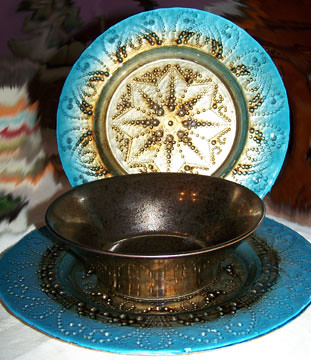
- Wendi's Dish Set
What did we buy? Dishes! Seems a bit strange to finally spend some money on something unnecessary and have it be dishes, right? Well, I had a few reasons for this purchase. The first is that when we are living in the RV, the space is going to be minimal. There won't be a lot of room for dishes, let alone much of anything else. Since there's not a lot of space to have dishes drying, we'll need to be washing, drying, and putting away immediately after use. That may not sound like a big deal, but when someone in the family decides to eat a few different things and leave the dirty dishes in the tiny RV sink, on the small counter, or somewhere else, it's going to really seem like a bigger mess than it is. So, to remedy this I thought it would be good for each of us to have our own dishes. That way we have a sense of responsibility for our own particular dishes--we know they are ours and we are responsible for taking care of them.
Here's an update from Wendi. I think this can be considered, with 99% confidence, the big announcement:
Of course, there's that 1% chance that something unexpected will happen. But, Portland feels right. It always has for us; we nearly moved there in the late 1990s. We had books on Portland back then, and I was buying their newspaper each week to hunt for jobs. It just never panned out, though. I suppose we were meant to live in Pittsburgh for a spell. It would be easy for me to list many reasons why Pittsburgh served a purpose for us. But, yeah, I think we're Portlanders at heart. So much about that city resonates with us. It'll be a homecoming, for sure! I want to reiterate a few things that I'd written in comments recently, slightly clarified in places.
Read more: Pure Jeevan Perceives Peace, Purpose, and Prosperity in Populous Portland!

Jim's mother, JoAnn, LOVES pasta. I'm sure many of you can relate to that---pasta is a big part of the cooked diet and just about everyone loves it. When going raw, many individuals say they just can't do it because they miss pasta too much. Well, that's no longer a problem. There is a raw way to make pasta and you are going to love it if you haven't experienced it, yet!
As a gift for Mother's Day, we sent a pasta-making tool to JoAnn along with a pasta sauce recipe we created for her (see the Paradisio Pasta Pomodoro entry). To make it easier for her to learn how to create pasta, and to answer some of the emails we've been receiving about the device we used to make the pasta, we have put together a two-part video showing how to make delicious, beautiful raw pastas! You'll learn how to use two different pasta-making devices, as well as how to use a simple vegetable peeler to create delicious noodles!
Jim here... A health-conscious friend of mine was feeling sick today. And, while I certainly do not advocate harping on the sick, I did have a very mild discussion with her when she phoned me for some advice. I asked, "Do you know what cognitive dissonance is "
"I'm not sure," she replied.

Jim here... Whenever I want to learn how to do something new, here's how I go about it:
>>> I practice. <<<