Know Any Literary Animal Lovers?

Hi there PureJeevan readers! We wanted to let you know that Jim's new novel CHROO is available on Amazon. It's a crazy adventure involving a billionaire heiress, her Chihuahua BFF ("Chroo") and a host of human and animal characters. Find out more on Amazon! Here are some links:

I want to admit something to all of you: Sometimes I still cry because of how people treated me when I was obese. Because I stuffed all of my "negative" emotions deep inside my entire life, it's going to take some time to fully release them. I'm working on it, however, and making tremendous progress with healing myself on all levels. I'm not telling you these things so you'll feel sorry for me, however. I'm telling you because I am thankful for all the pain I endured. It shaped me (in more ways than just my physical appearance) into the person I am today.
Even though it sounds strange, and somehow wrong to feel this way, I'm thankful that I was obese. I'm thankful for all of the experiences during my life, even the extremely painful, traumatic ones. Maybe if I was a different kind of person I would wish that those things didn't happen to me. However, I am using those experiences in positive ways. They've helped me understand people even better, and to understand myself on a deeper level, as well. When people reach out to me it's not only because I'm an approachable person, it's because they sense that I understand them--and they're right. I DO understand them. I understand you. My experiences, coupled with my gift of empathy, help me relate to you in a way that maybe not everyone else is able to do.

As promised yesterday, here s the Pure Jeevan cross-country tour itinerary! Will Wendi and KDcat be in your town or city? If so, please be sure to let us know, so they can meet you in person! We re all very excited that Pure Jeevan will be meeting some of you in person very soon!
We'll be posting a button on the right side of the blog later this week. When you click on the button, it'll take you to an up-to-date itinerary of all cities on the tour, as well as any talks/gatherings, etc. that may be going on. On that page, you may also be able to view some live video streaming of Wendi and KDcat as they're out and about finding the perfect location for Pure Jeevan. Stay tuned for more info!

Jim here... Certainly, we're all familiar with the old saw, "You can lead a horse to water, but you can't make him drink," right ? So often, the life of a raw foodie is perfectly captured by that saying. We are, of course, the ones leading our equine brothers and sisters to the sweet trough of raw foods, just as others coaxed us into the barn for our first drink.
Have You Been Led To This Post ??
So, what is this post It's a big old horse trough to which, if you're a raw foodie, you can lead others. Or, if you're someone unfamiliar with raw foods, and have been sent here by another, what you'll find below is the water. No one can make you drink it. And, please don't be offended at my comparing you to a horse because (1) we're all horses, (2) this is all just my strange opinion, and (3) horses are beautiful, magical beings! Being compared to a horse is a compliment!

In our Mnemonics for the ?Clean 15? ? Or, ?Conventional? Produce That Tests Lowest for Residual Pesticides blog post last week, we put an asterisk next to "sweet corn" and took it off our list of foods to eat. Even though sweet corn tests relatively low for pesticides, Pure Jeevan still feels the vegetable isn't a safe choice for a healthy diet. There are primarily two reasons for our decision to completely remove corn from our diets. First, of all the vegetables that have undergone genetic modification (GM), GM corn is one that has been proven to cross-pollinate with non-GM corn. Second, since corn is so plentiful and easy to grow, it has been modified to become all sorts of flavors, sweeteners, fillers, etc., in food products and many individuals have developed sensitivities to it.
Read more: Is Corn Safe to Eat? No, and Neither is Most Papaya!
I was sitting here today thinking about all of you, our lovely online friends who visit this blog. You follow what's going on with us, learn from us, find inspiration in the things we share, and even offer support to us in many ways.
Some of you reach out by leaving comments, many of you send emails, and a larger majority of you are quiet friends who haven't made contact with us, yet. Each and every one of you means so very much to me (and to Jim, too).
We don't keep this blog for ourselves; we keep it for all of you. It is our desire to share all that we've been through, and what we've learned, in order to help you with your own journey. Most of all, however, my personal desire is to inspire you to live the life you truly want to be living (in more ways than just through what you eat).
Three months ago today, we put up a post called "Is Alcohol Raw " I wanted to post a little follow-up to that today, while I'm thinking of the story. (And, by the way, a great conversation ensued in the comments section of that article. However, if you visit it now, you'll see that the comments have disappeared. We're hoping to have these and many other comments restored once a new version of Disqus is released.)
In that article, I touched on how the body can seemingly store states of consciousness (noting how I dreamed of being drunk and felt authentically drunk in the dream). This sort of phenomenon is well documented anecdotally (e.g., often associated with LSD use), although still not fully understood by medical doctors or psychologists. In any case, the term "flashback" comes to mind:
Read more: Strange Wine Experience & Jim's *Emergency Smoothie*

We've promised many of you that we'd share some ideas for the whole family (especially the children), so here's one idea that might prove particularly popular. In a household of two former English majors, it's only natural that we've always adored and admired alliteration. So, we may be biased to believe that these "Breathtakingly Bejeweled Blueberry Banana Breakfast Bowls" will be as beloved by your beauteous bellies as they are by ours. See what you think!
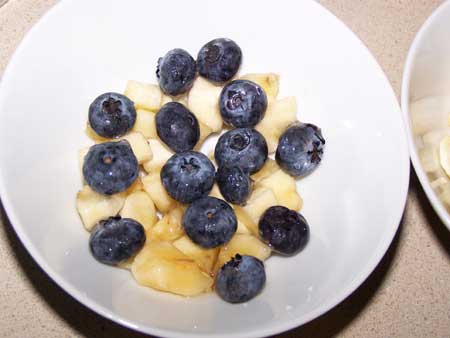
Read more: Breathtakingly Bejeweled Blueberry Banana Breakfast Bowls
And here's the conclusion of Wendi's San Francisco travelogue:
 That evening we met up with Carolyn, a long-time friend since college, who was our lovely host for a few days. Carolyn has a gift with cats, which was a real treat for KDcat to see. Do you know how you can teach dogs to sit and give kisses? Well, Carolyn has taught one of her rescued cats to do the same thing! He *really* sits and *really* gives kisses on command! WOW!
Carolyn showed us all around the San Franciso and Berkeley areas, bringing KDcat to a thrift shop (she's been having fun popping into random thrift shops to see what she can find) and a fun shop called Ancient Ways, stopping by some Indian shops so I could pick up some more bindis and some ground coriander for a dish I made while visiting, checking out the Berkeley campus area, and taking us shopping for organic foods.
Read more: Part 4 of 4: Glowing Gypsy Gals Glimpse the Glorious Golden Gate's Gastronomical Goodness
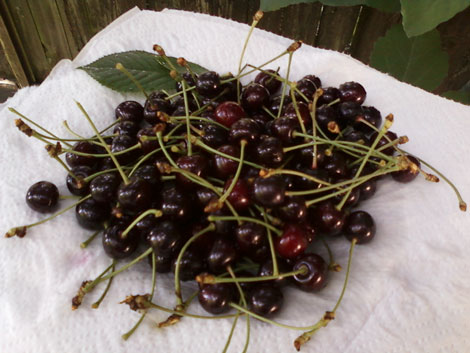
We're extremely busy this week with some home projects, so we figured we'd simply share a few interesting photos each day. Here's today's -- a big plate of freshly picked cherries from our yard! ?These are smaller cherries than you'll find in stores. We believe they're sour cherries, which is a very healthy variety, even though they're not as tasty as Bing's or Ranier's. ?They're reportedly good for pies, though. I've eaten tons of them so far; ?they're at their peak at the moment here.
I tell you... the dangerous thing about cherries is something you'll only discover when you're out there on a ladder, standing on that tip-top rung (which clearly states: "Do NOT stand on this rung!"), and you're reaching higher and higher for that next bunch of nature's goodness. Even in this situation, you find yourself thinking: "If I could just reach a *little bit* higher!" ?Sooner or later, you have to realize that some cherries are there for the birds, squirrels, and raccoons.

To keep all of you inspired while we are away, we've asked some
remarkable individuals to share their raw food stories with you. Enjoy!

We may never fully comprehend the mysteries of life and death. One thing is for certain, however, with both we experience tremendous amounts of emotion.
At this moment, we are experiencing extreme sorrow after the still birth of our niece, Elizabeth Marie. She was named after my mother who died a few years ago. During this period of tremendous grief, we will be spending time with my dear sister and her family, offering our love and support.