Know Any Literary Animal Lovers?

Hi there PureJeevan readers! We wanted to let you know that Jim's new novel CHROO is available on Amazon. It's a crazy adventure involving a billionaire heiress, her Chihuahua BFF ("Chroo") and a host of human and animal characters. Find out more on Amazon! Here are some links:

Let me take you down,'cause I'm going to
Strawberry Fields.
A few weeks ago, we hosted a Diabetes Awareness week here at Pure Jeevan. This was our contribution to the larger Reversing Diabetes Naturally movement that we blogged about. We wanted to let you know that the package of bonus materials offered to people who purchase the Simply Raw DVD is quite amazing! (See this post for details.) We reviewed all of the materials ourselves, and it's just a ton of great information.
The original deadline for receiving the free bonus materials was the end of April. However, the deadline has been extended through Friday, May 8. So, if you know anyone who has diabetes who could benefit from either the ?Simply Raw? documentary and/or the companion film, ?The Ultimate Enyclopedia of the Raw Food Listyle," simply point them to http://tinyurl.com/pj-diabetes.
Read more: Two Days Left for Raw Food Bonus Materials for RDN Movement
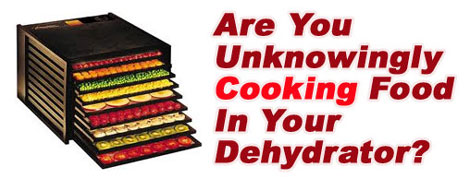
Those consuming a raw food diet sometimes use a dehydrator to prepare raw food dishes. They do this at low temperatures, below the point of actually cooking the foods, to intensify flavors, reduce the amount of moisture in the dish, and sometimes to take the chill off something they'd rather serve a bit warmer than straight out of the refrigerator. There is a practice that we've seen, however, that is actually cooking the very foods were taking such great measures to consume raw! Let me share an experience I had when I first started eating raw foods, that will help explain how some of us may be cooking our foods by mistake.
In the beginning of eating raw foods, my entire family loved the Vegetable Stir-Dont-Fry I used to make (you can find that recipe in the free eBook you downloaded when you first visited our site). One day I created a double recipe so we could eat more the next day, without going through the process of preparing it again fresh. The following day I took the bowl of Stir-Dont-Fry out of the refrigerator and put it into the dehydrator to take the chill off. It wasn't warming up fast enough on such a low temperature, so I thought I'd just cover the dish a little bit to trap in some of the heat that seemed to leave each time I checked the dish and stirred it around. So, I took a plate and placed it on top of the bowl with about an inch, or two, opening.
Leaving Sin City, our fearless raw travelers headed south to Arizona for all sorts of raw food adventures. First up was a trip to Prescott Valley to meet Abi and Eli. Let's take a peek into Wendi's travelogue again, shall we
 You probably haven't met our official tour guide yet. We call her Simone. She's a bit testy at times, but always gets us safely to our destination (although sometimes in rather roundabout ways). She added an extra one-time $89 fee to our trip budget, but we're very satisfied with her performance so far. You see, Simone is our trusty GPS unit!
Leaving Las Vegas, she guided us through the Hoover Dam area on our way to Arizona, a geographic area that I think would be better described as a "state of extremes." There, we experienced super hot, sunny days, freezing nights, snow outside even when it's sunny and hot, and also a bizarre experience we had in which some bananas actually froze and then nearly roasted all in the same day.
Read more: Arriving At Abi's Arizona Abode After Arduous Attempts
Hi Everyone! It's been a while since we've run a "My Raw Story" feature. So, here's one from my good friend Chris Paris, who I met and hung out with at the Raw Spirit Festival this past summer. I think you'll like his take on raw, his before & after pics, and the personal topics he covers such as the role raw foods played in his spirituality. -Jim

?
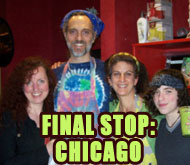 Here it is, the final stop along our 40-day cross-country tour, Chicago, IL, before returning home to Jim! It's been an incredible time, meeting so many wonderful people, seeing so much natural beauty across the country, deciding where we'll relocate once our home sells, tasting incredible raw foods along the way, and spreading the word about the raw food lifestyle whenever an opportunity presented itself!
Below you'll find the final notes I wrote about our tour, along with some videos and pictures of our final stop in Chicago, Illinois.
We definitely arrived in Chicago refreshed and ready for some adventures. So, we headed directly downtown to search out a new raw food restaurant that our friends Kathy and Danny Living had mentioned to us.
RAW, the newly opened restaurant by Polly Gaza and Carole Jones, is situated inside the Ogilvie Train Station in a recently constructed French Market food court. When we figured out how to get into the market, we were impressed. It's a nice concept and has a fun feeling to it, just strolling along a market place (all while inside a large building housing a train station) that seemed as though it was almost outdoors. When we found the new RAW restaurant, we were thrilled. The colors, decorations, and displays were all very well done. We had to wait a while to talk with the owners, since the restaurant was doing some great business when we arrived. You can see a video we took of the owners, below, and find out more about the restaurant on their web site: Chicago Raw Food. The video was edited down because the sound quality wasn't very good, but you'll hear some inspiring thoughts from Carole about manifesting your dreams and how she and Polly simply manifested the restaurant by beginning with their thoughts. Carole advises: Live Your Passions!
After leaving the restaurant, we headed straight to Borrowed Earth Cafe to visit with our friends Kathy and Danny Living. For those of you who don't already know them, Kathy and Danny are incredibly loving people who are down to earth and doing some incredible things with their lives (manifesting along the same lines that Carole touches on in the video, above, and also inspiring others along the way to live their dreams and treat the planet with kindness). We first met Danny and Kathy last year during a visit to Chicago, and we immediately loved them. If we hadn't met them last year, our route back home during this tour wouldn't have included a stop in Chicago. However, we did meet them and I wanted to spend more time with them so a stop in Chicago was added to our trip itinerary. I love their energy, their soft and gentle loving nature, and to top it off the raw foods they serve in their Borrwed Earth Cafe are delicious. So, KDcat and I were looking forward to spending time with them again (and Jim was sad to miss out on seeing them this time).
When I told Danny and Kathy that we were coming in for a visit during our tour, they asked if we'd be interested in talking to their raw food meetup group. We agreed, of course, and they introduced us to David Hanley, a member of their large group. David hosted us for our stay in Chicago and we had a nice time getting to know him. He's into stairclimb racing, yoga, software development, loves fixing homes (like Jim does), raw foods, and so much more. In his home, David has a massage chair that KDcat really enjoyed a lot. David drove us to our talk at the meetup, where we met with even more incredible people. It was a large group, so we met at a Whole Foods meeting room not very far from the cafe. There were a lot of questions from those attending the talk, which I always enjoy. It's nice to meet so many people who are interested in learning a about ways they can improve their health.
That evening, we shared with David the generous amounts of raw foods that Kathy and Danny had sent home with us for the evening. We enjoyed things like Borrowed Earth's World Famous Salad, Burrito Loco, Sweet Potato Quesadilla, a green smoothie, some cheese cake, and the most incredible raw apple pie I've ever tasted. I'm not kidding about that statement, either. I used to consider myself queen of the apple pie back when I baked my foods, and this raw apple pie that Kathy and Danny have created was even more delicious than my best baked apple pie. If you don't believe me, it's worth a trip to Chicago just to check it out! Absolutely DELICIOUS! Maybe if enough people ask, Kathy and Danny will share the recipe with all of you through one of our special guest chef editions of Makin' It Monday!
Before leaving Chicago and heading toward home, we stopped by Borrowed Earth Cafe once more to spend a little extra time with Kathy and Danny. We had great fun together and as much as KDcat and I were looking forward to being with Jim again, we wished we had more time to spend with Kathy and Danny. While there, we talked a lot about the power of intention and creating our futures. Danny also brought out some tuning forks and balanced my energy using them. Let me tell you, that was some powerful healing he was doing. After he was done, I felt euphoric and grounded all at the same time. I was filled with even more love than I normally feel flowing within and without my body. Wow! When I told Jim about it, we agreed that we'd like to learn more about tuning forks, too.
Danny and Kathy are always a wealth of knowledge and inspiration and I was sad to leave their company. Before going, they sent us out the door with even more delicious raw foods to feed us until we returned home. There was even some leftover to share with Jim when we arrived home the following evening!
Below, you'll see a video we took while visiting Borrowed Earth Cafe last year during our visit to Chicago. You can see in this video how incredibly sweet Kathy and Danny are, but you can tell even better by meeting them in person, yourself. If you're in the Chicago, IL, area, be sure to stop by and introduce yourself to them!
So, that ends our tour! After Chicago we headed back to Pittsburgh to be reunited with Jim. The next time we cross the country, we'll be doing it together as a family. Being apart like we did it this time (which was necessary for budgetary reasons) took away from some of the fun we could have all experienced together.
Again, it was such a joy meeting so many of you as we visited different cities and states. Thanks, again, to everyone who hosted us and showed us a great time in your little part of the country! It's a trip we'll never forget, and one that will always bring fond memories to mind.
Lots of love to all of you,
Wendi
XOXOXO
p.s. Don't forget to show support of our Trip Snack Sponsor, Natural Zing, who made the snack portion of this trip possible! Thanks, again, Helen and Jeff! We love you both!
We hope you ll check out our generous snack sponsor for the trip, Natural Zing, who made our travels extra enjoyable! They have the best selection of raw food snacks, supplies, and appliances for a raw food lifestyle!


The way your smile just beams
The way you sing off-key
(Note: This is a closely-related piece to an earlier post ?entitled "Practice Is Your Key to Going Raw." I'll include a link to that article, below.* This one focuses more on recognizing your current level of progress.)
These days, I spend most of my free time cleaning up our fixer-upper home in Portland, so I haven't been going to the gym or regularly running as I had in the past. ?Hopefully, the house work is sufficient physical activity for me -- it sure does generate an appetite most days!
Short post today... We're currently dealing w with a pesky kitchen drain issue that's wreaking havoc in our household. Fortunately, a very talented and power-tool-weilding local plumber just fixed the problem. In the process, he seems to have applied those power tools to our bank account -- $175 for less than one hour's work!? (Ouch!) And the kicker is that the current state of our kitchen is "absolutely atrocious."? I'm serious... we're at like DefCon 5 in terms of the disastrous nature of that room -- and as you well know, for a raw household, that's probably 10 times more frustrating than it is for others. (I smell a whole post coming soon on this topic ...)
Today, we mainly just wanted to say that, at the end of our post yesterday, we briefly asked what you would like to see more of here at Pure Jeevan. We have received some great comments and emails in return, and have decided to devote tomorrow's post to responding to / addressing some of the suggestions we received. So, if you have any further thoughts to share about raw foods content you'd like to see more or less of, please let us know either by commenting below, or by email. Wendi is at WendiDee [at] Pure Jeevan.com. Jim is at Rawdiant [at] gmail.com.

 EVERYONE LOVES RAW TACOS!!! So, this week, we're going to show you FOUR "Makin' It Monday" videos instead of just one. These were filmed in Berkeley, CA, at our dear friend Carolyn's apartment. We hope you love these recipes. We actually eat raw tacos quite regularly -- especially when tomatoes are in season.
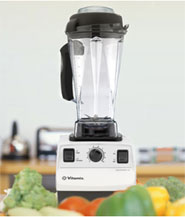 Hey there, everyone! Thanks for visiting Pure Jeevan. We want our welcome article, for now, to be this article on Vitamix blenders. There are certainly a few essential elements (e.g. good knives, cutting boards, a good food processor, etc.) to any raw food kitchen, and one of them is an awesome high-speed blender. Yes, there are many great blenders in the world, and yes there are a few decent top-of-the-line models on par with Vita-Mix. But, at the end of the day, our recommendation is the Vita-Mix (and yes, it's better than Blendtec, in our view). Here's a crazy video Jim did a while back for a Vitamix contest:
Note: That "free shipping" code, below, is no longer active. We'll let you know when we get a new free shipping code. For now, we hope you enjoy the video. :-)
We purchased ours 15+ years ago, and have subjected it to at least daily use (if not many times per day most of the time!) -- and it's still going strong. If you don't understand why a Vita-Mix is different from even a high-end blender from a department store, it's basically the sheer power. These things can pulverize pretty much anything -- time after time, without blowing out the motor. For example, you can make ultra-thick, healthy, raw ice creams day after day all summer long, and the machine will keep on working for years (and, in our case, we're almost ready to say "decades").
We used to be an affiliate w/ them, and are reapplying to be one. For now, we hope you like the video, above.