Know Any Literary Animal Lovers?

Hi there PureJeevan readers! We wanted to let you know that Jim's new novel CHROO is available on Amazon. It's a crazy adventure involving a billionaire heiress, her Chihuahua BFF ("Chroo") and a host of human and animal characters. Find out more on Amazon! Here are some links:

I hear the question all the time: "Don't you miss eating out at restaurants " My answer is always, "No. I prefer the fresher organic foods I can create for myself in my own home. I can pay the same amount for better food if I stay at home to eat." It's true, too. I don't miss eating out at restaurants. Sometimes I miss the convenience of someone else doing my food prep and cleaning up afterward, but as far as the actual food that I consume, I prefer the foods we eat at home. Besides, when you eat out as a raw foodist, your choices are limited to only a salad if you live in an area with no raw food restaurants.
Sometime last year, as a treat for Jim, we went to a restaurant. I got a huge salad that I used to love when I ate cooked foods at that particular restaurant. I remembered the greens were always dark, the onions were nice and flavorful, and the dressing was a simple oil and vinegar with salt. Well, after consuming only fresh foods in our home for quite some time, the salad that I used to think tasted so great now seemed to be lifeless and limp. It wasn't enjoyable to eat, and I sure didn't like paying so much for a nonorganic salad that didn't even taste good to me. So, we didn't eat out again after that.
Here's an update from Wendi. I think this can be considered, with 99% confidence, the big announcement:
Of course, there's that 1% chance that something unexpected will happen. But, Portland feels right. It always has for us; we nearly moved there in the late 1990s. We had books on Portland back then, and I was buying their newspaper each week to hunt for jobs. It just never panned out, though. I suppose we were meant to live in Pittsburgh for a spell. It would be easy for me to list many reasons why Pittsburgh served a purpose for us. But, yeah, I think we're Portlanders at heart. So much about that city resonates with us. It'll be a homecoming, for sure! I want to reiterate a few things that I'd written in comments recently, slightly clarified in places.
Read more: Pure Jeevan Perceives Peace, Purpose, and Prosperity in Populous Portland!
I'm excited about something that one of my friends has been working on. Melissa is gifted in so many areas, one of which is wild edible identification. She recently told me she was working on something that would help a lot of people and I was excited about her new project. Well, now it's ready to be shared with everyone!
Take the time to meet...

I've already posted the recipe for this, but I wanted to talk about the orange pudding a bit. Since going raw, I've become a mostly intuitive eater. Whatever I feel like eating is what I eat. This usually means I am eating the same food for an extended period of time until I feel drawn to something different. Lately it has been the orange pudding.
I've been starting my mornings with a large bowl of it. If Jim is making lunch then I'll eat the salad or nut dip that he makes, otherwise it's orange pudding again. Then, if I didn't eat a salad during the day I usually have a salad for dinner and...a dessert of--you guessed it!--more orange pudding.
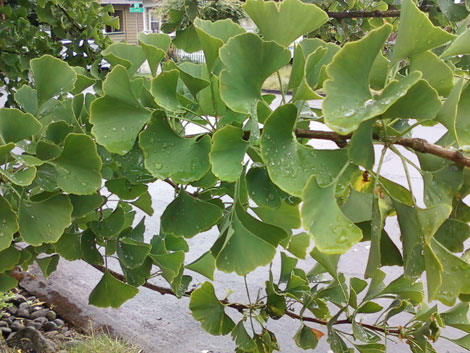
Ahh, yes... Ginkgo Biloba. What a distinctive tree, don't you think? So easy to identify, and so many reported health benefits. This one belongs to a neighbor that seems to have an affinity with Asian landscaping motifs. They also have gorgeous bamboo growing in their yard, and other Asian elements. I would have liked to have harvested some leaves to dry for some Ginkgo tea, but the owner wasn't around to ask. Perhaps some other time.

To help keep all of you inspired, we ve asked some remarkable individuals to share their raw food stories with you. Enjoy! (Today's "My Raw Story" is also a special installment for our Diabetes Awareness Week!)
There's SO much to celebrate lately! Check it out:
 Our dear friend Robin (aka Rawbin) celebrates her birthday today. We created a fun video for Rawbin, who has the ability to make anyone laugh! Rawbin blogs here and you can read her "My Raw Story" installment here.She's also the east coast Raw Spirit Festival representative. (RSF east happens August 29-30, 2009 in Maryland. More info here.)

As promised yesterday, here s the Pure Jeevan cross-country tour itinerary! Will Wendi and KDcat be in your town or city? If so, please be sure to let us know, so they can meet you in person! We re all very excited that Pure Jeevan will be meeting some of you in person very soon!
We'll be posting a button on the right side of the blog later this week. When you click on the button, it'll take you to an up-to-date itinerary of all cities on the tour, as well as any talks/gatherings, etc. that may be going on. On that page, you may also be able to view some live video streaming of Wendi and KDcat as they're out and about finding the perfect location for Pure Jeevan. Stay tuned for more info!
Is cacao dangerous or is it a super food? Anyone who's been learning about raw foods knows about raw cacao (check out a recent episode of Know Your Food: Cacao). It's raw chocolate without all the processing and additives normally included in the chocolate bars many buy from standard grocery stores. In its raw form, cacao has different nutritional components than typical processed chocolate. Many claim that raw chocolate is filled with mega doses of nutrients, making it a super food, and therefore extremely healthy for the human body. Others claim that even in its raw state, cacao is a stimulant that taxes the human body and cacao is more like a poison than a food. I've heard murmurs about negative effects of cacao for many years, but that was always subdued by the vociferous praise of cacao.
Recently, my friend Kevin Gianni (The Renegade Health Show) spoke out about cacao and his experiences with it. Kevin is well known in the raw food community, so his words came as a shock to many people. He explained in his video (below) that he developed a rash on his stomach. After much investigating and diet changes, he came to the conclusion that cacao was causing the rash (eliminating the cacao caused his skin to clear). He also stated that cacao had been stripping his body of vital minerals. Kevin pointed out that he was simply sharing his own experience with cacao, possibly shedding some light on a subject that may need to be further investigated. He advised others to take a look at their own reactions to the food, to see if they are experiencing any problems.

In our Mnemonics for the ?Clean 15? ? Or, ?Conventional? Produce That Tests Lowest for Residual Pesticides blog post last week, we put an asterisk next to "sweet corn" and took it off our list of foods to eat. Even though sweet corn tests relatively low for pesticides, Pure Jeevan still feels the vegetable isn't a safe choice for a healthy diet. There are primarily two reasons for our decision to completely remove corn from our diets. First, of all the vegetables that have undergone genetic modification (GM), GM corn is one that has been proven to cross-pollinate with non-GM corn. Second, since corn is so plentiful and easy to grow, it has been modified to become all sorts of flavors, sweeteners, fillers, etc., in food products and many individuals have developed sensitivities to it.
Read more: Is Corn Safe to Eat? No, and Neither is Most Papaya!

We began this series with one possible psychological explanation of obesity, moved on to a possible philosophical explanation, and will now cover one that could be both of those, or could find classification within the emotional and/or spiritual realms. ?Wendi has often told me of hearing Dr. Gabriel Cousens speak in Sedona, Arizona, a few years ago. One remark in particular stuck with her. This may be a slight paraphrase, but Dr. Cousens said:
"There's never enough food to feed a hungry soul."
As we all know, physical hunger happens when our bodies need food -- when our stomachs are literally empty and aching for fuel to sustain our life. But, what about non-physical types of "emptiness"? Surely, we experience a kind of hunger in these cases as well.