Know Any Literary Animal Lovers?

Hi there PureJeevan readers! We wanted to let you know that Jim's new novel CHROO is available on Amazon. It's a crazy adventure involving a billionaire heiress, her Chihuahua BFF ("Chroo") and a host of human and animal characters. Find out more on Amazon! Here are some links:
***** DISCLAIMER: As with all of our posts here at Pure Jeevan, and particularly those tagged with a new term, "Nadi Balance, please refer to the disclaimer that runs at the bottom of all Pure Jeevan pages. Wendi and Jim are health researchers, educators, and extreme self-experimenters, not doctors. ******

Yesterday, we talked about live blood being a fantastic indication of overall health and well-being.Wendi's initial live blood review didn't show the extent of the Lyme disease. But, it did show an indication that something was going on (while Jim's blood showed overall health).
Read more: Nadi Balance: Exploring Fats and What Finally Healed Wendi
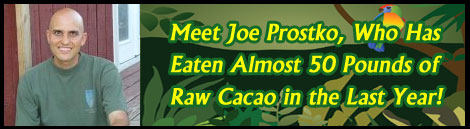
Hi everyone! Jim here with a really special treat for you today. I'm interviewing our friend Joe Prostko, who we've known for a good year or so through the Pittsburgh raw food meetup group. You may remember Joe from our cacao pod video a while back.
 We just had a big raw food potluck costume party here, and Joe showed up as an Oompa-Loompa. At first, I admittedly did not get the deeper part of this joke. I simply thought it was a novel costume because it was a character from the Willie Wonka book / movie. Later, however, it really sunk in, as I decided to flip through the Willie Wonka book to read up on Oompa-Loompas. Here's a quote from Willie Wonka author Roald Dahl:
Read more: Meet Joe Prostko, Who Has Eaten Almost 50 Pounds of Raw Cacao in the Last Year!
For some odd reason, I've had the privilege of "doing Thanksgiving" with a lot of different friends and families over the years. Because of this, and of course just from talking with others and reading things others have posted, I'm fairly certain that Thanksgiving means different things to different people.For some, it's their favorite annual holiday and fills them with joyous memories of Thanksgivings past and incredible anticipation of Thanksgivings to come. Some historian friends of mine seem fascinated by the historical aspects of the holiday -- the whole story of the pilgrims, etc. On the other end of the spectrum, I've actually encountered a few people who take offense at the very idea of this holiday (and they've got some convincing reasons to protest the wider celebrations)!
 While all holidays are certainly "food-centric" by tradition, it's arguable that no other holiday (at least here in America) can match Thanksgiving's reputation in terms of feasting. It's kind of funny when you think about it because many holidays (or, "holy days") are actually traditionally observed by abstaining from food. So, there are fasts, and feasts. I think the majority view, based on my own sampling of various friend and family traditions, seems to be: It's mostly about having a huge meal. Yes, there is certainly an undercurrent of being thankful out there. A few families I've been with have had traditional, almost ceremonial, activities that went along with the meal (e.g., going around the room, taking turns stating what you're grateful for).

Let's continue this video cavalcade with a very quickly made video basically peeking inside Karyn's Raw in Chicago. I didn't really have an opportunity to spend a good deal of leisurely time there, as I did with two other Chicago area restaurants, so this video is *very* basic, and not at all thorough in terms of what is offered there. But, if you're not from Chicago and have no other way to see it, perhaps its interesting to take a quick (just 3+ min) look. Here's the video:

Wow, is it Friday already !? Time flies when you're powered by 100% raw organic goodness! Today, we wanted to share an audio interview with you. Last night, Alex Ortner from the Movement to Reverse Diabetes Naturally interviewed us about our recent work helping them spread their message. We were honored to hear him introduce us as "two people that hold a special place in my heart right now, and I'll tell you why that is: They are probably the two most active people that we've had in the movement to reverse diabetes naturally."
Well, Alex, it was our pleasure! We met scores of new people during our work for RDN, generated major awareness about the movement, and spread the word about the raw food lifestyle as well. To listen to or download the interview, just visit their site, here. Topics covered include:
Wow, what a strange episode we have for you tonight! As you'll see, it was a really bizarre day here at Pure Jeevan. Wendi's out of town with her friends Rawbin and Jeff (owner of NaturalZing) helping NaturalZing with their booth at the Green Festival in Washington, DC. Too bad she's away; she missed opening the mail today and seeing a highly unusual letter from the Department of Homeland Security! The topic? Well, it turns out Pure Jeevan is under governmental surveillance -- and our chief surveillor, one "Larry Ferguson," actually decided to introduce himself and make some comments about our Bananas episode (which we hadn't even released yet!). Sounds highly unusual, I know. But, he was actually doing us a favor. Take a look (vid shows me reading part of his letter, then the banana episode proper):
As you heard, Larry writes: "I believe your viewers deserve to know, for example, that bananas have roughly 100 calories each, are high in Vitamin C, and fiber. You might also want to mention that they contain considerable levels of B6, which is good for metabolic functions as well as nervous and immune systems. B6 also helps you produce antibodies to fight diseases and plays a strong role in brain function and even maintaining hormonal balance. Your body can't store B6, btw, so you need to get it every day. Of course, most people will know already about the great potassium levels in bananas. Potassium is great for controlling blood pressure and certainly reduces risks of heart problems. Bananas also contain manganese, which your viewers probably already know about after your persimmons video."

I'm fairly sure that we've covered how to *open* a young coconut (also known as a Thai coconut). It seems like each raw food site has a video and/or article about that. I think it's actually a commandment in the Official Raw Foodism Bylaws somewhere: "Thou shalt show everyone how to open a coconut."
But *selecting* them... that's something that's not often covered in-depth. It's an advanced topic -- super-advanced, even. So, are you ready to learn the secrets?
Read more: How to *Select* a Young (Thai) Coconut at the Store
Here's another brief video from our travels. Since time for editing is limited, I think I'll just run some more of the shorter vids this week and then get into the longer, more in-depth interviews next week. So, this is a short, fun conversation I had with Steve, who tends the raw juice and smoothie bar at Cousin's Incredible Vitality raw restaurant in Chicago. Here's the vid:
Read more: Pure Jeevan Interviews Steve from Cousins Raw Restaurant in Chicago
Jim here... Thought we'd share some hidden camera footage from the Pure Jeevan household. Didn't you know ? ... the Pure Jeevan household is under continual video surveillance!? We have an enormous bank of these cameras, all feeding live streams to our costly, off-site high-tek storage facilities, monitoring every room in the house -- all to capture moments of inspiration such as this one. Why carry pen and paper all the time when you can simply install hundreds of "inspiration-cams" and pay techies to maintain a gargantuan bank of petabyte hard drives ? So, in this clip, the actual origin of an idea is captured. (We totally weren't just acting, ok ) So, having scoured said bank of petabyte hard drives, we isolated the following clip --thought you'd enjoy it as a preview of what's ahead tomorrow.

We have something special for today s Makin? It Monday! Remember Terilynn, the brilliant chef behind The Daily Raw Caf , whom we introduced you to not long ago? Well, this weekend she posted a recipe challenge open to anyone willing to participate. We here at Pure Jeevan are always up for an adventure, so thanks for the challenge, Terilynn!
The rules were simple: Use the list of possible ingredients, create a raw vegan food dish, and send pictures and information about your dish to The Daily Raw Caf . Here s the list for the challenge, with the items we didn t have available crossed out:

Jim here... Many people write to us asking whether we own pets and, if so, whether they are raw, too. Well, I wish I had a straight answer for you, but I think the answer is better told via a dedicated blog post.
As I'm writing this, part of me is tempted to include this post in our "My Raw Story" series. You see, Julia (pictured above) had some serious health issues just after we adopted her from a local rescue shelter, and we're still relatively early-on in our attempt to understand and reverse these issues.