Know Any Literary Animal Lovers?

Hi there PureJeevan readers! We wanted to let you know that Jim's new novel CHROO is available on Amazon. It's a crazy adventure involving a billionaire heiress, her Chihuahua BFF ("Chroo") and a host of human and animal characters. Find out more on Amazon! Here are some links:

Jim here with another exciting installment of Weird Wednesday. (What, you thought that just because Wendi is out of town this week, we'd have no Weird Wednesday )
In any discipline, I think it's important to consider the entire argument in taking a stance on a given issue. Examine each issue from both sides (pro and con) -- and then make the best choice you can. That makes sense, right?

As this is a holistic web site, it's important that we take time every so often to feature pieces on other aspects of human health besides diet. So, today's subject is unrelated to raw foods, but is directly related to your health. (Don't worry: We'll get back to raw foods on Monday!)
Today I want to share a super-valuable lesson I learned when I was just 21 years old. Back then, Wendi worked within the advertising department of a large newspaper. She helped me meet the paper's photography editor who, in turn, approved an internship for me during my senior year of college. So, several days per week for one semester, I hung out with professional newspaper photographers. It was a lot of fun -- and with real darkrooms, too (as this was way before the age of digital cameras).
Ketchup
1 cup sun dried tomatoes, soaked for one hour
3 small fresh tomatoes
Welcome to Day 2 of Pure Jeevan's "Salad Dressing Week"!? Today we take a trip across the Pacific to the land of the "Rawsing Sun." I've yet to meet any raw vegans from Japan, but would be highly interested in hearing about what it's like to be raw vegan there.
 Today's video not only shows a tasty salad dressing recipe, but it's really a testament to bold improvisation in your raw kitchen. In order to create something new, you really have to be willing to experiment. Sometimes you simply fail!? But, more often than not, a recipe that you have not quite perfected just needs some tweaking.


Rita Romano, author of the widely available book Dining in the Raw and executive chef for many years at the Hippocrates Health Institute, is a true pioneer of the raw movement. We were thrilled to have the opportunity to visit with her and her two lovely Boston Terriers, Angel and Oreo. Here's PART TWO of our talk with her:
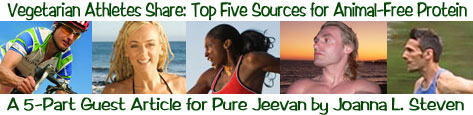
In this special five-part series, Joanna Steven uncovers where some top vegetarian athletes get their protein. Here's part one, focusing on Tim VanOrden's take on this issue.
When alternatives to the Standard American Diet are discussed, protein is on everyone's mind. There are many reasons why someone might want to eat a plant based diet, whether for allergy concerns, health reasons, or more variety. But nagging doubts often come up;? Are plant proteins adequate for athletes and body builders ? Are they really the preferred protein source of the human body ? Are they better than animal based protein or are they just consumed for environmental reasons ? To answer these questions, why not ask the experts:? triathletes, professional dancers, bodybuilders and extreme sport racers ? Here are the answers from some of the most competitive athletes in their respective fields.
Read more: Vegetarian Athletes Share: Top 5 Sources for Animal-free Protein (Part 1 of 5)
"Only somebody who really takes the time to understand [Pure Jeevan's Salsa's*] potential can then coax it into its fullest expression. Then, I mean, oh its flavors, they're just the most haunting and brilliant and thrilling and subtle and ... ancient on the planet." ~ Miles Raymond in "Sideways" (2004) (*slightly modified).
Jim here... Over the weekend, I'd made a string of videos for Pure Jeevan using my handy-dandy new phone. To my great surprise, when I went to post them to YouTube, they all came out sideways! So, I'm sorry, friends... you'll have to endure (if you so choose) a somewhat disorienting video, below. But, hey, at least it reminded me of that wondrous quote from the movie Sideways! I imagine Paul Giamatti describing one of my own recent creations this way -- a sort-of half-raw, yet still very healthy delight that I like to make sometimes.
 My reason for featuring a less than 100% raw recipe is two-fold. First, I'd been discussing transitioning to raw (see yesterday's post). And, adding more raw into your non-raw diet is a great way to transition. I believe that raw sauces are an excellent way to achieve this, as I'll explain in the video. Second, if you do prefer a 100% raw dish, then you can simply replace the beans with something else -- perhaps sprouted beans, or maybe your own invention from the dehydrator.

Okay, it's question day once again -- and we've received some great ones lately. Before I begin, just let me reiterate once more that Wendi and I can't give medical advice here. We're motivational, inspirational raw food / natural health writers and educators (considerably knowledgeable and experienced ones, I might humbly add!); not doctors.So, whenever we give "advice" (or, whenever our writing appears as such), what we really mean is, "Well, if that were me, this is what I would do." And, the rest is in the disclaimer that runs on all of our pages.
 Not only do we not give medical advice because we're not doctors (as if that wasn't enough of a reason!), but we also know that each person is different and, as such, all symptoms and conditions are unique to each person's individual situation. If person A and person B are both experiencing high blood pressure, it could easily be two different things causing that -- and the treatments or approaches could differ tremendously. What might fix person A might kill person B! (Sorry person B. No hard feelings.)
Read more: Reader Question: Returning to "Healthy" Eating After Healing with Raw
My nine days of mono meal eating are over! I'll write about the final day tomorrow.
April 14, 2008
Today I have even more energy. My tongue is coated more, however. It s not horrible, but it s definitely less red and more of a light pink. My eyes have continued to feel dry and my eyelids are heavy. What causes that, I wonder? My nails are whiter and harder, but they still break and rip when I m working around the house.

Welcome to the very first Take the Time Tuesday entry! What's Take the Time Tuesday, you may ask? Well, it's a time to meet someone special. Each Tuesday we'll introduce you to an individual or business we think might be of interest to you. So, who's in the spotlight for this very first Take the Time Tuesday entry? Pure Jeevan, of course!
Take the Time to Meet...
Just a quick update for those in the Pittsburgh area:
My dear friend Melissa has planned some fun raw food gatherings that you may be interested in checking out. The first is a raw food dinner and demo, the second is a wild herb walk.
Raw Foods Demo and Dinner?