Know Any Literary Animal Lovers?

Hi there PureJeevan readers! We wanted to let you know that Jim's new novel CHROO is available on Amazon. It's a crazy adventure involving a billionaire heiress, her Chihuahua BFF ("Chroo") and a host of human and animal characters. Find out more on Amazon! Here are some links:

Jim here... This post is for anyone who has turned to raw foods in an attempt to become healthy -- to lose weight, lower cholesterol, to lower blood pressure, to beat diabetes, or perhaps to overcome something even more serious. Let me ask you something (rhetorically): Have you ever, in your journey toward optimal health, looked at someone else -- someone else who eats "worse" than you do, yet who appears outwardly more healthy -- and thought, "Why is it so hard for ME and yet so effortless for that person "
Have questions run through your mind such as: ?How can that other person eat all of the wrong things, and yet look healthy? ?Why is it that I eat better than most people, and yet I'm the one facing a health problem Why is it that some people go raw and their issues clear up so quickly, and yet here I am still not feeling and looking 100% healthy? Why is it that physical health is not always bestowed on those who really deserve it?
It's been an interesting week for us here. We've looked at a handful of ways that people may either become obese, or sustain an obese body -- all largely for reasons outside of dietary intake. The three situations we looked at included maintaining weight as a defense mechanism (Tuesday), becoming obese through worrying about becoming obese (Wednesday), and obesity as basically a physical manifestation of a non-physical longing (Thursday).
Without a doubt, these are just three out of hundreds of possible non-physical contributors to poor health. The idea was merely to start a thread on these things, opening people's minds to possibilities that perhaps they'd never seriously considered.

I knew right away that I would be filing this under our "Fun-filled Friday" bannner. Finding pawpaws is a huge treat! They're surprisingly little-known, and also very surprisingly tropical in nature. Who would think that something this delicious and exotic-tasting would thrive in so much of the non-trpoical world!? In this video, you'll learn where to look for pawpaw groves, how to identify a pawpaw tree, and what pawpaws look and taste like.
Read more: Learn How to Identify Pawpaws: Join Us on a Pawpaw Hunting Expedition!

Driving to work today, we noticed that McDonald's has launched its latest product aimed at the health-conscious demographic. In case you haven't heard, you can now purchase fruit smoothies at Mickey D's! Sounds like real progress, right? Well, let's take a closer look and see if they're really as healthy as they sound.
McDonald's is not exactly known as a healthfood destination. After all, a typical lunch at the Golden Arches these days might well include something like an Angus Bacon & Cheese, Large Fries, and a Large Coke. ?Together, that's 1,600 calories, 64 grams of fat, and 2,400 mg of sodium, 99% of which is from highly cooked, highly processed, non-organic, factory-farmed, nutrition-barren source materials . (Add on another 75 calories and 550 more mg of sodium if you plan to go through, say, five packets of ketchup along with those fries.) (Source) And, some people eat that daily!
Read more: The Anatomy of a McSmoothie & Pure Jeevan Calls for New Term for "Smoothie"

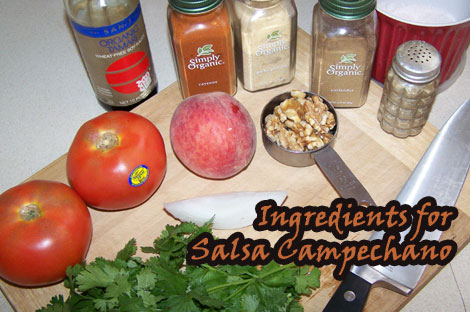
For today's Makin' It Monday feature, we'd like to present "Salsa Campechano." We'll have to admit, though, that we do not speak Spanish. So, we have to give some credit to Google's online language translator. When we went to name this recipe, Wendi suggested that this is a "manly" dish (since I created it). However, we didn't find the perfect Spanish word to fit the recipe.Then, considering the walnuts in the recipe, Wendi suggested that perhaps "hearty" was a better adjective. Google returned the Spanish word campechano for this, and we immediately thought: Yes!, that sounds just perfect!? So, here's an amazing recipe for you. It's a hearty salsa recipe, but I actually like to eat it as a soup.

To help keep all of you inspired, we ve asked some
remarkable individuals to share their raw food stories with you. Enjoy!

Jim here... When you're a committed raw foodie, certain activities that most other people consider routine can become somewhat difficult if you don't apply a bit of forethought and planning. Take traveling, for example -- specifically, flying.
What if you're flying out of town -- say, to the Florida Keys (wink, wink) -- and want to make sure you'll have enough to eat during the day-long trip? What if you also want to bring along some staple raw food items as well ? What if some of these are generally refridgerated ? How can you accomplish all of that?
Here's an impromptu interview with Matt Miller, the gourmet raw foods chef from Maggie's Mercantile, a vegan/raw restaurant in Pittsburgh, PA. We met Matt @ a recent Raw Foods Meetup here in Pittsburgh. In the video, we discuss Matt's famously addictive raw blue corn chips -- deemed by yours truly as the "holy grail" of raw foods. Below, I'll go over the ingredients, etc.
Read more: Jim from Pure Jeevan Interviews Raw Chef Matt Miller
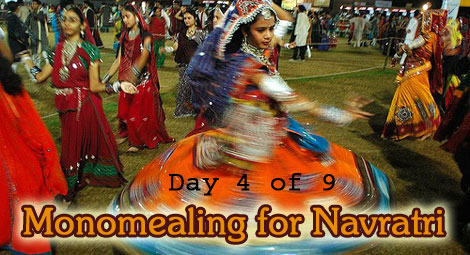
Today is the beginning of the second three-day focus on the attributes of a different Goddess who is most worshiped during the Hindu celebration of Navratri. She is Goddess Lakshmi, bringer of wealth and good luck. Let's focus on the idea of wealth. When we first hear the word, many of us think about monetary wealth. However, there is a much deeper meaning ... that of abundance. Feminine energy has the ability to bring forth, to birth, abundance that is beyond the imagination, in every aspect of our lives. Female energy is fertile, able to create a beautiful life and future, shine forth and bring wisdom into view, all with grace and beauty. All of these are attributes of Goddess Lakshmi, qualities we all have within us. Qualities I celebrate within myself and within all of you (male and female, alike).
 End of Day 3:
 Jim here... Wow, what a great week it's been here at Pure Jeevan, focusing on diabetes for five straight days!? To cap it off, I have some fun news to share:? Tomorrow is Wendi's birthday!? And, guess what ? When I asked her what she wanted to do to celebrate this year, she said she'd like to devote her special day to spreading the word about the Movement ot Reverse Diabetes Naturally. So, we made some calls and sent out some press releases.
A few venues were enthusiastically receptive, so we're hitting the streets tomorrow -- celebrating Wendi's birthday by handing out diabetes awareness literature! Here's the press release I sent to the media, which tells where we'll be. If you're from Pittsburgh, we hope you'll stop by to say hello and/or ask questions about natural diabetes reversal and of course raw foods!
= = = = = = = = = =

On this lovely Valentine's Day, I am focusing on how thankful I am for LOVE! I'm not into the whole this-is-the-day-you-are-supposed-to-show-love thing, though. I think love is something that should always be around, felt, and shared. Every day is a new day to express the love you have in so many varied ways, why hold it back for one special day a year?