Know Any Literary Animal Lovers?

Hi there PureJeevan readers! We wanted to let you know that Jim's new novel CHROO is available on Amazon. It's a crazy adventure involving a billionaire heiress, her Chihuahua BFF ("Chroo") and a host of human and animal characters. Find out more on Amazon! Here are some links:

Thank you, thank you, thank you! Today for Thankful Thursday, we wanted to say a special THANK YOU to our readers. It means so much to us that you come to visit our blog. With every new comment (both here on the blog and through email) it fills us with great happiness!
Is there something you'd like to see more of here on our blog? Something you'd like us to discuss? We know you are looking for more recipes, since you've told us (be sure to check out our recent posts where we've linked to some fantastic sites offering recipes!). What else would you like to read about or have us share with you?

Today we welcome an up-and-coming raw chef, Sam, from DebbieDoesRaw for the first of Pure Jeevan's new Makin' It Monday "Guest Raw Chef" editions. Sam will demonstrate how to make a simple Peach Pudding, which she tells us is the invention of her very good friend Anthony from Rawmodel.com. We think Sam did a super job! Don't you ! Sam, you're welcome to guest-host on our blog any time you like.
Read more: Makin' It Monday "Guest Raw Chef" Edition Welcomes Sam!
We're heading out of town again! This time we'll be visiting Leela Mata at her Peaceful Valley Ashram, the location of the first raw food spiritual retreat I held last year.
Here's a video I took of Leela Mata last year:
?

When I first decided to try a raw food diet again (I had sampled it for about three months a few years before going completely raw), I wanted to do it in a way to prove that it either does or doesn t work. The best way to do that, I figured, was through consistent blood tests. So, that s what I did. I have continued to document my path to health with regular blood tests. Many of you know that the results have been remarkable. My dramatic shift in weight is the most obvious to others, but there were equally impressive changes going on inside my body, as well.
It has been about a year since my last blood work was done, so I knew I should schedule an appointment to get the testing done soon (since I want to keep the tests somewhat yearly). I tend to always put the testing off, however. As much as I m curious about the results, the truth is that I m terrified of needles. Over the past few months, I was continuing to put this yearly testing off, but something has spurred me to get it done sooner than later.
Read more: Raw Food and Measurable Health: Does Wendi Have Lyme Disease?
Wow, is it really Episode 3 already? How time flies! Remember way back when we started this informative, informational, nutrition-oriented "Know Your Food" series? Seems like ages ago, doesn't it? (Oh, wait... It WAS ages ago. It's just taken us a while to get up to speed with this video stuff!) Anyway, here's the video, followed by some camera/video editing news -- oh, and of course some highly urgent celery information. (Okay, it isn't really urgent at all; we just needed to add a dash of drama.) So, see what you think. You might even learn a thing or two about our stalky green friend.
Not TOO bad, right? We're getting to our goal of roughly 3-minute episodes. Of course, this is still one of our first attempts, shot last Sunday. We thought it was decent enough to not entitle it "salvaged" as we did the previous installment.
There are many things to be thankful for in this life, but for our very first Thankful Thursday entry we'd like to stress how thankful we are for the vibrant health we now have. Consuming only fresh, organic raw fruits, vegetables, nuts and seeds has allowed our bodies to heal from the inside out. For this we will forever be thankful. In fact, we are so thankful that we are here, as Pure Jeevan, to spread the word about how raw, life-filled foods can bring you renewed health!
Okay, we promise that, once the "Know Your Food" series normalizes (hopefully by next week), we'll be posting daily 3- to 4-minute segments, not these gargantuan bandwidth- and free-time-hogs! But, it's a decent 8 minutes of solid entertainment (kind of/sort of). So, hope you enjoy. We call this "Episode 1 (sort of)." You'll see why. Includes a few bonus minutes of discussion on goals & synchronicity.
As you saw, we didn't air the entire APPLE show. So, a few notes are in order:
Before we run this blog entry, let me first announce one awesome thing:? Wendi and Kdcat are back home now!!? Yep, the trip is now officially over, and was a HUGE success. Not only did our fearless raw travelers identify Pure Jeevan's soon-to-be new home town -- Portland, Oregon! -- but Wendi and KDcat also met and made friends with hundreds of people from around the country. I'm sure Wendi will be back here on the blog with overall reflections and so forth soon. However, the trip generated so much content that it's going to take a while to catch up!? So, let's pick up with the travel narrative where we last left off. As you may recall, the girls were leaving San Luis Obispo and heading into sunny Los Angeles! Let's see what Wendi had to say, again with her travelogue:
 Wow, it's finally looking like CA with all the palm trees! After hitting and dealing with some major traffic of a large city, we arrived to the warmest welcome at the home of Debbie Young (of DebbieDoesRaw) -- a decorative greeting waiting on the door, gift bags handed to us as we walked inside, loving hugs and smiles, and the most amazing raw meal ever (samosas!, chai, pineapple lassi, mango chutney, tamarind chutney, biscotti cookies), and a snack basket waiting in our private apartment! At this stop, we were totally spoiled by Debbie and her beautiful family!
This is one of the stops I was really looking forward to, because Debbie and I have been online friends for a long time. We were able to spend a short amount of time together at the Raw Spirit Festival in 2008, and I loved her and wanted to spend more time with her and meet her lovely family in person (including their adorable dog, Malcolm).
Read more: 2010 Trip Coverage Continues: Los Angeles, California!!!

In this video, Pure Jeevan heads to Washington, D.C., to visit some close friends. See what these raw foodists pack to eat for the weekend and hear proof that Wendi Dee is getting younger! A friend who has known Wendi for 20 years says she now looks as young as she did when they first met! *giggles* Raw foods are AMAZING at restoring youthfulness! Are you getting younger, too !
You'll see a picture of a raw apple pie that Wendi created (the recipe is included in our free raw food recipe ebook) and hear her friends rave about the raw cheesecake she prepared for them. It's always nice to make some extra special raw treats for your friends, so they can see that you're enjoying the food that's helping you regain your health (and youth!).

What a fun weekend we'll be having! We leave later today to visit some friends in Virginia. Sweet little Rhia (a niece's daughter) will be turning one year old and there will be a huge party for her. I'll be wearing a sari, there will be lots of Indian food to tempt me back to the cooked side of life (but, never fear, I am strong!), and we'll be staying up very late enjoying the party Saturday evening.
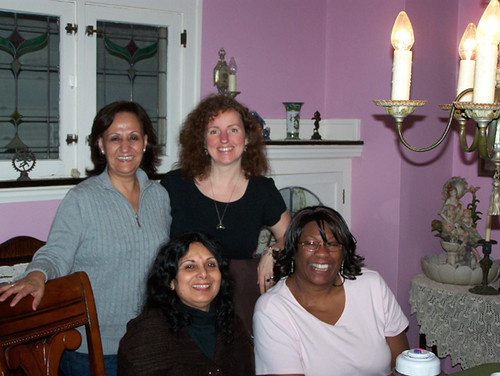
Mohtarama, Wendi, Mamta, Deborah