Know Any Literary Animal Lovers?

Hi there PureJeevan readers! We wanted to let you know that Jim's new novel CHROO is available on Amazon. It's a crazy adventure involving a billionaire heiress, her Chihuahua BFF ("Chroo") and a host of human and animal characters. Find out more on Amazon! Here are some links:

Hi everyone. Did you miss me on Friday? Was your entire day absolutely hinging on evaluating the quality of the raw salad dressing recipe that you very rightly expected to see demonstrated right here? ... and then I posted nothing at all! Well, missing one day isn't so bad, really. I think it's the first one I've missed since Wendi stepped away from the blog temporarily. Anyone want to guess what happened? ... Yep, a nasty case of the flu took me down!?
O, my raw friends, I thought I was a goner Friday -- thought for sure I had th' deadly swine. But, being the resilient, nearly infallible raw foodie that I am, I totally kicked it's porcine rear end, and am now supercharged and ready to rock and roll once again here on Pure Jeevan's blog!
Read more: One for Lucy: Raw Thai Coconut Curry Salad Dressing!

It's day three and all is going okay. I seem to have a bit more energy since it's not all being sapped trying to digest complex meals. The last time I did mono mealing, I received countless emails from Pure Jeevan members who were concerned I was doing something unhealthy. Eating simply for nine days, however, is not unhealthy.
 Did you know the body doesn't need a full range of vitamins and minerals at each and every meal? Somehow many of us were taught that each meal needs to be a complete balance of vitamins, minerals, proteins, fats, carbohydrates and that just isn't the case. What the body needs is a well-rounded diet, overall, to be in a balanced state. If, over the span of a month or two, you've consumed a variety of fruits, vegetables, nuts, seeds, and sprouts you will find that you've met just about all of your nutritional needs.
In this video, Wendi talks with Leela Mata, spiritual leader of the Peaceful Valley Ashram, about her experiences with the raw food diet and a bit about a cob oven structure that was built on the ashram property. This is part 2 of a 5-part series featuring Peaceful Valley Ashram.
Read more: Leela Mata Discusses Her Experiences with Raw Foods

Jim here... A little over a month ago, we couldn't contain our excitement about an online contest to win the best job EVER -- living as caretaker of a tropical island in Queensland, Australia, on the Great Barrier Reef for 6 months (and being paid $100k for the task!).
The deadline has come for this and, as we promised, we BOTH applied. My video was the first to be processed. So, we posted a screenshot above, which you can click to go view it (or just click here) -- and also please vote and rate it a 5!!! (I've heard that the rating system can get a little screwy on that site -- that you need to wait for it to load and maybe mouse over the rating part first. But, a 5-star rating would really help, as would the traffic, even if you don't watch the entire video.

To help keep all of you inspired, we ve asked some
remarkable individuals to share their raw food stories with you. Enjoy!

The diets of raw foodists are as varied as those of individuals consuming the Standard American Diet. The majority of raw foodists are either: 1) gourmet raw foodists, who consume dishes that are usually heavy in fat from nuts (Pure Jeevan started out this way); 2) basics raw foodists, who don't process their fruits and veggies in blenders, food processors, or dehydrators; 3) mono raw foodists, who consume single foods for each meal (i.e., a meal of only apples for breakfast, romaine lettuce for lunch); 4) low fat raw foodists, who consume processed meals at times, but prefer to keep their fat intake below 20% of their calories (Pure Jeevan is working toward this); and
Take the time to meet #5 ...

Here at Pure Jeevan we are preparing for our cross country tour to educate others about raw foods. This means we are paring down on a lot of things, donating a lot, selling some things, and pretty much not buying anything unless it's absolutely necessary. That's what we've been doing for almost two years now (we're waiting for the house to sell). Recently, however, I decided it was time to spend a little bit of money even if it wasn't absolutely necessary.
-
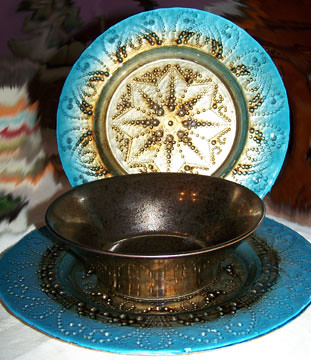
- Wendi's Dish Set
What did we buy? Dishes! Seems a bit strange to finally spend some money on something unnecessary and have it be dishes, right? Well, I had a few reasons for this purchase. The first is that when we are living in the RV, the space is going to be minimal. There won't be a lot of room for dishes, let alone much of anything else. Since there's not a lot of space to have dishes drying, we'll need to be washing, drying, and putting away immediately after use. That may not sound like a big deal, but when someone in the family decides to eat a few different things and leave the dirty dishes in the tiny RV sink, on the small counter, or somewhere else, it's going to really seem like a bigger mess than it is. So, to remedy this I thought it would be good for each of us to have our own dishes. That way we have a sense of responsibility for our own particular dishes--we know they are ours and we are responsible for taking care of them.
Note: This entry is not meant for our regular readers. Search engines are directing people to our page when they enter "mono and headaches" and I want to take this opportunity to reach out to those who may not know about this amazing lifestyle the rest of you already know about! ;-) Plus, I want to help them with their headaches.
Mono and Headaches: Looking for Help
Mononucleosis (Mono) is a common viral illness. When children develop mono, it is usually not obvious since it seems like a normal cold. When teens and adults develop mono, however, the symptoms are much more severe. Most individuals will feel better within about three weeks, but fatigue can continue on for about three months! Who wants to feel ill that long? Who wants to feel tired for MONTHS ! Who wants to suffer from such severe headaches ! Not me, that's for sure.

Read more: Mono and Headaches: This Entry is Not For Our Regular Readers
We had a wonderful weekend that started with a raw food potluck in our home (through the Pittsburgh Raw Food Meetup group). There were about twenty people and so many lovely raw food dishes! I haven't checked the camera, yet, but I hope someone remembered to capture some pictures of the food and guests. It was all very yummy, including the beet pasta I made with a cream sauce. I also made some carob peppermint sweets that KDcat formed into bite-sized balls and arranged them on a platter. A friend of mine told me that the people who show up for raw food potlucks tend to be genuinely nice people, and she was right. It was a pleasure meeting everyone and I look forward to next month's meetup.
The rest of our weekend was spent with our guest, Devaki, who just left a few minutes ago to return to the ashram. She played some beautiful music on the harmonium and she and some other lovely guests filled our home with the beauty and energy of Kirtan chanting. Some of the chants were in English, too. I thought I wouldn't like them as much, but they were just as beautiful as the Indian ones. One of my close friends who was here for the Kirtan told me that I was glowing after the chanting! I love the blissful feeling that comes from chanting and meditation.
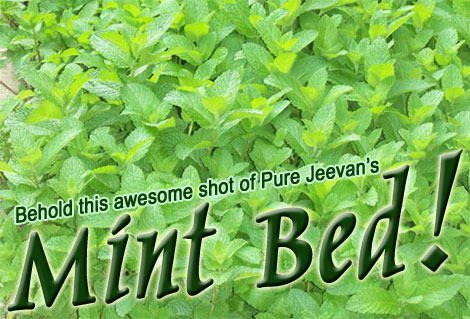
I wrote on Monday that today (Thursday), we would be discussing mint here -- specifically, harvesting some late-remaining mint from our mint bed (shown above in all its glory) and making something with it. I failed, however, to take into account that it's been getting darker earlier and earlier these days. By the time I was able to get outside and talk about mint, it was just too dark.
So, I thought I'd forego the video, and just write up some minty facts to freshen up your Thursday. To begin, I would highly encourage anyone who is new to gardening, and wants some early success, to experiment with mint (including spearmint, peppermint, and the various varietals available here and there). I can almost guarantee that you'll have some wild (and I do mean wild!) success, and will soon enjoy more mint than the law allows. It's so easily grown, and spreads around so easily (via its root system), that it would almost be considered invasive if it weren't so darned desirable and fragrant. (It's tough to walk past a mint bed without snatching up a leaf, rolling it between your fingers, and inhaling the scent deeply.)

Jim's mother, JoAnn, LOVES pasta. I'm sure many of you can relate to that---pasta is a big part of the cooked diet and just about everyone loves it. When going raw, many individuals say they just can't do it because they miss pasta too much. Well, that's no longer a problem. There is a raw way to make pasta and you are going to love it if you haven't experienced it, yet!
As a gift for Mother's Day, we sent a pasta-making tool to JoAnn along with a pasta sauce recipe we created for her (see the Paradisio Pasta Pomodoro entry). To make it easier for her to learn how to create pasta, and to answer some of the emails we've been receiving about the device we used to make the pasta, we have put together a two-part video showing how to make delicious, beautiful raw pastas! You'll learn how to use two different pasta-making devices, as well as how to use a simple vegetable peeler to create delicious noodles!