Know Any Literary Animal Lovers?

Hi there PureJeevan readers! We wanted to let you know that Jim's new novel CHROO is available on Amazon. It's a crazy adventure involving a billionaire heiress, her Chihuahua BFF ("Chroo") and a host of human and animal characters. Find out more on Amazon! Here are some links:

Jim here...Well, something awful happened today at Pure Jeevan, something utterly shocking to any raw foodie on the planet -- our Vitamix container broke! I know, I know... breathe with me: Deep breath in... deep breath out. There, that's better. It's going to be okay, I just know it!
Here's what happened:? The agitator assembly (the metal part at the bottom that connects to the blades inside the container) wore out. It blew some kind of bearing or something, lost its internal oil, and started making an infernal noise when we blended our morning smoothie. It was pretty clear we'd blended up our last elixir in that container.

Jim here with another exciting installment of Weird Wednesday. (What, you thought that just because Wendi is out of town this week, we'd have no Weird Wednesday )
In any discipline, I think it's important to consider the entire argument in taking a stance on a given issue. Examine each issue from both sides (pro and con) -- and then make the best choice you can. That makes sense, right?

Recently, we were asked how to balance meals when one individual is an under-weight-open-to-raw-semi-carnivore and the other is overweight and feels the need to be on a raw food diet to lose weight and regain health.
Many of you reading this will agree: It's wonderful that the partner is open to the raw food diet! That's going to make life so much easier. Many on the raw food path lack a supportive partner, and that's an issue we've discussed in the past here on the blog and will continue to address in the future.

In the comedy film, L.A. Story, there's a scene in which weatherman Harris K. Telemacher (Steve Martin) visits a friend and is asked to taste a *very* green-looking juice. He does, and then proclaims it's "exactly like licking a shag carpet." ?Funny how some people adore intense greens while others experience the polar-opposite reaction. (There are numerous funny food- and health-related jokes in that movie, by the way!)
Yesterday, we discussed some unusual considerations with respect to greens, ultimately leading to a brief discussion of chlorophyll (the green pigment within almost all plants that plays a key role in photosynthesis).

Jim here... As I may have mentioned a while ago, I joined a gym recently. I figured, with Wendi and Bailey living on the other side of the country, I might as well find something healthy to do with my alone time until I'm able to join them soon (aside from my seemingly never-ending quest to rid our household of 13 years of rampant accumulation). I joined on a whim, actually. There's a gym near my home called Planet Fitness. Honestly, I have no idea how they make money. A membership costs just $10/month -- and it's a Wal-Mart-sized place, too, absolutely packed with state of the art machines. (Actually, it's a franchise, so there could very well be one near you.)
In any case, it had been a while since I'd been inside an actual gym. I've certainly remained relatively active, of course. But being in a gym is a little different -- and certainly has its plusses and minuses. On the minus side, I've always kind of felt that, if you add up all of the time it generally takes to get (1) get ready to go to a gym, (2) drive there, and (3) drive home -- say, a half-hour, total, for those things -- then you could probably better invest that time in just going for a run for a half-hour, leaving straight from your home. From a time management standpoint, I'm not crazy about gym memberships (meaning not that physical exercise isn't worth the investment of time, but rather that there are ways to accomplish the same results in much less time).
Read more: Exercise As a Reminder of the Human Body's Amazing Efficiency
Thank you, thank you, thank you! Today for Thankful Thursday, we wanted to say a special THANK YOU to our readers. It means so much to us that you come to visit our blog. With every new comment (both here on the blog and through email) it fills us with great happiness!
Is there something you'd like to see more of here on our blog? Something you'd like us to discuss? We know you are looking for more recipes, since you've told us (be sure to check out our recent posts where we've linked to some fantastic sites offering recipes!). What else would you like to read about or have us share with you?

Thanks to Bitt, yesterday, for pointing out that one possible misinterpretation of yesterday's post (on celebrity weight loss) could be that "thin = healthy." I'm sure that, while there are countless wonderful benefits to being a famous actor, one of the less wonderful aspects of that life must be the pressure to remain young, thin, attractive, etc. It would seem realistic to me to assert that, additionally, women are held to even more objectified standards than are the men out there (although, in fairness, note that 6 of the 11 stars profiled in the Yahoo feature linked to yesterday were in fact men).
In any case, the post's intention was never to imply that one's weight is necessarily the best indication of one's overall health. After all, we all know thin people afflicted with serious health challenges.

On March 1st we started a Juice-a-Day Jamboree, to challenge ourselves (and our readers) to include more fresh juice into our diets. We knew we weren't ready for an all-out juice feast, but a juice a day seemed like something we could commit to in our daily lives. So, the Juice-a-Day Jamboree was born. We've been posting periodic updates on our original post about the Jamboree, but figured we'd post periodic juice updates in the main part of our blog, as well, to encourage others to add some more fresh juice to your diets, as well.
We've missed one day of juice since we started the Jamboree. Our original goal was to have our juice first thing in the morning, but we weren't always successful with that. So, we told ourselves that any time of the day is fine, but if we can start the day with a juice we'd prefer it that way. The changes we've been feeling are more pronounced when we begin the day with fresh juice, rather than when we have our juice later in the day.
There are many things to be thankful for in this life, but for our very first Thankful Thursday entry we'd like to stress how thankful we are for the vibrant health we now have. Consuming only fresh, organic raw fruits, vegetables, nuts and seeds has allowed our bodies to heal from the inside out. For this we will forever be thankful. In fact, we are so thankful that we are here, as Pure Jeevan, to spread the word about how raw, life-filled foods can bring you renewed health!
Welcome to Pure Jeevan's "Juice-a-Day Jamboree"! You're probably wondering, "What IS Pure Jeevan's Juice-a-Day Jamboree, anyway " Well, it's simple: It's an ongoing, informal, loosely organized "event" centered around juicing. Think of it as an interim step between (1) any kind of diet or lifestyle, from SAD to full-on raw, that does not include much regular juice, and (2) an all out juice feast where that's ALL you'd consume for a period of time. Basically, we're saying, "Let's just make this simple and accessible for everyone. Let's just make a goal to simply drink more fresh juice!"
Wendi and I have been thinking a lot about incorporating more juicing into our lives lately (which is something we've done off and on over the years but never stuck with long-term). One thing holding us back from doing it more often is the time requirement. When we juice, it usually takes a half hour or so from start to finish. I know it doesn't seem that complicated, but I suppose it's just the whole process of setting up the juicer, washing and peeling the produce, juicing it, setting the juice aside while we clean the juicer, doling out the juice into glasses, cleaning up the mini-mess that makes, and then sitting down to actually enjoy the juice.

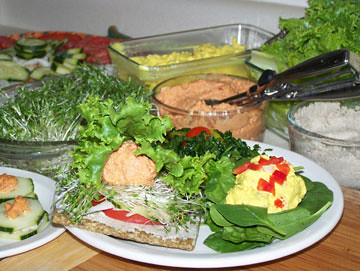
I'm still working on the dishes that will be served at the upcoming 3-Day Raw Food Spiritual Ashram Retreat (only 2 spots left!). Today, I worked on the Sandwich Fixin's that will be served for lunch on one of the retreat days.