Know Any Literary Animal Lovers?

Hi there PureJeevan readers! We wanted to let you know that Jim's new novel CHROO is available on Amazon. It's a crazy adventure involving a billionaire heiress, her Chihuahua BFF ("Chroo") and a host of human and animal characters. Find out more on Amazon! Here are some links:
Jim here... Until our home sells (SOON!!!) and Wendi and I launch ourselves into the world as full-time raw food teachers / lecturers / inspiration providers, I'm more or less stuck in the corporate world during the day. While much of what happens in this Dilbert-esque environment is, as many of you likely know, absolutely meaningless, there is nonetheless the occasional pearl of wisdom to be pried from the clammy jaws of the 9-to-5 world. I was, for example, just reminded of a story I heard at a seminar once. Not surprisingly, the seminar pertained to the art of money making. However, there's another more fulfilling message to it as well.
A large modern newspaper company still uses these ancient printing presses from the 1950s -- huge old monstrosities with enough belts, pulleys, and greasy gearboxes to make any modern-day steampunk enthusiast squeal with delight. One day, not long after the old press manager finally leaves the company, the main press breaks down. Manuals are consulted, technicians brought in, engineers asked to take a peek. No one can bring the beast back to life. But there's a woman on the Internet who specializes in these babies -- and, guess what, she's local! So, they call her in. She listens to their problem and says she can fix it, but it's going to run them $5,000.
In this video, Wendi talks with Leela Mata, spiritual leader of the Peaceful Valley Ashram, about her experiences with the raw food diet and a bit about a cob oven structure that was built on the ashram property. This is part 2 of a 5-part series featuring Peaceful Valley Ashram.
Read more: Leela Mata Discusses Her Experiences with Raw Foods
[caption id="" align="aligncenter" width="500" caption="Perfected Raw Vegan Potato Pancake Recipe!"]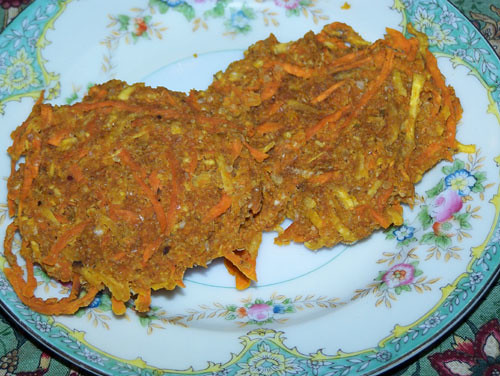 [/caption]
I've done it, I've done it, I've DONE IT!!!? I've perfected a recipe for raw vegan potato pancakes! My friend Melissa shared her potato pancake recipe with me and, like always, I had to play around with it (I rarely go by a set recipe). Had it not been for her original recipe, I wouldn't be writing this post! So, thanks, Melissa!!
In the next day, or two, I'm going to type up the recipe and send it out to all of our subscribers. So, if you haven't signed up recently for either our newsletter or the two free eBooks, do it soon! In addition to the potato pancakes recipe, I'm going to share another amazing recipe I created for Jim's birthday this past weekend: Raw Vegan Ice Cream Cake!! YUM!


I am extremely thankful for sleep. I can't imagine striving to sleep only four hours a night. Jim always says he wishes he didn't have to sleep, that he's wasting his life when he sleeps. For me, I've always loved sleeping. I feel so great after I wake up. Not only that, I thoroughly enjoy dreaming. I wouldn't want to miss out on the amazing dream life I've been able to enjoy while I sleep.

Today, and every day, I am thankful for lovely Mother Earth. Where would we be without Mother? May we always care for her in a gentle and loving way.
====================
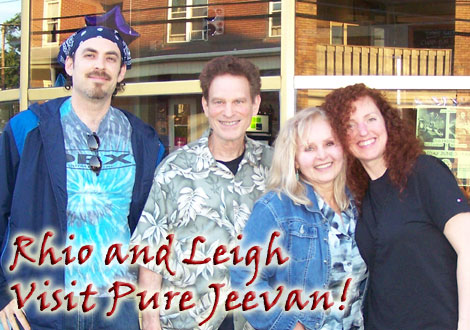
Jim here... We had a whirlwind weekend last weekend when the uber-talented couple Rhio and Leigh came to Pittsburgh for a three-day visit. As many of you probably know, Rhio is a well-known pioneer of the raw food movement, having written one of the definitive books on raw foods, Hooked on Raw. She's also the host of a popular Internet radio show of the same name, for which Leigh serves as primary engineer and co-host. Both have extensive backgrounds in music, as well, which is fitting for such a colorful, vibrant couple.
Saturday, Rhio gave a two-part presentation to a capacity crowd at a local coffee shop / art gallery.Part One was a demonstration on making raw dairy-free yogurt using almonds (a technique demonstrated, I believe, on her new DVD, "What's NOT Cookin' in Rhio's Kitchen " -- available soon on her web site at www.rawfoodinfo.com). According to the yogurt eaters in the crowd (of which I'm not one -- never went in for much dairy), the recipe mimics yogurt perfectly! So, if you're a raw foodie who misses dairy yogurt, you're definitely going to want to connect wth Rhio to learn the technique.
This video is nearly 10 minutes long (sorry, we'll aim for shorter ones in the future), but shows a full process for making a delicious, spicy nut dip. From there, we show two options for making the sandwich -- one using dehydrated raw bread, another using lettuce as the wrapper. I wanted to add that the packaged raw bread used herein is from Love Force, a great company that has provided sponsorship support to Pure Jeevan in the past. Here's a link to their site in case you're interested acquiring some of their bread or finding out where it's sold. (It's very good, as are their raw organic energy bars!)
Read more: Video: Jim from Pure Jeevan Makes Nutdip / Raw Sandwiches!

Wow, are you in for a treat! I came up with the most delicious soup recipe today! I wanted to make something that didn't require use of the food processor, blender, or dehydrator because I've gotten quite a few emails saying that it's too hard to be raw if you don't have the money for the appliances.
I disagree that it's too hard to be raw without the appliances. It's definitely easier to do it *with* the appliances, but it's not overly hard to do it without. So, from time-to-time I'll try to create recipes that don't use anything more than a knife and a chopping board to show you that it's not too difficult to eat raw. :-)

When you get into raw foods, one thing you're probably going to notice from time to time is that others are "concerned" about your health. This is hugely ironic -- not only because it's likely your own concern about your own health that brought you to raw in the first place, but because you most likely hold the conviction that the raw food diet (or some close variant of it) represents the most healthy dietary regimen available for humans.
Nevertheless, you'll receive a lot of concern. You'll receive it even when you have that "raw glow" and are looking and feeling better than you have in years! The main concerns:
I'm makin' nothing today, or for the next eight days! Think of all the time I'm saving myself by consuming only mono meals for nine days. What will I end up doing with that extra time? So far, today, I've spent a long time outside soaking up the sun's beautiful rays that I've missed far too much this Winter. I have no idea what the rest of this mono journey is going to be like, but I'm up for the adventure!
I've started a little journal on my desktop to track my nine days of mono meals, so I'll share what I've written from time-to-time. Here's what I have, so far...
***** DISCLAIMER: As with all of our posts here at Pure Jeevan, and particularly those tagged with a new term, "Nadi Balance, please refer to the disclaimer that runs at the bottom of all Pure Jeevan pages. Wendi and Jim are health researchers, educators, and extreme self-experimenters, not doctors. ******

Yesterday, we talked about live blood being a fantastic indication of overall health and well-being.Wendi's initial live blood review didn't show the extent of the Lyme disease. But, it did show an indication that something was going on (while Jim's blood showed overall health).
Read more: Nadi Balance: Exploring Fats and What Finally Healed Wendi