Know Any Literary Animal Lovers?

Hi there PureJeevan readers! We wanted to let you know that Jim's new novel CHROO is available on Amazon. It's a crazy adventure involving a billionaire heiress, her Chihuahua BFF ("Chroo") and a host of human and animal characters. Find out more on Amazon! Here are some links:

A month has gone by since my last health update. At this point, I consider myself healed of lyme disease! In the past I asked the lyme specialist doctor if there's a way to test to see for certain the lyme is gone, but he said there isn't. So, I go on my inner wisdom, which tells me that it's gone and now I simply need to continue healing from all that the lyme brought with it.
We're still not comfortable sharing what we've been learning and doing to help move my body into an even healthier state, but it's obviously working. I've been able to go back to daily living, for the most part, without much assistance at all. I've organized the house again (Jim and KDcaT were busy caring for me and the house wasn't the top priority for the past half a year), caught up on all of the laundry, responded to all of my email that had been piling up, and I've been able to be more social again. The biggest improvements are that I can now prepare my own food without experiencing any pain, and I can dress myself with only minimal assistance at times! BIG improvements!
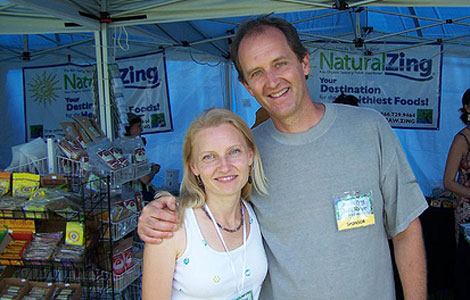
... just a quick interruption of "Crazy Week" to do two things:
1. Congratulate Natural Zing on their 8th year in business!

We just returned from the East End Food Co-op, where we answered raw food questions for two hours. We were still answering questions on our way out the door, and would have stayed longer but the place was closing. ;-) So, if anyone from this evening stops by our site and you still have questions, just comment here (or send me an email) and I'll be happy to answer them.
I'm more of a one-on-one kind of person, so I was a bit nervous about sitting in front of everyone to answer questions. Jim and KDcat were there to help me, of course, otherwise I probably wouldn't have been there at all. Once people started arriving, I was comfortable. The first people who entered the room were super sweet and I could tell they were genuinely nice people. Then little by little the room filled up, and I was surprisingly comfortable.Maybe in addition to all of the other positive changes in my life, my self confidence is getting better, too!
Yesterday, we covered the concept of "unsubscribing" from unhealthy practices. This was of course based on the common Internet practice of subscribing and unsubscribing to various things like newsletters and email lists. I receive quite a few of these each day, many raw foods ones and many non-raw ones. Among the non-raw, one that has been interesting to me lately is called the Art of Non-Conformity, penned by Chris Guillebeau. Basically, Chris' site chronicles his adventures in reaching his personal goal -- to travel to every country in the world! Along the way, he writes about all sorts of out-of-the-box things, as the blog name implies.
Today, he posted something that is remarkably insightful and applicable to our subject matter here, even though his context was completely different. The entry, entitled simply "Before and After," discusses the drinking water problems in much of Africa, focusing for the moment on Liberia. Atop the piece (the "before" picture) is a muddy water hole, the only source of drinking water for one village. The next picture (the "after" shot) shows a different, very happy village obtaining fresh, clean water from a newly installed well. Chris closes his article with the following quote:

Yesterday, I posted a question on Facebook and was met with some wonderful responses. The question was essentially, "If you're a trying to run a health-conscious household, and if you truly believe that most sugary candy is actually damaging to people's health, then what should you give away to all of the little trick-or-treaters who visit on Halloween night "
I got some great responses! Raisins, fruit leathers, glow sticks, etc. Thanks to those responses, I went out and bought about 60 glow-stick bracelets (the kind that you snap and then they glow brightly for 6 horus or so). I think the kids will think these are neat, and will all want to wear them. I also picked up a bunch of small juice boxes with 100% juice in them. (They're pasteurized, of course, but at least it's not sugary junk.) So, between all of that, I think I'll make it through the night without getting egged.

When we were heading out of town, I said that this trip might be a bit difficult on Jim because it's his first time being exposed to our friend Mamta's Indian food while he's 100% raw. I created some rich, delicious dishes to keep him satisfied, so that the temptation wouldn't overpower him. I expected no problems for myself, since I've been raw for more than three years and have been exposed to this temptation before without any problems.
Well, guess what? The cravings are here! You see, Mamta is THE BEST Indian food chef EVER. We've eaten literally thousands of Indian meals over the years, and even enjoyed it while touring India for nearly a month in the 1990s, but nothing has ever compared to Mamta's skill at creating the most delicious food on the planet. As usual, she sent home lots of food when we left this weekend -- this time all for KDcat, who is so very happy she's not eating 100% raw foods. I don't even know how many different dishes came home with us, but their aroma has been extremely tempting.

Today we welcome Devaki, the yoga instructor at Peaceful Valley Ashram, for another episode of Pure Jeevan s Makin? It Monday ?Guest Raw Chef? edition. In this episode, Devaki demonstrates how to make raw Cabbage-Mango salad. We ate the salad shown just after shooting the video. It was quite tasty and refreshing! Here s the recipe:
Read more: Devaki Makes Cabbage-Mango Salad on Makin' It Monday "Guest Raw Chef" Edition
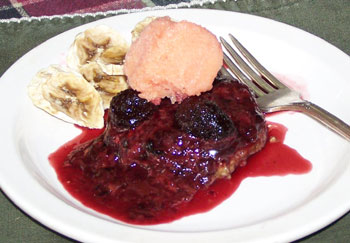
Jim here... Thought I'd post a pic from Wendi's birthday last Friday. Shown above is the "birthday cake" -- more of a birthday treat, really. If it looks decent to you, here's the recipe:
The "cake" part:
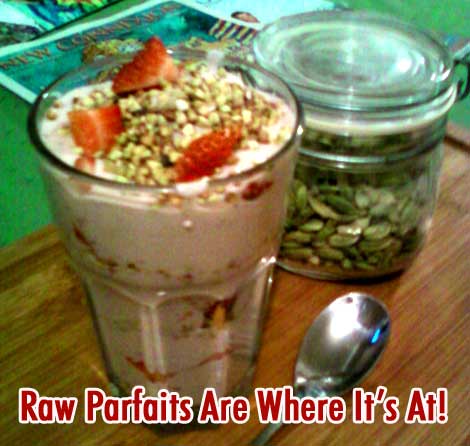
Above is a quick camera-phone pic I posted to our Facebook group lately. I did talk about making raw parfaits on that page, but want to talk a little more about them today, as it's just the perfect time to be talking about delicious raw parfaits (at least here in America, in any case, where many of the fresh berries you'll probably want are cheap and in season). I'll share a brief story about them, and then share my own basic recipe, and then we'll make some plans for MORE parfait talk really soon, okay?
I'm almost hesitant to talk about raw food parfaits here because, well, if the government found out how unbelievably healthy and ENJOYABLE parfaits are, I'm sure they'd make them illegal. But, I'll take a chance...

Hey everyone!? I hope you're doing well. We started out the week with a great video from Joe, Tracey, and Heather. I thought I'd stay with the video blog format for a while, as I've been capturing some outstanding stuff here in Chicago. (We're here until Thursday.)? Well, a few of the vids are "okay," but the bulk of them are absolutely amazing, so be sure to check in every day for these great Chicago vids. (BTW, I'll dub this series, "The Chicago Raw Food Scene," although partially misleadingly so, as the videos are not always *about* Chicago, per se. Rather, we shot all of the videos *in* Chicago. So, pardon the slightly misleading banner graphic.)
Read more: Veritable "Wal Mart of Produce" Discovered in Chicago, Pineapples for $1.49!
Jim here... I'd like to mainly talk about organics today, but thought I'd wrap that subject into a longer, rather quirky piece on ranking produce on some sort of a scale that would indicate how awesome (or awful) it is. See what you think...
Have you ever thought of arranging produce into a sort of "heirarchy of quality"? Well, I'm not going to attempt to do that here, but I would like to discuss the concept for a moment in order to at least explain what I'm getting at. While I've not yet attempted to do this exercise, I nonetheless occasionally envision a large chart or something that conveys my feelings about how I personally rank the quality of fruits and vegetables I put into my body. This all probably sounds vague, so let me share some examples.
Read more: Pure Jeevan's "Produce Buying Tips" Series, #2: Buying Organics