Know Any Literary Animal Lovers?

Hi there PureJeevan readers! We wanted to let you know that Jim's new novel CHROO is available on Amazon. It's a crazy adventure involving a billionaire heiress, her Chihuahua BFF ("Chroo") and a host of human and animal characters. Find out more on Amazon! Here are some links:
Jim here... Exactly one month ago today, I announced my intention to do a month-long trial of a low-fat raw vegan protocol largely based on the well-known 80-10-10 diet. I posted a half-way point update on May 15th, and now here we are at June 1st already. So, are you ready for the thrilling conclusion
As I've stated before, I went into this experiment rather hard-core, with one full week of zero overt fats, and then gradually introducing a few richer ingredients (although keeping within the 10% fat ceiling). I found much of the past month to be an exercise in restraint and self-control, similar to the issue many people face when going raw while the rest of the family is still eating cooked foods.However, it got significantly easier as time passed.
Read more: Jim's Low-Fat Raw Vegan Month Concludes. Now What?!
And here's the conclusion of Wendi's San Francisco travelogue:
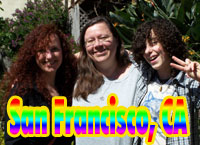 That evening we met up with Carolyn, a long-time friend since college, who was our lovely host for a few days. Carolyn has a gift with cats, which was a real treat for KDcat to see. Do you know how you can teach dogs to sit and give kisses? Well, Carolyn has taught one of her rescued cats to do the same thing! He *really* sits and *really* gives kisses on command! WOW!
Carolyn showed us all around the San Franciso and Berkeley areas, bringing KDcat to a thrift shop (she's been having fun popping into random thrift shops to see what she can find) and a fun shop called Ancient Ways, stopping by some Indian shops so I could pick up some more bindis and some ground coriander for a dish I made while visiting, checking out the Berkeley campus area, and taking us shopping for organic foods.
Read more: Part 4 of 4: Glowing Gypsy Gals Glimpse the Glorious Golden Gate's Gastronomical Goodness

 Day 8:
Let's focus on creativity for a bit. This is an area where many men have been comfortable expressing a feminine quality, especially when done through art and music. I say many, because we all know at least a few men who were raised to believe that a strong, powerful man doesn't spend his time with such frivolous things. Instead, he works hard to earn an income to support his family. In the past, and still sometimes today, creative men were viewed as weaker and less masculine, not practical and in control. The feminine quality of creativity was, however, encouraged in women who were afforded more time for such "frivolity."

When you get into raw foods, one thing you're probably going to notice from time to time is that others are "concerned" about your health. This is hugely ironic -- not only because it's likely your own concern about your own health that brought you to raw in the first place, but because you most likely hold the conviction that the raw food diet (or some close variant of it) represents the most healthy dietary regimen available for humans.
Nevertheless, you'll receive a lot of concern. You'll receive it even when you have that "raw glow" and are looking and feeling better than you have in years! The main concerns:
I was sitting here today thinking about all of you, our lovely online friends who visit this blog. You follow what's going on with us, learn from us, find inspiration in the things we share, and even offer support to us in many ways.
Some of you reach out by leaving comments, many of you send emails, and a larger majority of you are quiet friends who haven't made contact with us, yet. Each and every one of you means so very much to me (and to Jim, too).
We don't keep this blog for ourselves; we keep it for all of you. It is our desire to share all that we've been through, and what we've learned, in order to help you with your own journey. Most of all, however, my personal desire is to inspire you to live the life you truly want to be living (in more ways than just through what you eat).
Even though it's not time to share everything with you about the life-changing events going on with us here at Pure Jeevan, I'm going to try harder to squeeze in a few minutes once in a while to update this blog with other information. I miss coming here and connecting with all of you. Thank you for so many lovely emails that you've been sending to me. I will be responding to all of you very soon. Please forgive me for taking so long to respond, but once we fill you in on everything that's been going on, I think you'll understand that it's difficult to find time to keep up with email and blog writing, among other things.
The latest news, as far as raw foods go, is that I'm having a love affair with a particular fruit. When I was transitioning to raw foods over two years ago, and also during the first few months of eating 100% raw foods, I was in love with young Thai coconuts. I couldn't get enough of them and they did some amazing things for my body---the most amazing was lowering my cholesterol to a healthy range within one month! After many months of consuming at least one coconut per day, however, my love affair ended. I still loved those Thai coconuts, but they just weren't as attractive to me anymore.
For some odd reason, I've had the privilege of "doing Thanksgiving" with a lot of different friends and families over the years. Because of this, and of course just from talking with others and reading things others have posted, I'm fairly certain that Thanksgiving means different things to different people.For some, it's their favorite annual holiday and fills them with joyous memories of Thanksgivings past and incredible anticipation of Thanksgivings to come. Some historian friends of mine seem fascinated by the historical aspects of the holiday -- the whole story of the pilgrims, etc. On the other end of the spectrum, I've actually encountered a few people who take offense at the very idea of this holiday (and they've got some convincing reasons to protest the wider celebrations)!
 While all holidays are certainly "food-centric" by tradition, it's arguable that no other holiday (at least here in America) can match Thanksgiving's reputation in terms of feasting. It's kind of funny when you think about it because many holidays (or, "holy days") are actually traditionally observed by abstaining from food. So, there are fasts, and feasts. I think the majority view, based on my own sampling of various friend and family traditions, seems to be: It's mostly about having a huge meal. Yes, there is certainly an undercurrent of being thankful out there. A few families I've been with have had traditional, almost ceremonial, activities that went along with the meal (e.g., going around the room, taking turns stating what you're grateful for).
To continue with our Summertime Raw series, we took a trip to Pittsburgh's Frick Park to enjoy the beautiful day. Before leaving, we packed another meal to show you how easy it can be to eat a raw food diet while away from home.Frick Park was wildly popular among dogs; we saw canines of all shapes and sizes -- all playful, yet calm in comparison to our lovely Julia, a rescued blue Doberman. Joogie enjoyed the outing very much because she was able to snack on cucumbers (a favorite treat), chase after a few joggers (we're teaching her that this isn't proper doggy behavior), knock the cooler out of Jim's hands when we were leaving (which broke a few of our best glass dishes), and lick the faces of a few new furry friends. We've been to many parks, but we have a feeling this is now Julia's favorite. ?
In yesterday's blog and video post, we showed you how easy it is to simply grab fresh fruits and veggies and head out the door for an outing. In that show, no refrigeration or preparation was necessary. However, we also know that many of you are new to raw foods, and perhaps eating simple chopped produce isn't so appealing for you compared to traditional foods you'd normally eat while in a park. So, today's goal is to demonstrate how simple it can be, making it easy for you to stick to a raw food lifestyle and not feel tempted by the cooked foods that may be around while you're out enjoying the summer with friends and family. So, today's video is about stepping it up to the next level.

??
As we have mentioned here and there, our home (affectionately called "The Luck House") is currently for sale. Once it sells, we will be hitting the road full-time, educating people all across the country about the benefits of the raw foods lifestyle. Until then, we're spending a good amount of time going through the motions of selling the place. It's a wonderful home!!!?

Today, we're going to show you haw to make some tasty brownies. Best of all, this recipe takes only a few minutes. Let's get to it!
First, throw a couple of big handfulls of raisins into your food processor.
In yesterday's installment, we talked a bit about Salem, Oregon. I inadvertently missed this video in Wendi's batch of uploads. So, here's Wendi interviewing Kerry Matson on her path to raw and some of her favorite raw foods!
Once again, we thank our trip snack sponsor, Natural Zing, for helping us to make this possible on our budget!