Know Any Literary Animal Lovers?

Hi there PureJeevan readers! We wanted to let you know that Jim's new novel CHROO is available on Amazon. It's a crazy adventure involving a billionaire heiress, her Chihuahua BFF ("Chroo") and a host of human and animal characters. Find out more on Amazon! Here are some links:

Next weekend I'll be at the Green Festival in Washington, DC. helping Natural Zing at their vendor booth (I'm completely in love with Natural Zing because of their honest business ethics and commitment to having the highest quality products available---and the president is a truly beautiful individual). My dear friend RawBin will be picking me up next Thursday for a RAWsome weekend and I'll fly back on Monday!
Here's a list of some Green Festival facts from their Web site:

On March 1st we started a Juice-a-Day Jamboree, to challenge ourselves (and our readers) to include more fresh juice into our diets. We knew we weren't ready for an all-out juice feast, but a juice a day seemed like something we could commit to in our daily lives. So, the Juice-a-Day Jamboree was born. We've been posting periodic updates on our original post about the Jamboree, but figured we'd post periodic juice updates in the main part of our blog, as well, to encourage others to add some more fresh juice to your diets, as well.
We've missed one day of juice since we started the Jamboree. Our original goal was to have our juice first thing in the morning, but we weren't always successful with that. So, we told ourselves that any time of the day is fine, but if we can start the day with a juice we'd prefer it that way. The changes we've been feeling are more pronounced when we begin the day with fresh juice, rather than when we have our juice later in the day.
Hi Everyone! It's been a while since we've run a "My Raw Story" feature. So, here's one from my good friend Chris Paris, who I met and hung out with at the Raw Spirit Festival this past summer. I think you'll like his take on raw, his before & after pics, and the personal topics he covers such as the role raw foods played in his spirituality. -Jim

?

Today, we'd like to take the time to introduce some raw athletes who continually inspire others. There is a huge misunderstanding about the need for protein in our bodies, especially within the world of competetive sports. Many believe that without large amounts of protein we can't be strong, we can't build muscle. Raw athletes are proving that a vegan diet not only supplies enough energy to sustain the human body during competition, it also allows them to many times outperform competitors who are half their age.
|
Who Would Win Read more: Take the Time Tuesday: Raw Athletes 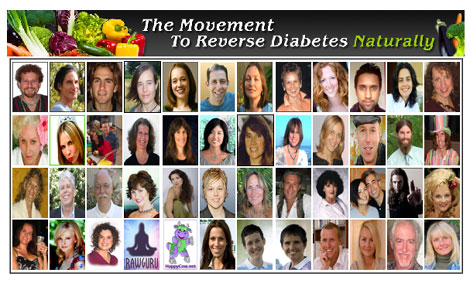
Wow, what an amazingly informative week here at Pure Jeevan. We've been featuring some great "My Raw Story" installments focusing on diabetes reversal via raw foods (and have more to come!). We've also been actively trying to encourage you to step forward and join the movement to reverse diabetes naturally. Why are we dedicating an entire week to diabetes?
Many individuals have no idea that diabetes can not only be reversed via a raw food diet, but a person's life can be filled with health and vitality again. This Saturday, April 25 (Wendi's birthday!), is Reversing Diabetes Naturally Awareness Day. Together, we can spread this important and life-changing news. A Bit of India in Pittsburgh s Back Yard? During an intense personal journey in recent years, I ve discovered that the more I m able to know my true self, the more my perception of the world changes. As a result, my surroundings have changed as well ?people, places, directions. At one point, internal and external changes happened so rapidly, it was difficult to fully process anything; I felt overwhelmed. Amid urges to explore so many new directions, all at the same time, it became impossible to focus. My initial instinct was to flee to India, where I could peacefully stay at an ashram and process all that was transpiring in my mind. Although circumstances kept me from traveling abroad, I knew I needed to simplify. That s when I remembered an old issue of Point of Light I d kept. I dug it out and quickly flipped through the pages? There it was: Peaceful Valley Ashram & Retreat, located just north of Pittsburgh!
We're going to be running the above banner for a few days as we bring you highlights of the raw food scene in the beautiful Florida Keys. Here's an older post, from August 2008, about modifying one's diet to experiment with attaining even greater health. ?I know the before/after pics, alone, are inspirational enough to live a raw vegan lifestyle! *blows kisses to everyone* ========================
We have two events scheduled for this weekend and we are looking forward to both of them! The first is a Raw Food Potluck Meetup. I haven't decided what I'm creating, yet. So far I'm thinking I'll make either an apple pie or some beet noodles with alfredo sauce, but I know how things usually go when it's time for me to prepare something special. I usually feel like I don't want to make what I had planned, and I search around in the fridge to see what pops out at me. I almost always go by what I'm inspired to create at that moment. So, who knows what I'll end up making. I'll try to take pictures of my creation as well as pictures of the other raw food dishes that others bring. This will be our first raw food potluck. When I first went raw it was something I was doing special for myself, by myself, so I didn't join any of the raw food meetups and didn't want to make it a group activity with my friends.After two years of raw (a little over one at 100%), I've done (and continue to do) what I needed for myself.Now, I'm ready to share my experiences with everyone and to be an active member of the raw food community.So, I'm looking forward to the raw food potluck tomorrow!? You are welcome to join us at the potluck if you are in the area!
Corvallis is the city we ve mentioned multiple times -- the city that feels like it s the right fit for us. Well, it lived up to our dreams in just about every way. It s a progressive, hip town with a lot going on. The people are friendly, the weather is beautiful, the land is gorgeous, and there are lots of unschoolers. Access to fresh, ogranic, raw foods doesn't seem to be an issue anywhere in Oregon, according to reports from the road so far. While they've been away, we've talked quite a bit each night about what they're finding -- and fresh organic produce seems pretty much everywhere out west. "The west," wrote Jim Morrison, "is the best." (Surely he was a raw foodie.) Jon Gold, owner of the Sunny Side Up Cafe (a vegan and vegetarian restaurant there) and an unschool father, put together a little gathering of unschoolers for KDcat and Wendi. They were able to meet some local unschoolers and ask questions. There was also a gathering one day at the cafe where KDcat was able to do some art at a table with some other unschool teens. It's definitely a creative, easy-going town with some fantastic people in it! 
It's not much longer before I'll be serving all kinds of delicious foods to those attending the 3-Day Raw Food Spiritual Ashram Retreat! I've been working on the recipes and taking pictures to include with the bound materials going home with everyone attending the retreat. |


 After leaving Salem, Oregon, Wendi and KDcat drove less than an hour to the city of Corvallis where they met up with their hosts the Zander's -- Joni, Steve, Bekka, and Stephanie -- a fellow unschooling family Wendi had come to know in an online forum.