Know Any Literary Animal Lovers?

Hi there PureJeevan readers! We wanted to let you know that Jim's new novel CHROO is available on Amazon. It's a crazy adventure involving a billionaire heiress, her Chihuahua BFF ("Chroo") and a host of human and animal characters. Find out more on Amazon! Here are some links:

Every day I receive countless emails filled with questions about the raw food diet, my own success with reducing nearly 100 pounds and regaining health, and pleas for help by many who feel like they've hit bottom and there's no way up. Some emails have me in tears, because I can completely relate to what many of you are going through. I feel your pain, frustration, desperation.
One thing I've always been good at is listening, truly listening to what others are saying (and being an empath allows me to know what some are saying, even when they many times aren't verbalizing it). Another thing I've always been good at is intuitively knowing how to help others who are asking for advice. Jim used to joke that he wanted me to go into business running an advice column because ever since he's known me, I've been the person everyone comes to for help and advice. So, when I receive so many emails asking for help, it feels natural for me to reach out and connect with those needing help. It's what I do best well, that and spreading love!
In this special five-part series, Joanna Steven uncovers where some top vegetarian athletes get their protein. Here's part one, focusing on Tim VanOrden's take on this issue.
When alternatives to the Standard American Diet are discussed, protein is on everyone's mind. There are many reasons why someone might want to eat a plant based diet, whether for allergy concerns, health reasons, or more variety. But nagging doubts often come up;? Are plant proteins adequate for athletes and body builders ? Are they really the preferred protein source of the human body ? Are they better than animal based protein or are they just consumed for environmental reasons ? To answer these questions, why not ask the experts:? triathletes, professional dancers, bodybuilders and extreme sport racers ? Here are the answers from some of the most competitive athletes in their respective fields.
Read more: Vegetarian Athletes Share: Top 5 Sources for Animal-free Protein (Part 1 of 5)
Sad Update: Our friend Michelle Pierson, interviewed here, passed away in July 2016 after a kayak accident in Hawaii.
We've spent the past three days focusing on the core subject of critical importance in the raw food lifestyle -- the FOOD! However, as most people will agree, it's also about so more than "just the food." Here at Pure Jeevan, we've always made a point to stress the holistic nature of our philosophy (mind, body, spirit, emotions), and we'll certainly continue to do that.
The Raw Spirit Festivals also do a magnificent job of illustrating this point. While they do offer *spectacular* raw foods and presentations centered around raw foods, you'll also find music, dancing, yoga, and other uplifting recreational activities all day long!


Wendi tells a funny story sometimes about a woman she'd met who was considering undergoing gastric bypass surgery to help her lose weight. When Wendi asked the woman whether she'd consider changing her diet to a raw foods regimen, she responded with something like, "Oh, no, that's too radical."
This is really what it's come to in society; having part of your digestive system surgically altered (in a profound, irreversible, dangerous, and invasive way) is no more than some nonchalant, consequence-free elective decision ... while eating more salads is viewed as "radical."

For the past twelve years I've been doing some monthly freelance work for a nonprofit company. I've done other work in addition to the work for this company, but for the past few years I've solely been working with them. The work is sweet---straight-forward desktop publishing for a legal advertising publication. I don't have to read, write, edit, research, or anything else---simply format the pages. The pay is great, too!
Well, I just received a call a few minutes ago notifying me that the publication will no longer be printed. I'm overjoyed for the trees---I wish all publications would go digital. However, since it's going digital, they won't be needing my services much longer.

I'm posting this at the end of a busy day, but let's see what I can call fun in just an ordinary day.
It was fun singing at the top of my lungs with KDcat in the car today--both of us over exaggerating the vocals and giggling a lot.
***** DISCLAIMER: As with all of our posts here at Pure Jeevan, and particularly those coming up over the next week and a half (which will all be tagged with a new term, "Nadi Balance,"), please refer to the disclaimer that runs at the bottom of all Pure Jeevan Pages. Wendi and Jim are health researchers, educators, and extreme self-experimenters. ******
With this post we launch what is perhaps the most important series of posts in the history of Pure Jeevan's blog, and indeed within the entire field of natural health. This series covers ground-breaking health science education that we've been immersed in, and which will form the basis for much of the direction in which Pure Jeevan will be heading in the coming years. You know we're all about helping others, about educating others about what we've learned, and about inspiring you to take your health into your own hands and blossom into your most vibrant selves. But, ?this time you're in for some never-before talked about, mind-blowing health science information. This has changed our lives, and continues to do so, and it will more than likely change yours (and others'), as well. [Jim says: The ultimate question is not "What is the matrix "; it is: "What is Nadi Balance "]
Nadi Balance: Part I

Pure Jeevan is hitting the road? this weekend, heading to Chicago for some super-double-secret raw business stuff, returning late Monday. (Can't discuss it yet, but it's raw food related and ultra-cool. We'll get to it in due time, I promise.)?
Actually, it's going to be quite an interesting trip, as we have some very serious, very intense work to do in Chicago over the entire weekend, but we're not sure yet whether it'll be Wendi doing the work or me! It all depends on how Wendi feels -- and with Lyme, you just never know. So, one of us will be busy, the other largely free to explore the windy city with KDcaT and Th' Jooge.
Read more: Pure Jeevan Hitting Chicago This Weekend. Suggestions Anyone?
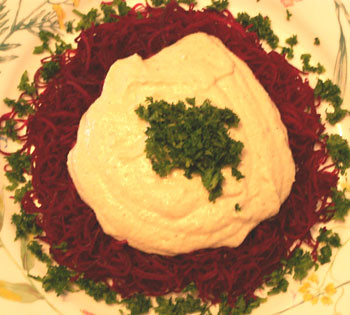
The mono meals ended and I did create that beet pasta with alfredo sauce that I was dreaming about. So, here's the recipe:
BEET PASTA
Want to have a little bit of fun today here on the blog? We'd love to hear your list of favorite foods for each color of the rainbow! I wonder how many of us will have similar fruits and vegetables on our lists, and how many of us will come up with vegetables and fruits that others have overlooked?