Know Any Literary Animal Lovers?

Hi there PureJeevan readers! We wanted to let you know that Jim's new novel CHROO is available on Amazon. It's a crazy adventure involving a billionaire heiress, her Chihuahua BFF ("Chroo") and a host of human and animal characters. Find out more on Amazon! Here are some links:

It's time for another "Makin' It Monday" installment!? This time, Pittsburgh raw foodies Joe Prostko and Tracey Anne Miller (along with videographer Heather) demonstrate their "Turbo Tornado Superfood Solution," which has (as you'll see) a *ton* of superfood ingredients. Take a look:
Read more: Makin' It Monday: Turbo Tornado Superfood Solution
April 12, 2008
Today we are doing some Spring cleaning and getting rid of stuff that has been collecting that we don t really need or use. I just finished the bananas (eight of them) and later I ll start eating the oranges that we have. I have plenty of oranges to get me through the day and into tomorrow until we go shopping. I m hopeful that there will be cantaloupes at the food co-op tomorrow. It would be fun to have a cantaloupe day!
How many days do I have left? I guess three? Overall, it hasn t really been all that difficult.


Q. Do you know of any nutritional protocol that would be beneficial for reducing or *gasp* even healing fibromyalgia using a high raw diet regimen
Do you feel that something like live blood testing, or mineral level testing would be beneficial? Wendy, after following your long ordeal with Lyme disease **Gentle Hugs to you** I believe you might be able to understand the pain, fatigue and depression that is involved while dealing with a chronic illness. ?I am looking forward to hearing more about your healing journey!
Sending love,? C.

As I write this, Wendi and KDcat have been en route to Portland for 39+ hours so far (including a long layover in Chicago)! Looks like they still have another 22 or so hours to go. What a monumental trip, eh ! Cross-country travel by rail really gives you a better appreciation for the distance, as compared with air travel or even highway travel. Imagine what it must have been like in the covered-wagon days!
 So far, reports from the train have been not so wonderful. KDcat seems to be having a good time roaming around socializing. But, Wendi's experiencing some major motion sickness. Oddly, we never anticipated this problem -- which is incredible, as we spent more than a month planning this trip! But, it just goes to show you that you cannot anticipate everything in life!

Last night I dreamed of meandering through an unfamiliar cityscape, following some lonely sidewalk next to a river at night, feeling particularly sad and miserable beneath dim yellow street lights. I wore a black suit, carried a highball glass, and was absolutely drunk!
Having crossed the river, I soon realized (even in my dream-drunken state) that I'd been wandering aimlessly. Feeling rather pathetic, I decided to walk back across the river and sober up in a casino that I knew was there. Drunk and depressed, I figured I'd just sit in front of a slot machine for a few hours.

It turns out that planning a 40-day/40-night cross-country trip is a LOT of work! (Who knew ??!) Wendi and I seem to be spending every waking moment planning this thing, which may explain why we've missed a day or two's posts here on Pure Jeevan. But, we're gearing up for something absolutely amazing -- and it all starts next week!? So, if there is a quiet day or two this week, just keep in mind that the rawsome content is going to be absolutely insane here starting late next week and continuing through March into early April!
Today, we wanted to extend a huge thanks to Jeff and Helen Rose, owners of Natural Zing, for offering to sponsor the snack portion of Wendi and KDcat's trip. Jeff and Helen understand that, being a raw foodie, it can be a little tough to be on the road for such a long time. Sure, Wendi and KDcat will probably be snacking on a lot of fresh fruit, but it's also nice to have some packaged raw goodies as well while you're traveling. So, Wendi and KDcat will be loading up on some of their favorites -- botija olives, Love Force breads, Gopal's power wraps, some nut butters, some raw chocolates, and more. So, in thanking Natural Zing, we'll be running banners and so forth along with our content during Pure Jeevan's trip.

To keep all of you inspired while we are away, we've asked some
remarkable individuals to share their raw food stories with you. Enjoy!
Pardon the video quality there. A.J. and I shot that video at night and, although it looked decent on the camera's preview screen, the actual video came out almost totally black!? However, with a bit of video processing, we were able to salvage it. It's not optimal video, but it's at least watchable (and, hey, also conveys a little of that nighttime festival feeling).
A quick note about veganism before I share some additional info... As we've stated here many times, Pure Jeevan advocates a raw vegan lifestyle. What do we intend that to mean, exactly? Well, strictly speaking, veganism excludes all animal products, both in terms of diet and lifestyle.
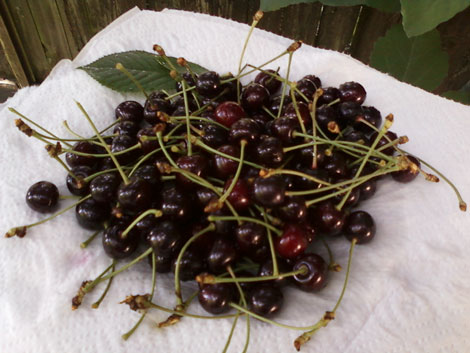
We're extremely busy this week with some home projects, so we figured we'd simply share a few interesting photos each day. Here's today's -- a big plate of freshly picked cherries from our yard! ?These are smaller cherries than you'll find in stores. We believe they're sour cherries, which is a very healthy variety, even though they're not as tasty as Bing's or Ranier's. ?They're reportedly good for pies, though. I've eaten tons of them so far; ?they're at their peak at the moment here.
I tell you... the dangerous thing about cherries is something you'll only discover when you're out there on a ladder, standing on that tip-top rung (which clearly states: "Do NOT stand on this rung!"), and you're reaching higher and higher for that next bunch of nature's goodness. Even in this situation, you find yourself thinking: "If I could just reach a *little bit* higher!" ?Sooner or later, you have to realize that some cherries are there for the birds, squirrels, and raccoons.
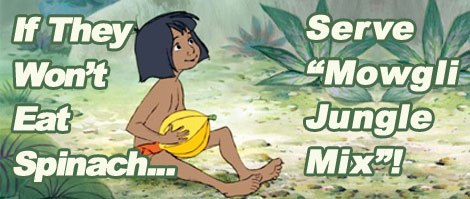
Since our child was exposed to a large variety of vegetables and fruits at a young age, she has always enjoyed consuming them in myriad ways. When children's exposure to fruits and veggies has been limited, however, they don't always like consuming things that are so different from what they've grown accustomed to eating (and this many times carries into adulthood).
It's vital that children be exposed to a variety of foods, as often as possible, while growing up. For the vast majority of children, however, that has not been the case. Packaged, processed, and fast foods are a standard part of our society; we don't think twice about serving such foods to our children. Everyone is doing it, it's affordable and convenient, and they like it!
***** DISCLAIMER: As with all of our posts here at Pure Jeevan, and particularly those tagged with a new term, "Nadi Balance," please refer to the disclaimer that runs at the bottom of all Pure Jeevan pages. Wendi and Jim are health researchers, educators, and extreme self-experimenters, not doctors. ******

There are four parts to blood: red blood cells, white blood cells, platelets, and plasma. Using a specialized microscope, one can easily view these parts of the blood. Red blood cells deliver oxygen to, and carbon dioxide from, the body. White blood cells, also known as leukocytes, help defend the body against disease and anything that they see as unnatural or foreign. Platelets help form clots to prevent bleeding. Plasma, comprised of about 90% water, is the fluid that transports all of the above.