Know Any Literary Animal Lovers?

Hi there PureJeevan readers! We wanted to let you know that Jim's new novel CHROO is available on Amazon. It's a crazy adventure involving a billionaire heiress, her Chihuahua BFF ("Chroo") and a host of human and animal characters. Find out more on Amazon! Here are some links:

I'm pretty sure I've said this before, but I'm thankful for so many things that it could take me a very long time to list them all. Today, however, I'm focusing on how thankful I am to have loving, supportive friends in my life.
When I was a child we moved a lot (every two years, on average). I continued to move a lot even after college, when it was no longer my mother making the decisions about moving.Why am I telling you this on a Thankful Thursday ?Because all of that moving around when I was a young child partly shaped the way I made friends.

Thinking of Writing a "My Raw Story" Piece for Pure Jeevan's Blog
Fantastic! We d love to consider running your raw story to help inspire others. Please know that the "My Raw Story" series isn't only about success with weight loss on the raw food diet. It's about an overall life change that happens when a raw food diet is followed. We want to hear how your life was dramatically changed by adopting a raw food lifestyle. Below are some guidelines to help you submit your story:

Two years ago, we were putting the final touches on launching the Pure Jeevan web site and blog. (While the blog archives show material dating back to 2006, the material from '06 and '07 is all pulled from Wendi's "Going Raw" journal, which was kept on another site. We pulled it into this site when we launched it to give those starting out on raw an inside look at one person's experiences in transitioning to a raw food diet.)


Rita Romano, author of the widely available book Dining in the Raw and executive chef for many years at the Hippocrates Health Institute, is a true pioneer of the raw movement. We were thrilled to have the opportunity to visit with her and her two lovely Boston Terriers, Angel and Oreo. Here's PART TWO of our talk with her:
My nine days of mono meal eating are over! I'll write about the final day tomorrow.
April 14, 2008
Today I have even more energy. My tongue is coated more, however. It s not horrible, but it s definitely less red and more of a light pink. My eyes have continued to feel dry and my eyelids are heavy. What causes that, I wonder? My nails are whiter and harder, but they still break and rip when I m working around the house.

Since Pure Jeevan specializes in raw food weight loss, we receive a lot of questions about what is required in order to lose excess weight. Many individuals want to know if they need to go on a 100% raw food diet in order to release excess weight.
The answer is, "No, you do not need to switch to a 100% raw food diet in order to lose weight." If you're asking if a 100% raw food diet works better for losing weight than slowly transitioning and increasing your raw food intake, the answer is still, "No."

After making a 'batch' of green smoothies, what is generally considered an appropriate serving size?
Thanks for the question, Gary!? I don't think I can give an across-the-board answer to fit everyone, since we're all so wonderfully different. The answer would have to take into consideration various factors, such as:

Jim here... Yesterday I promised to hypnotize you, so here it is (below). This is something I published elsewhere long ago, slightly modified. Interestingly, in the original version, I'd made reference to various cooked food items -- for example, describing the smell of fresh-baked muffins as comforting. Well, as pleasant as that smell may be to everyone, I just thought it would be odd to include it here on a blog devoted to raw foods.
I think, by the way, that next week I may post a piece on aroma and how it dovetails with raw foods. I'm sure there are interesting things to write about that topic. For now, I'll simply point you to the funny hypnotism picture, below. While it characterizes hypnotism as a sort of mystical power wielded over another's true will, that's definitely not the case. As you'll see, the text below is really just a very innocent, very calming, relaxing suggestion. Read it seriously and see if you aren't relaxed and happy afterward. Have a great weekend!
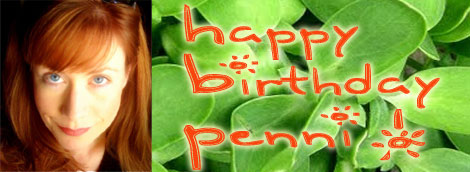
We don't always announce birthdays of friends and family here. But this particular individual is an integral part of the raw food community and we want you all to meet her!
Today is the birthday of the radiantly beautiful Penni Shelton! For those of you who don't know Penni, she's an incredible woman; she's got a heart of gold and is filled with love and compassion. She has been a loving friend of Wendi and member of the Pure Jeevan family for a very long time.
Read more: Penni Shelton: Raw Food Community Builder and Supporter!
Persimmons are a tad unusual, aren't they? Perhaps they're simply uncommon. After all, few major grocers carry them regularly (at least, not in our area). But, occasionally, they crop up as a specialty, limited-quantity offering. That's more or less how we obtained some recently. Wendi *loves* them, so we quickly snatched up a few at our local co-op last week. Here's the vid (below).
Thanks again to BH and Janet McKee for being our special guests for this episode.

The Environmental Working Group publishes something really useful called the Shoppers Guide to Pesticides. In it, they offer two handy lists: (1) The Dirty Dozen -- conventionally grown produce items that contain the most residual pesticides, and (2) The Clean 15 -- conventionally grown produce items that contain the least residual pesticides.
While we believe that organic is always best, there nonetheless are times when most of us (for whatever reason) consider purchasing or consuming conventionally grown (meaning "sprayed with pesticides") produce.
Read more: Mnemonic for the "Dirty Dozen" Foods that You Should Only Buy if Organic!