Know Any Literary Animal Lovers?

Hi there PureJeevan readers! We wanted to let you know that Jim's new novel CHROO is available on Amazon. It's a crazy adventure involving a billionaire heiress, her Chihuahua BFF ("Chroo") and a host of human and animal characters. Find out more on Amazon! Here are some links:

Last night I dreamed of meandering through an unfamiliar cityscape, following some lonely sidewalk next to a river at night, feeling particularly sad and miserable beneath dim yellow street lights. I wore a black suit, carried a highball glass, and was absolutely drunk!
Having crossed the river, I soon realized (even in my dream-drunken state) that I'd been wandering aimlessly. Feeling rather pathetic, I decided to walk back across the river and sober up in a casino that I knew was there. Drunk and depressed, I figured I'd just sit in front of a slot machine for a few hours.
[Sorry, we lost the pic in a web update... will repost if we find it!]
Last night, Jim ate the first warm food he's had in over a year! I created a dinner that was placed in the dehydrator for about an hour before it was served. This dish is delicious at room temperature, also, but I thought it might be more special if I served it a bit warm. Jim thought it was a nice change to the colder temperatures of the smoothies he's been practically living on!
Here's the recipe, if you think you'd like to try it.

Jim here... I thought it might be interesting to spend the rest of this week looking at some quotations we've come across that discuss obesity entirely outside of the context of diet. ?While these quotes focus on obesity, it's likely (in my opinion) that the authors' intentions pertain to almost any health challenge (obesity or otherwise).
Today, we're going to quote a well-known author, Marion Woodman. Tomorrow, we'll hear from Rhonda Byrne, Thursday Dr. Gabriel Cousens, and Friday I'll recap with something I posted on Facebook a while back from Tony Robbins.It should be an interesting week -- and, by the way, I'll tie all of this back into raw foods on Friday, and discuss then why the raw food diet makes a lot of sense for healing obesity and other health challenges even if, as these authors imply, one's diet may not be the sole or ultimate cause of one's health challenges.

Today, and every day, I am thankful for lovely Mother Earth. Where would we be without Mother? May we always care for her in a gentle and loving way.
====================
Some of you who are new to raw foods may be happy to learn that there are festivals for individuals interested in the raw foods lifestyle! They are a fantastic opportunity to meet like-minded friends. For those of you who attended the Raw Spirit Festival in 2008, seeing images from that event may stir the magical memories you collected while there.
Below is part one of a two-part guest piece by Rawbin Anderson, in which she recounts her 2008 Raw Spirit Festival J.O.B. experiences of working in the kitchen. Rawbin is now the Raw Spirit Festival East Coast Manager and can be reached at Rawbin [at] rawspirit.com.
?
Read more: A J.O.B. (Joy of Being) at the Raw Spirit Festival (Part 1 of 2)
Well, here's my latest update on my nine days of mono meal eating. I have a headache this evening and I'm headed to bed early. I'm hoping the headache is a detox symptom and that it will be gone when I wake up.
April 9, 2008
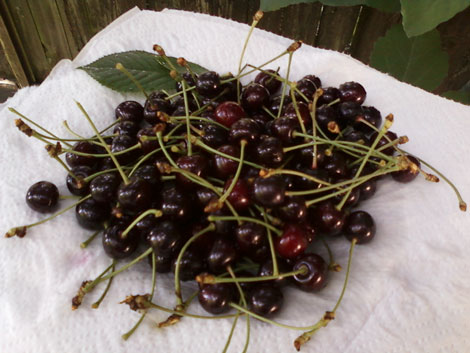
We're extremely busy this week with some home projects, so we figured we'd simply share a few interesting photos each day. Here's today's -- a big plate of freshly picked cherries from our yard! ?These are smaller cherries than you'll find in stores. We believe they're sour cherries, which is a very healthy variety, even though they're not as tasty as Bing's or Ranier's. ?They're reportedly good for pies, though. I've eaten tons of them so far; ?they're at their peak at the moment here.
I tell you... the dangerous thing about cherries is something you'll only discover when you're out there on a ladder, standing on that tip-top rung (which clearly states: "Do NOT stand on this rung!"), and you're reaching higher and higher for that next bunch of nature's goodness. Even in this situation, you find yourself thinking: "If I could just reach a *little bit* higher!" ?Sooner or later, you have to realize that some cherries are there for the birds, squirrels, and raccoons.

Do you know how sometimes you meet somebody new and they tell you their name and it just doesn't seem to fit for some reason? Well, that's just not the case for the person that we'd like to introduce to you today. This person's name describes the individual she is as well as the community that she creates.
Take the Time to Meet? Happy Oasis!
It's nice to meet new people, isn't it? For today's Take the Time Tuesday, I'd love for you to meet someone who's really helping to make a difference in the raw food world in an exciting way.
Take the time to meet...
***** DISCLAIMER: As with all of our posts here at Pure Jeevan, and particularly those coming up over the next week and a half (which will all be tagged with a new term, "Nadi Balance,"), please refer to the disclaimer that runs at the bottom of all Pure Jeevan Pages. Wendi and Jim are health researchers, educators, and extreme self-experimenters. ******
With this post we launch what is perhaps the most important series of posts in the history of Pure Jeevan's blog, and indeed within the entire field of natural health. This series covers ground-breaking health science education that we've been immersed in, and which will form the basis for much of the direction in which Pure Jeevan will be heading in the coming years. You know we're all about helping others, about educating others about what we've learned, and about inspiring you to take your health into your own hands and blossom into your most vibrant selves. But, ?this time you're in for some never-before talked about, mind-blowing health science information. This has changed our lives, and continues to do so, and it will more than likely change yours (and others'), as well. [Jim says: The ultimate question is not "What is the matrix "; it is: "What is Nadi Balance "]
Nadi Balance: Part I

As some of you already know, along with regaining my physical health I've also been working on every other aspect of my overall health and being. I don't just want a healthy body---I want the whole package (vibrancy and bliss inside and out, in every way possible).
One area of my mental health that has been slow to heal is my self confidence. I continue to work on it in many ways and have made some tremendous progress over the past year, or so. I feel worthy of so much more than I ever did before.Many people never doubt their self worth---they have a good sense of who they are and assume that others see them as they are, as well.
Read more: Thankful Thursday: We Like It Raw and Dhrumil Purohit