Know Any Literary Animal Lovers?

Hi there PureJeevan readers! We wanted to let you know that Jim's new novel CHROO is available on Amazon. It's a crazy adventure involving a billionaire heiress, her Chihuahua BFF ("Chroo") and a host of human and animal characters. Find out more on Amazon! Here are some links:

It turns out that planning a 40-day/40-night cross-country trip is a LOT of work! (Who knew ??!) Wendi and I seem to be spending every waking moment planning this thing, which may explain why we've missed a day or two's posts here on Pure Jeevan. But, we're gearing up for something absolutely amazing -- and it all starts next week!? So, if there is a quiet day or two this week, just keep in mind that the rawsome content is going to be absolutely insane here starting late next week and continuing through March into early April!
Today, we wanted to extend a huge thanks to Jeff and Helen Rose, owners of Natural Zing, for offering to sponsor the snack portion of Wendi and KDcat's trip. Jeff and Helen understand that, being a raw foodie, it can be a little tough to be on the road for such a long time. Sure, Wendi and KDcat will probably be snacking on a lot of fresh fruit, but it's also nice to have some packaged raw goodies as well while you're traveling. So, Wendi and KDcat will be loading up on some of their favorites -- botija olives, Love Force breads, Gopal's power wraps, some nut butters, some raw chocolates, and more. So, in thanking Natural Zing, we'll be running banners and so forth along with our content during Pure Jeevan's trip.

This weekend is Mother's Day, so today's Thankful Thursday is dedicated to the memory of my own mother, Elizabeth.

I received an email from one of our lovely Pure Jeevan family members. Joanne is subscribed to our mailings and she received the ice cream cake recipe I had created for Jim back in January. Well, take a look at what she did with the recipe! It's LOVEly!

Hi Wendi!I took Jim's birthday cake recipe to the next level.

Isn't it high time we incorporate more Internet phenomena into our daily lives? Okay, maybe not everything (reminding myself that certain others aren't always amused when I say "BRB" instead of "I'll be right back.") But, I really do think there are some conceptual web ideas out there that could benefit us if applied more often.

All this month, Jim has been experimenting with a low-fat, raw vegan diet. He discusses his reasons for trying a low fat diet, and how he s been feeling with the changes, in his first and second posts so far this month.
Many of you have heard us mention the famous low-fat, raw vegan 80/10/10 diet here on our blog. Well, today I d like to highlight the individual behind that diet. So?
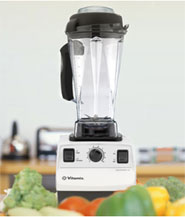 Hey there, everyone! Thanks for visiting Pure Jeevan. We want our welcome article, for now, to be this article on Vitamix blenders. There are certainly a few essential elements (e.g. good knives, cutting boards, a good food processor, etc.) to any raw food kitchen, and one of them is an awesome high-speed blender. Yes, there are many great blenders in the world, and yes there are a few decent top-of-the-line models on par with Vita-Mix. But, at the end of the day, our recommendation is the Vita-Mix (and yes, it's better than Blendtec, in our view). Here's a crazy video Jim did a while back for a Vitamix contest:
Note: That "free shipping" code, below, is no longer active. We'll let you know when we get a new free shipping code. For now, we hope you enjoy the video. :-)
We purchased ours 15+ years ago, and have subjected it to at least daily use (if not many times per day most of the time!) -- and it's still going strong. If you don't understand why a Vita-Mix is different from even a high-end blender from a department store, it's basically the sheer power. These things can pulverize pretty much anything -- time after time, without blowing out the motor. For example, you can make ultra-thick, healthy, raw ice creams day after day all summer long, and the machine will keep on working for years (and, in our case, we're almost ready to say "decades").
We used to be an affiliate w/ them, and are reapplying to be one. For now, we hope you like the video, above.
Well, here's my latest update on my nine days of mono meal eating. I have a headache this evening and I'm headed to bed early. I'm hoping the headache is a detox symptom and that it will be gone when I wake up.
April 9, 2008
Jim here... Here's a compilation of vids from my little Flip camera, all taken over our weekend roadtrip to Washington, D.C. It's not all strictly raw-food related, but does include some raw tips. First up, you'll see our rawsomely packed food coolers. Between using ice and frozen fruits, everything kept cool just fine.
Early in the video, Wendi shares a handy tip for keeping your smoothies cool on the road. If you're going to drink your smoothies right away, you might have little concern for keeping a drink cold. However, we had eaten breakfast already and knew we wouldn't want to get into our smoothies for another hour or so after leaving. Frozen berries to the rescue! (Just make sure to hunt down a large glass bottle with an opening large enough to pour frozen berries into.)

So far, so good, with the mono-meal fasting for Navratri! I mentioned that I'll be sharing an almost diary-like blog entry at the end of each day, to share things with all of you. Well, today's diary entry is quite long. I do share a lot about what was going on with me before the fast, and why I haven't been around much online to connect with all of you.
How's everyone else doing? Are you enjoying your raw food journey? What have you been learning about yourselves, your bodies, and your overall health?

While I was growing up in the Midwest, I had a rich uncle who lived out East in Philadelphia. I didn't know him very well at the time, but would often glean stories via the family grape vines of his business successes. After high school, I attended college in Northeastern Pennsylvania -- Wilkes University -- where, incidentally, I first met Wendi! :-)
Being out there, I got to visit my uncle from time to time, and dine with him and his family. ?Among other things, he was quite the gourmand. I'm not so sure what he'd have thought of raw foods, although I suspect he'd have appreciated the many gourmet efforts.

Sorry for the strange behavior of this site over the past few weeks, friends. As a former professional web programmer, and always a?bit of a mad hacker, I'm usually really great at keeping the web end of Pure Jeevan running very smoothly.
But, this is a Wordpress blog -- and so you have things like plugins and widgets and themes and updates, all interacting (and sometimes conflicting) with one another. I've noticed lately that this blog home page has developed all sorts of peculiar issues, not the least of which is a very slow-loading tendency.
Read more: Hopefully Pure Jeevan Loads a *Little* Faster Today!