Know Any Literary Animal Lovers?

Hi there PureJeevan readers! We wanted to let you know that Jim's new novel CHROO is available on Amazon. It's a crazy adventure involving a billionaire heiress, her Chihuahua BFF ("Chroo") and a host of human and animal characters. Find out more on Amazon! Here are some links:

Today we're running another installment of our "Thankful Thursday" series. This time, we're especially thankful ... for YOU, the Pure Jeevan family! Who'd have thought, less than two years ago when launching this blog, that we'd make thousands of connections with others looking for inspiration on their raw food journey !!? It's simply astounding -- and we're still actually "just getting started."
As always, we're thrilled to provide information and inspiration. It's counter-intuitive, when you really consider it; "raw foods" may be just two simple words, yet there always seems to be more and more to talk about, more people to interview, more success stories to highlight, more recipes to contribute, more tips and tricks to share, more personal reflections to offer.
Read more: Thankful Thursday: Pure Jeevan Asks for Your Help!
 Jim thought it was important for me to update everyone about my health, especially since so many of you have been sending emails, etc., and I haven't responded.
I do appreciate all the love and concern (thank you all so VERY much!), but it's painful for me to type for very long. This update is going to most likely bring about some more pain, but I don't want you to keep worrying about me and my health. So, I'll share what's been going on.
There's an antibiotic that will decrease the pain temporarily if you have Lyme disease (it won't help the pain if it's caused by anything else), and I was able to obtain some of it. So far, today is day five on it. And here's some great news: The pain started lessening on day three -- the aches completely gone, leaving only sharp pains when I move my joints in certain ways. I'll be on this antibiotic (and possibly some others for "co-infections" that sometimes come with Lyme, but I won't know until more blood tests are done and the Lyme specialist reviews the results).

Q. I am trying to go raw and juicing for only two days now and I am soooo hungry and I really don't quite understand what to eat. I went out and bought a bunch of raw vegetables but I am lost on exactly how to prepare the meals and I'm so tired of being fat. Can you direct me to a simple start of book or can you give me some simple recipes or what you did to get started on your first month? Thank you.
Signed,
Frustrated and Fat in Virginia
A. Dear LOVELY BEING,
 ?
?
Well, it's nearing the end of 2009, and I've been unwell for half of the year. (To make a positive statement out of that, I'll add that I've been well for the other half!) It's hard to believe so much time has gone by and about half a year of my life was spent in pain, tears, and sometimes fear (mostly in the beginning of the lyme disease). I'm definitely looking forward to the new year, to leaving this disease behind me while taking the lessons I've learned with me into 2010.
As many of you know, I was very proactive in finding a "cure" to the disease as soon as it was identified. I tried allopathic remedies (antibiotics for about three months), alternative remedies (herbal protocols, vitamin/mineral/supplemental protocols, aromatherapy techniques, healing massage, hands-on-healing, water fasting, prayer/meditation/positive visualization), and so much more. Nothing completely cured my body from the lyme bacteria that seems to have spread throughout my body and found favorite spots to multiply (particularly in my shoulders and arms).
Read more: Wendi's Health Update: Cooked Food Experiment and Great News!

Let's stay sharp by learning about brain power! Did you know that the less exercise your brain receives through reading, learning new things (like you do here on our blog!), playing games, and contemplating puzzles the more it is likely to become weak and not serve you well into your centenarian years? Scientists have been trying to figure out ways to improve the brain's function and have learned a lot, but are still uncertain what causes Alzheimer's Disease, or any other form of Dementia.
If you ve ever known someone who suffers with a loss of mental capabilities, you know how sad and sometimes scary that can be. Last week, Jim posted a blog that touched a bit on the subject of Alzheimer s Disease. He wrote in that article, ?I want better than just a small chance that I ll live healthfully for a full lifespan. I want to stack the aging deck in my favor. ?Eating a healthy, raw food diet is something Jim was hoping to use in order to stack the deck in his favor of a life free of memory loss and full of vibrant health.
Today we revive our occasional "Thankful Thursday" feature to give thanks for a special Internet destination: Twitter.com. We're sure a number of you who may be unfamiliar with Twitter may be asking, "What in the world does this have to do with raw foods "
In fact, there's quite a bit of raw foods "activity" on that site! But first, let's take a look at what Twitter is. Basically, it's a web site where you sign up with a username, and then you answer the question, "What are you doing " in 140 characters or less.

Jim here... Whenever I want to learn how to do something new, here's how I go about it:
>>> I practice. <<<
I had to write an update after my grocery shopping today! Remember I said just yesterday that sometimes people comment about the amount of produce we are buying? Well, a sweet older woman saw all of the bananas going into our cart and she asked, "What are you going to do with all of those bananas " You already know the response I gave: "Eat them!"

One of the really nice workers at the food co op commented that he can eat about eleven bananas sometimes. I told him, and another friend we saw shopping at the same time, that I can do that now, too. I explained how I used to get full on just one banana when I ate cooked foods. But, now that my system is so much cleaner and healthier, I can consume 10-11 bananas in a day (bananas should be covered with brown specks to truly be ripe and digestable). I don't remember the maximum I ever ate in a day--it's somewhere in my Going Raw journal, I'm sure. It might have even been more than 10 or 11 when I was going through my major banana-eating phase. Now I eat about 4-6 bananas a day, which doesn't seem like a lot to me (but in the past I would have wondered about all of those bananas in someone's cart, too!).
Read more: What are you going to do with all of those bananas?

We've spent some time on this blog talking about how much fun you can have via the meetup.com web site. If you search that site, you can probably find raw food meetups near you!? But, a few readers have asked us some follow-ups, such as What should I bring and What should I do if I'd like to host a raw foods meetup
*Attending* Raw Foods Meetups
Okay, so you signed up for a raw foods meetup group, waited patiently for the next event to come round, and now it's time!? But, wait... this is your first such outing. What should you bring
Read more: Raw Meetups: What to Bring, How to Host Them (Part 1)
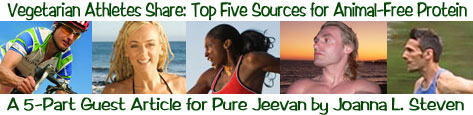
In this special five-part series, Joanna Steven uncovers where some top vegetarian athletes get their protein. Here's part five, focusing on Tonya Kay's take on this issue.
AVOCADO
Professional dance is of most challenging sports requiring athletes to perform at expert levels of flexibility, strength, coordination and emotional fitness in order to entertain their audiences. Having been vegetarian since age 7, Tonya Kay has built her glorious professional dance career entirely on a vegetarian diet.
Read more: Vegetarian Athletes Share: Top 5 Sources for Animal-free Protein (Part 5 of 5)

Today is Wendi's Birthday, so please join me in wishing her all the best for the coming year! Since this was our first year in Portland, just an hour-and-a-half's drive to the Pacific, I'd known for ages what we were going to do to celebrate Wendi's birthday -- a picnic at the beach, of course!
A few days ago, the weather reports for the central Oregon coast cities unanimously agreed: Rain! ?But, after living here for a few months, one learns that a forecast of rain *never* means that it's going to rain all day long. Rather, it just means that it'll likely rain at some point, or at many points, in a given day. The rest of the time, it could very well be perfectly sunny outside!
Read more: What Are Negative Ions, And Are They Beneficial to Human Health?