Know Any Literary Animal Lovers?

Hi there PureJeevan readers! We wanted to let you know that Jim's new novel CHROO is available on Amazon. It's a crazy adventure involving a billionaire heiress, her Chihuahua BFF ("Chroo") and a host of human and animal characters. Find out more on Amazon! Here are some links:
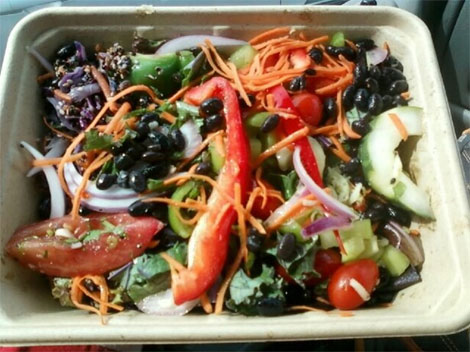
Jim here... As I hinted at last week, I decided to try changing things up a bit and seeing what I thought of it. The salad you see above included the first cooked food I've had in more than two years. If you look closely, you can see that I sprinkled on a few spoonfuls of black beans. Also, in the upper left corner, there's a small spoonful of quinoa. I don't want to give the wrong impression here: ?This blog will certainly remain a major go-to source for raw food nutrition information. It's just that, today, I want to talk about experimentation a little bit.
First, I think it's generally healthy to experiment with your diet -- especially when you get the sense that something isn't working in your current diet. The fact is, diet is a dynamic thing, not a static aspect of your life. It has to be this way because so many factors affect our physiology on a day-to-day basis. Off the top of my head, these include the facts that:
Read more: Experimentation: The 95% Raw Salad... A Good Idea or Not?
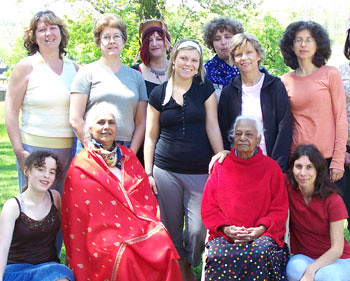
A partial group picture from the retreat.
The 3-Day Raw Food Spiritual Ashram Retreat was a success! All my time and effort that went into creating the event was well worth the experience. When Leela Mata and I discussed a possible raw food retreat about a year ago, I had no idea how to go about creating such an event. I have never done anything like this, so I approached it by asking myself: "What would I want if I was attending a raw food spiritual retreat " From there, I created a retreat that I would love to attend, myself. In fact, when it was completely organized and guests began signing up, I wished that an identical event existed that I really could take part in, as well!
We've got three incredible posts coming your way this week, and we're going to get started right here and NOW with a one-hour interview with the incredible Kevin Gianni. As most of you know, we postponed our RV Tour recently.As part of that, we'd planned to stage a fun event related to the All Raw Directory.We'd planned to air this interview with Kevin (conducted back in December 2008) for that event.
Fast-forward to today and we realize that, like our raw RV Tour, our All Raw Directory promotion will have to wait. It's funny how things trickle down like that. But, all is not lost. This is still an incredible interview -- and guess what ! It's only part one of a two-part interview, as well as a special super-fun surprise we'll be announcing on Friday. We promise: No one in the raw food community will want to miss Friday's post. All we'll say now is that it's a truly unique, limited opportunity unlike anything you've seen here before! Trust us: You couldn't possibly guess what it is!
Read more: Part 1 of a 3-Part Series Profiling the Multi-Talented Kevin Gianni!

This is the first installment of a new series that we plan to run occasionally here on the Pure Jeevan blog. The series is called "Raw Foods 101" (the same name as our free eBook that has now been read by more than 5,000 people around the world!). Raw Foods 101 will become the latest addition to our category list (available along the right side of our sidebar). In time, clicking on Raw Foods 101 will deliver a plethora of raw food tidbits.
So, where should we start? ... How about the topic of soaking nuts and seeds ! This is a question that comes up repeatedly in emails sent to Pure Jeevan.
Read more: Raw Foods 101: Why Should You Soak Nuts Before Eating Them?

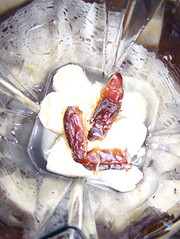
The new Vitamix container arrived within two days (they knew we were hard core Vitamix users and put the container in the mail the day we ordered it to replace the broken one). So, what was the first thing we made in our shiny new container (after washing it, of course)? A DELICIOUS coconut smoothie!



Have you ever heard about mono meals? When I first did, it sounded like such a great idea. When you eat a mono meal, you eat one item (and only one item) for the entire meal. Eating that way is supposed to be very cleansing and it gives your digestive system a rest from processing different types of foods at the same time. Supposedly there is a boost in energy, as well, since your digestion isn't taking up so much energy.
I recently received an email asking for advice from one of our Hindu readers, asking what I could recommend as far as light eating during the nine-day Indian festival of Navratri. Navratri is traditionally a time of fasting for nine days, however in modern society most Hindus no longer fast. Many do, however, pay more attention to their diets, and they try to eat lighter meals that do not contain animal products. Since our reader is just starting his exploration into raw foods, I didn't want to offer him advice that would make his nine days of Navratri difficult.He recently purchased a Vitamix, so I suggested that he make a lot of smoothies, since he has been enjoying them so much.

Mistakes are bad, right Well, not always. Here's an example of a great one, and it's something that demonstrates a conviction I have about raw foods! You see, in all of this talk of moving to Portland, I made a huge gaffe recently in my thinking about finances.
You see, I was pondering the terms of a home loan one afternoon -- percentage rates, down payments, monthly payments, tax escrows, etc. It was all really dry, boring material. Suddenly, I thought to myself, "Wow, here we are about to buy another house, after owning this one for so many years. In less than 10 years, we would have owned this one outright, but now we'll be starting over again with a 30-year mortgage."
?
Jim here... A few months ago, I'd posted an article here on the topic of Cognitive Dissonance. This theme seems to crop up from time to time in questions people ask about the raw foods lifestyle. For example, one new raw fooder recently posted a question in a raw foods forum asking whether other raw foodies had reached a place in their lives at which things changed so much that they felt as though they were living a contradiction. Because this struck home for me, I'd like to reiterate my response, somewhat edited, below.


I'm excited about something that one of my friends has been working on. Melissa is gifted in so many areas, one of which is wild edible identification. She recently told me she was working on something that would help a lot of people and I was excited about her new project. Well, now it's ready to be shared with everyone!
Take the time to meet...
Today, we thought we'd share another non-diet-oriented explanation of obesity. It's from Rhonda Byrne, author of the international multi-media phenomenon known as "The Secret," which provides readers with in-depth philosophical explanation and instruction with respect to the Law of Attraction.
Wendi and I have The Secret on CD, and often enjoy listening to it. I think, in fairness, we both have a few legitimate criticisms about certain aspects of it (and I'll share one or two, below). However, on the whole, many of the ideas within resonate deeply for us and we find much of the underlying message profoundly uplifting and empowering -- especially (for me) much of the discussion regarding maintaining a healthy, positive, optimistic attitude and practicing gratitude.

Pure Jeevan is hitting the road? this weekend, heading to Chicago for some super-double-secret raw business stuff, returning late Monday. (Can't discuss it yet, but it's raw food related and ultra-cool. We'll get to it in due time, I promise.)?
Actually, it's going to be quite an interesting trip, as we have some very serious, very intense work to do in Chicago over the entire weekend, but we're not sure yet whether it'll be Wendi doing the work or me! It all depends on how Wendi feels -- and with Lyme, you just never know. So, one of us will be busy, the other largely free to explore the windy city with KDcaT and Th' Jooge.
Read more: Pure Jeevan Hitting Chicago This Weekend. Suggestions Anyone?