Know Any Literary Animal Lovers?

Hi there PureJeevan readers! We wanted to let you know that Jim's new novel CHROO is available on Amazon. It's a crazy adventure involving a billionaire heiress, her Chihuahua BFF ("Chroo") and a host of human and animal characters. Find out more on Amazon! Here are some links:
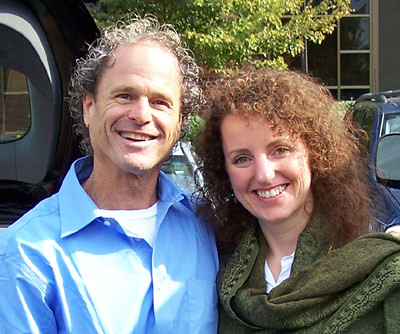
I met Dr. Doug Graham in person at the Raw Spirit Festival. He has a soft, gentle voice but his message is anything but soft. He's straight-forward about diet and health being intimately related. Dr. D. invited me to be his guest this past Saturday at a doctors' convention where he boldly stated to his audience of doctors: "I'm probably not going to make you all that happy with the things I'm going to tell you."
There he was, standing in front of a room of doctors who have taken an oath to harm none. These doctors were there to learn about health and nutrition, but I don't think they had any idea about what they were going to learn from Dr. D. "What I say may fly in the face of what you've been taught," Dr. D. admitted. Many of the doctors leaned forward a bit, eyes and ears a bit more open at the thought of hearing something radical.
It's been a while since we offered an update on Wendi's health challenge. So, I asked if she felt up to writing a blog post to let everyone know what she's going through, highlighting a few new directions taken of late. As usual, I added some color splashes and graphics here and there, just for aesthetics. But, the following post is from Wendi. -Jim

Many thanks and lots of love go out to all of you for the love and support you ve been sending my way. I can t spend much time at the computer, but Jim has been trying to keep up with my email and he s been passing along your love, concern, advice, and healing energy. Thanks so much for everything, including the things that have arrived through the postal service. I definitely feel the love from all of you and I want you to know that each and every one of you means so much to me! * blows kisses *
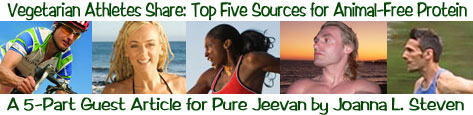
In this special five-part series, Joanna Steven uncovers where some top vegetarian athletes get their protein. Here's part four, focusing on Brendan Brazier's take on this issue.
GREEN LEAFIES
Brendan Brazier is one of only a few professional athletes in the world whose diet is 100% plant-based. He s a professional Ironman triathlete, bestselling author on performance nutrition, and the creator of an award-winning line of whole food nutritional products called Vega. He is also a two-time Canadian 50km Ultra Marathon Champion.
Read more: Vegetarian Athletes Share: Top 5 Sources for Animal-free Protein (Part 4 of 5)
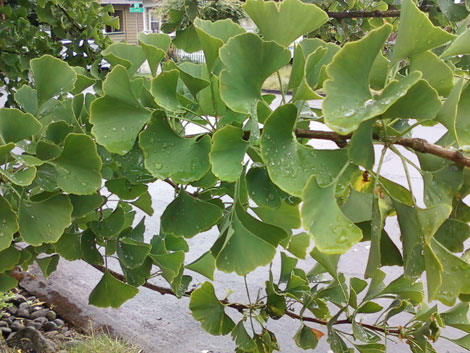
Ahh, yes... Ginkgo Biloba. What a distinctive tree, don't you think? So easy to identify, and so many reported health benefits. This one belongs to a neighbor that seems to have an affinity with Asian landscaping motifs. They also have gorgeous bamboo growing in their yard, and other Asian elements. I would have liked to have harvested some leaves to dry for some Ginkgo tea, but the owner wasn't around to ask. Perhaps some other time.

I want to admit something to all of you: Sometimes I still cry because of how people treated me when I was obese. Because I stuffed all of my "negative" emotions deep inside my entire life, it's going to take some time to fully release them. I'm working on it, however, and making tremendous progress with healing myself on all levels. I'm not telling you these things so you'll feel sorry for me, however. I'm telling you because I am thankful for all the pain I endured. It shaped me (in more ways than just my physical appearance) into the person I am today.
Even though it sounds strange, and somehow wrong to feel this way, I'm thankful that I was obese. I'm thankful for all of the experiences during my life, even the extremely painful, traumatic ones. Maybe if I was a different kind of person I would wish that those things didn't happen to me. However, I am using those experiences in positive ways. They've helped me understand people even better, and to understand myself on a deeper level, as well. When people reach out to me it's not only because I'm an approachable person, it's because they sense that I understand them--and they're right. I DO understand them. I understand you. My experiences, coupled with my gift of empathy, help me relate to you in a way that maybe not everyone else is able to do.

To help keep all of you inspired, we ve asked some
remarkable individuals to share their raw food stories with you. Enjoy!
To help keep all of you inspired, we ve asked some
remarkable individuals to share their raw food stories with you. Enjoy!
And here's the conclusion of Wendi's San Francisco travelogue:
 That evening we met up with Carolyn, a long-time friend since college, who was our lovely host for a few days. Carolyn has a gift with cats, which was a real treat for KDcat to see. Do you know how you can teach dogs to sit and give kisses? Well, Carolyn has taught one of her rescued cats to do the same thing! He *really* sits and *really* gives kisses on command! WOW!
Carolyn showed us all around the San Franciso and Berkeley areas, bringing KDcat to a thrift shop (she's been having fun popping into random thrift shops to see what she can find) and a fun shop called Ancient Ways, stopping by some Indian shops so I could pick up some more bindis and some ground coriander for a dish I made while visiting, checking out the Berkeley campus area, and taking us shopping for organic foods.
Read more: Part 4 of 4: Glowing Gypsy Gals Glimpse the Glorious Golden Gate's Gastronomical Goodness
Pardon the video quality there. A.J. and I shot that video at night and, although it looked decent on the camera's preview screen, the actual video came out almost totally black!? However, with a bit of video processing, we were able to salvage it. It's not optimal video, but it's at least watchable (and, hey, also conveys a little of that nighttime festival feeling).
A quick note about veganism before I share some additional info... As we've stated here many times, Pure Jeevan advocates a raw vegan lifestyle. What do we intend that to mean, exactly? Well, strictly speaking, veganism excludes all animal products, both in terms of diet and lifestyle.
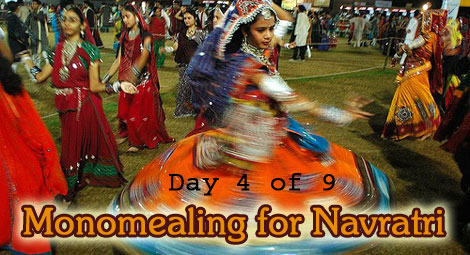
Today is the beginning of the second three-day focus on the attributes of a different Goddess who is most worshiped during the Hindu celebration of Navratri. She is Goddess Lakshmi, bringer of wealth and good luck. Let's focus on the idea of wealth. When we first hear the word, many of us think about monetary wealth. However, there is a much deeper meaning ... that of abundance. Feminine energy has the ability to bring forth, to birth, abundance that is beyond the imagination, in every aspect of our lives. Female energy is fertile, able to create a beautiful life and future, shine forth and bring wisdom into view, all with grace and beauty. All of these are attributes of Goddess Lakshmi, qualities we all have within us. Qualities I celebrate within myself and within all of you (male and female, alike).
 End of Day 3:

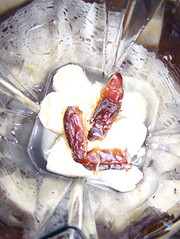
The new Vitamix container arrived within two days (they knew we were hard core Vitamix users and put the container in the mail the day we ordered it to replace the broken one). So, what was the first thing we made in our shiny new container (after washing it, of course)? A DELICIOUS coconut smoothie!