Know Any Literary Animal Lovers?

Hi there PureJeevan readers! We wanted to let you know that Jim's new novel CHROO is available on Amazon. It's a crazy adventure involving a billionaire heiress, her Chihuahua BFF ("Chroo") and a host of human and animal characters. Find out more on Amazon! Here are some links:

Wow, are you in for a treat! I came up with the most delicious soup recipe today! I wanted to make something that didn't require use of the food processor, blender, or dehydrator because I've gotten quite a few emails saying that it's too hard to be raw if you don't have the money for the appliances.
I disagree that it's too hard to be raw without the appliances. It's definitely easier to do it *with* the appliances, but it's not overly hard to do it without. So, from time-to-time I'll try to create recipes that don't use anything more than a knife and a chopping board to show you that it's not too difficult to eat raw. :-)
Mnemonics for the "Clean 15" -- Or, "Conventional" Produce That Tests Lowest for Residual Pesticides
Following up on yesterday's post, today we're going to take a look at the "Clean 15." These are the 15 produce items that, according to research done by the Environmental Working Group, contain the least amount of residual pesticides (even though they're still grown using pesticides).
What this boils down to is: IF you're going to eat conventionally grown produce, these items will harm you much less than those we covered yesterday. So, here's the list, and then we'll try to come up with a sentence to help you (and us) remember everything:

As promised, here's another question I'd like to openly address here instead of via Wendi's email system. This one also comes up from time to time, and I told this person to watch out for my two cents on this issue. So, here it is. The reader asks:
... During your transtioning to a raw food diet & the loss of so much weight, what if any exercising were you doing along the way
We have something special for today s Makin? It Monday! Remember Terilynn, the brilliant chef behind The Daily Raw Caf , whom we introduced you to not long ago? Well, this weekend she posted a recipe challenge open to anyone willing to participate. We here at Pure Jeevan are always up for an adventure, so thanks for the challenge, Terilynn!
The rules were simple: Use the list of possible ingredients, create a raw vegan food dish, and send pictures and information about your dish to The Daily Raw Caf . Here s the list for the challenge, with the items we didn t have available crossed out:
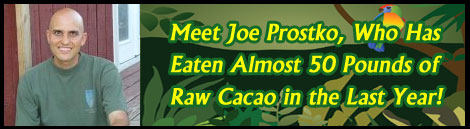
Hi everyone! Jim here with a really special treat for you today. I'm interviewing our friend Joe Prostko, who we've known for a good year or so through the Pittsburgh raw food meetup group. You may remember Joe from our cacao pod video a while back.
 We just had a big raw food potluck costume party here, and Joe showed up as an Oompa-Loompa. At first, I admittedly did not get the deeper part of this joke. I simply thought it was a novel costume because it was a character from the Willie Wonka book / movie. Later, however, it really sunk in, as I decided to flip through the Willie Wonka book to read up on Oompa-Loompas. Here's a quote from Willie Wonka author Roald Dahl:
Read more: Meet Joe Prostko, Who Has Eaten Almost 50 Pounds of Raw Cacao in the Last Year!

 Day 8:
Let's focus on creativity for a bit. This is an area where many men have been comfortable expressing a feminine quality, especially when done through art and music. I say many, because we all know at least a few men who were raised to believe that a strong, powerful man doesn't spend his time with such frivolous things. Instead, he works hard to earn an income to support his family. In the past, and still sometimes today, creative men were viewed as weaker and less masculine, not practical and in control. The feminine quality of creativity was, however, encouraged in women who were afforded more time for such "frivolity."

Here's a rare question a Pure Jeevan family member recently asked:
I eliminated 100lbs on raw food, but I've been "stuck" for the last year. I feel absolutely amazing when I can stick to raw food, but it's sooo hard when time is limited!
First, congratulations on your success with the raw food lifestyle! You must be feeling like a new person, even though you feel a bit stuck right now.
This is a recipe for the coconut shake that brought my cholesterol levels from very unhealthy down to extremely healthy within the span of one month!
Young Coconut Shake
Flesh and water from one young coconut
I've been back from the Raw Spirit Festival for about five days, now. The first few days I couldn't stop crying. I have a lot to share with all of you, maybe more than you'll want me to share. While away some pretty amazing healing took place. I found myself lifted out of the past and delivered to the future, in a way. I am here, whole, and aligned with who I am on all levels.
Pure Jeevan means Pure Life (or Total Life). Raw food is only part of my life, part of who I am, part of my journey. So, I'll be openly sharing who I am here in this blog; raw food isn't going to be the main focus---it's just part of my story and part of what I want to share.
Until I can sit down to begin sharing everything that transpired while I was away and over this past five days, I'll share some pictures with all of you!
You're in for a treat with this recipe. Our Guest Raw Chef this week is Shivie Kaur, half of "The Cook and Butler" duo of TeamRaw. Wendi shot this video a few weeks back in San Francisco during Pure Jeevan's recent cross-country tour! While there, Shivie and her partner Cemaaj created and served a delicious gourmet meal for Wendi and KDcat. The blog post from that visit was here. So, here's Shivie sharing with you how to make an easy and delicious raw salad dressing!
Read more: Makin' It Monday Guest Raw Chef Edition: Shivie Kaur Makes Salad Dressing
I received some very sad news about the holistic doctor I've been seeing during my raw journey. Dr. Amy Ruth Stine died Saturday after a rock climbing accident. This news breaks my heart. Dr. Stine was an amazing woman and doctor. She was extremely intelligent, acutely in tune with how we are all connected and one, compassionate, loving, thoughtful, and had a gift of really getting to know each patient as an individual and friend.
It was with Dr. Stine's care that I was able to track my progress with the raw food diet. She encouraged me to follow my instincts (which were telling me that raw is the way), cheered me on with the many changes that I was going through (physically, mentally, spiritually, and emotionally) over the years, and told me many times that I inspired her! Imagine how wonderful that made me feel---to be inspiring someone as wonderful as Dr. Stine.