Know Any Literary Animal Lovers?

Hi there PureJeevan readers! We wanted to let you know that Jim's new novel CHROO is available on Amazon. It's a crazy adventure involving a billionaire heiress, her Chihuahua BFF ("Chroo") and a host of human and animal characters. Find out more on Amazon! Here are some links:
Jim here... Wow, it's Monday, April 27! Let's do something different today: Let's celebrate Monday instead of bemoaning this day that represents the taditional start of the dreaded work week. Why? Because it's our sincere hope that whatever you do in your work week is a labor of love. And, if you're not quite there yet, then celebrate the fact that you WILL be there sometime soon. For us, it means another week of working to inspire you to achieve optimal health -- and that's not "work" at all; it's actually FUN!
So, without further adieu, let's jump into this week's fun. Our good friends Melissa and Dave Sokulski have launched a site recently called FoodUnderFoot ("unleash the energy of wild edibles"). Even in it's young seedling state, I think it's already a fascinating site, and promises to become an encyclopedic web destination for anyone interested in foraging wild edibles. So, check them out for some informative info and valuable freebies, too!
As raw foods enthusiasts for many years, Wendi and I have had the pleasure of patronizing raw food restaurants literally from coast to coast. Between us, we've been blessed to have sampled a more diverse spread of raw gourmet foods than have most people. (We hope that many others get to do this as well!)
From time to time in anyone's raw journey, it seems inevitable that thoughts crop up about opening a raw restaurant. For some, it's likely no more than a passing fantasy; for others, it may well become a firm business goal. We believe this is a fine and noble goal -- one that we'd like to see more people accomplish!
Read more: Some Thoughts on Opening a Raw Foods Restaurant -- Part I of II!

So, did you think we'd forget about Makin' It Monday during Wendi & KDcat's big cross-country tour? Absolutely not! ?While in Salem, Wendi filmed Kerry Matson demonstrating one of her favorite raw recipes -- heck, one of our favorites, too! I'd have to say that raw apple pie is one of the classic raw dessert recipes. Everyone interested in raw should know how to make this! (And anyone who tastes it will soon be interested in raw!)
Read more: Makin' It Monday Guest Raw Chef Edition: Kerry Matson Makes Raw Apple Pie
Jim here again... So, instead of Episode 1 of "Know Your Food," we present Episode 0.5, which documents the high drama of launching a video blog. Quite intense, my friends... Recall yesterday's installement -- when we captured the initial moment of inspiration in our library? Well, today's installment is a "confession cam" one, just like you see on every reality TV show ever produced.
The question is: Will we EVER actually launch our nutritional web show? Stay tuned...
Read more: Pure Jeevan Nearly Launches New Series. See Episode 0.5.
"Should you eat when you're not hungry "
That was a question I asked myself a lot when I was first transitioning to the raw food diet. Just about everything I ever read said that people shouldn't eat if they aren't hungry. We need to listen to what our bodies are telling us in order to be as healthy as possible.
What if your body is telling you it's not hungry, however, while your instinct is telling you that you still need to eat That's what was happening to me in the beginning of my raw journey. My digestion was very slow and food would sit in my stomach for most of the day, especially if the food I ate was processed or heavy. It didn't matter how much I ate, either. My portions were always very small compared to those that my fit-looking friends were eating. I always wondered how I was the obese one when my meals were so minimal in comparison.
Read more: Inner Guidance: Should You Eat When You're Not Hungry?

Jim here... I'm back from Raw Spirit Festival East with roughly 4 Gigs of pictures and videos to sort through, as well as 17 pages of handwritten notes about my rawsome experiences. So, tomorrow, I'll begin the task of sorting through it all and posting all sorts of fun stuff (photos, videos, and tales of adventures).
For now, all I'll say is that Rawbin Anderson, RSF East Manager, did a spectacular job in orchestrating the whole event. Here's Rawbin:
Jim here... Recently, a commenter on this blog, Lannette, mentioned being a cardiac rehab nurse. For some reason, reading this set my wheels spinning in various directions, among them onto the topic of meat consumption in the world. To begin, I'd like to recap something I'd said in response to her:
... it *astounds* me how people joke about heart health where I work. People around here routinely return from medical exams and actually adopt rather mischievous grins when they reveal how high their bad cholesterol levels are. It's like they're saying, "I know meat and dairy are bad for me, but I'm going to keep on eating it anyway. Isn't that funny ??!!!" Ummm, no. It's sad. They laugh it off as though there could be no possible future reckoning for them. It's reminiscent, IMHO, of Dr. Viktor Frankl's book "Man's Search for Meaning," in which he describes a psychological phenomenon he termed the "delusion of reprieve." For anyone unfamiliar w/ that, the term describes the phenomenon via which those faced with certain death (or near certain death) mentally construct some way out of it. They are deluded into believing that they'll have a reprieve from the inevitable. So, it's exactly the same to me -- these people see the heart attacks coming. They simply refuse to do anything about it, refuse to change their habits, deny what their blood work says to them. Why? Because they think "I'll be okay. Sure, this leads to heart disease in most people, but not in *me* because I'm a strong guy, I'm macho, I'm not as fat as some other person here, etc." Mostly, it's the meat, I think. It's got a powerful hold on our society...
So, today I wanted to write a little bit on the topic of meat consumption. This is an enormous issue, in my opinion. If you're reading this, it likely means you're already at least a vegetarian, so I do not need to quote you any saddening statistics on the horrors of the meat industry. In fact, before writing this, I decided to visit the PETA web site quickly in order to glean a few slaughterhouse facts. But, in no time, I became markedly depressed, so I'll largely avoid focusing on specific negative imagery here.
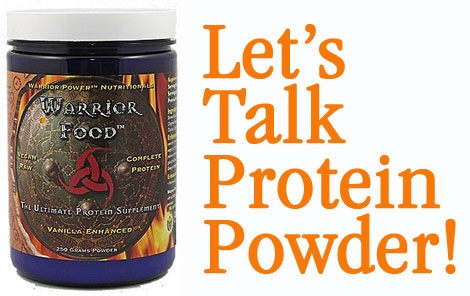
We get asked from time to time about whether we like to use protein powders and, if so, which brands we like. As you'll no doubt notice after getting into raw foods for a while, raw foodies (just like quite a lot of health-conscious people) often get into various powdered food additives. Some purists are against their use, of course. But, we're not so dead set against them. We do, however, believe that, if you're going to put something into your body as part of a health program, you should be conscious about it.
A few months ago, Wendi decided that she wanted to add some protein into her diet in the form of a protein powder. She did quite a bit of research at the time into the various brands available, charting out which ones were raw, which ones had various ingredients, and so forth. It was a fairly in-depth study, done for personal reasons unrelated to Pure Jeevan's blog articles. So, we never mentioned it before.
Read more: Protein Powder Smoothies Part 1 of 3: Selecting the Powder

Here at Pure Jeevan we are preparing for our cross country tour to educate others about raw foods. This means we are paring down on a lot of things, donating a lot, selling some things, and pretty much not buying anything unless it's absolutely necessary. That's what we've been doing for almost two years now (we're waiting for the house to sell). Recently, however, I decided it was time to spend a little bit of money even if it wasn't absolutely necessary.
-
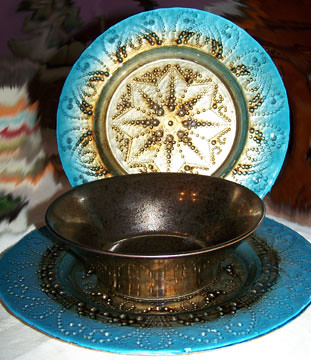
- Wendi's Dish Set
What did we buy? Dishes! Seems a bit strange to finally spend some money on something unnecessary and have it be dishes, right? Well, I had a few reasons for this purchase. The first is that when we are living in the RV, the space is going to be minimal. There won't be a lot of room for dishes, let alone much of anything else. Since there's not a lot of space to have dishes drying, we'll need to be washing, drying, and putting away immediately after use. That may not sound like a big deal, but when someone in the family decides to eat a few different things and leave the dirty dishes in the tiny RV sink, on the small counter, or somewhere else, it's going to really seem like a bigger mess than it is. So, to remedy this I thought it would be good for each of us to have our own dishes. That way we have a sense of responsibility for our own particular dishes--we know they are ours and we are responsible for taking care of them.
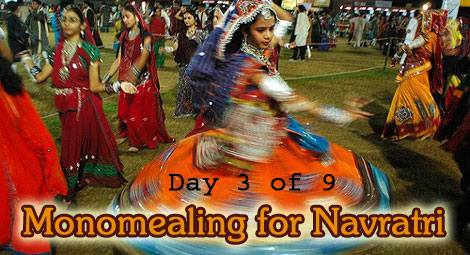
It's day three and all is going okay. I seem to have a bit more energy since it's not all being sapped trying to digest complex meals. The last time I did mono mealing, I received countless emails from Pure Jeevan members who were concerned I was doing something unhealthy. Eating simply for nine days, however, is not unhealthy.
 Did you know the body doesn't need a full range of vitamins and minerals at each and every meal? Somehow many of us were taught that each meal needs to be a complete balance of vitamins, minerals, proteins, fats, carbohydrates and that just isn't the case. What the body needs is a well-rounded diet, overall, to be in a balanced state. If, over the span of a month or two, you've consumed a variety of fruits, vegetables, nuts, seeds, and sprouts you will find that you've met just about all of your nutritional needs.
Welcome to Day One of "Dressings Week" here on Pure Jeevan. After finding out that KDcat took it upon herself to film a segment of "Makin' It Monday, Guest Raw Chef Edition," I decided that we should probably spend an entire *week* focusing on salad dressings.
Read more: Makin' It Monday Guest Raw Chef Edition: KDcat Makes Orange Pepper Cilantro Dressing