Know Any Literary Animal Lovers?

Hi there PureJeevan readers! We wanted to let you know that Jim's new novel CHROO is available on Amazon. It's a crazy adventure involving a billionaire heiress, her Chihuahua BFF ("Chroo") and a host of human and animal characters. Find out more on Amazon! Here are some links:

I'm going to be including questions and answers more often on the blog, since we've had a lot of emails from many of you saying you found last week's Q&A helpful and fun to read. I have many questions I've been saving to share with others, and more come in daily. Don't be shy if you have a question about anything that you think I'd possibly be able to help you with. Simply send me an email asking, and I'll reply to you personally. Questions that I feel might have a more general interest may be shared here on the blog (with the questioner being anonymous).
[Please email questions to me, rather than post them here on the blog: WendiDee [at] PureJeevan.com.]

In writing and researching our previous two posts, we came across a number of articles mentioning the benefits of chlorophyll for those who have been exposed to radiation. Nothing seemed to go so far as to call chlorophyll a cure-all. But, many sources cited clear benefits -- and it's great to read about potential preventative measures and treatments available through natural means. For example, the best source we found mentioned some specific studies:

Yesterday's smoothie was superlatively tasty, eh? It was clearly something out of Elvis' more energetic younger years, I think. You're probably wondering: "How does one follow an Elvis smoothie?!" I know ... it'll be tough to do.
Read more: Protein Powder Smoothies Part 3 of 3: The Donald Smoothie
Okay, we promise that, once the "Know Your Food" series normalizes (hopefully by next week), we'll be posting daily 3- to 4-minute segments, not these gargantuan bandwidth- and free-time-hogs! But, it's a decent 8 minutes of solid entertainment (kind of/sort of). So, hope you enjoy. We call this "Episode 1 (sort of)." You'll see why. Includes a few bonus minutes of discussion on goals & synchronicity.
As you saw, we didn't air the entire APPLE show. So, a few notes are in order:

Wow, who knew there would be so much to post here on this blog about Wendi an KDcat's 2010 tour ! Today is March 15, which officially marks the beginning of the second half of the trip -- and we're still talking about Portland! ? Since Portland, Wendi and Kdcat have had adventures in Grants Pass, Santa Rosa, San Francisco, San Luis Obispo, and as I write this there are two more angels in the City of Angels.
But, in the interest of keeping our coverage chronoligical, we'll continue where we left off last week -- Portland! Story, pics, and video all appear below!
Read more: W&K Select Portland as New Pure Jeevan Home, Head South for Further Adventures

Jim here with another exciting installment of Weird Wednesday. (What, you thought that just because Wendi is out of town this week, we'd have no Weird Wednesday )
In any discipline, I think it's important to consider the entire argument in taking a stance on a given issue. Examine each issue from both sides (pro and con) -- and then make the best choice you can. That makes sense, right?
Rawbin brings healing laughter and an unusual gift to unwell Wendi Dee.
Are raw foodists invincible to the common cold? I have to admit that I kind of assumed that was the case. If it's true, at what point does the invincibility kick in? I've been raw for over three years (over two at 100%) and yet the past few days have found me overcome with sneezing, sore throat, runny nose, and fatigue.
My first thought, once my throat started to hurt, was: "Did I eat anything different recently that I'm reacting to in a negative way " But, nothing had changed.My diet is relatively clean, with the exception of the times when I consume too much nut dip. So, when the sneezing and runny nose were added to the sore throat, I knew something else was going on. I had to admit it: "I'm not invincible."

Wow, so much happened in Chicago that it's taking literally weeks to show it all to you!? But, hey, it's also a lot of fun to share this stuff. Wasn't that a great talk yesterday with Kathy and Danny Living !? If you haven't seen it, definitely scroll down and watch!
Here's another one for you. Meet Hatice Yavuz, co-owner along with Chef Mehmet Ak of Cousin's Incredible Vitality, another great raw destination in the Windy City. "Hatice" is a Turkish name, in case you're wondering. The "c" is pronounced like a "j" -- so, her name sounds like "huh-TEE-jay." Our interview with her ran a little long, so I'm going to have to break it into two parts. Here's part one:
Read more: Pure Jeevan Visits Cousin's I.V., Interviews Co-Owner Hatice Yavuz (Part 1)

Welcome to Makin' It Monday, Guest Raw Chef edition. Today, Dave Sokulski of www.BirchCenter.com and www.FoodUnderFoot.com gets a little silly while making some delicious raw cacao treats! Enjoy the video:

Have you ever heard about mono meals? When I first did, it sounded like such a great idea. When you eat a mono meal, you eat one item (and only one item) for the entire meal. Eating that way is supposed to be very cleansing and it gives your digestive system a rest from processing different types of foods at the same time. Supposedly there is a boost in energy, as well, since your digestion isn't taking up so much energy.
I recently received an email asking for advice from one of our Hindu readers, asking what I could recommend as far as light eating during the nine-day Indian festival of Navratri. Navratri is traditionally a time of fasting for nine days, however in modern society most Hindus no longer fast. Many do, however, pay more attention to their diets, and they try to eat lighter meals that do not contain animal products. Since our reader is just starting his exploration into raw foods, I didn't want to offer him advice that would make his nine days of Navratri difficult.He recently purchased a Vitamix, so I suggested that he make a lot of smoothies, since he has been enjoying them so much.
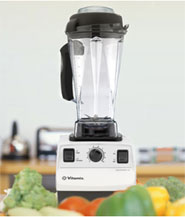 Hey there, everyone! Thanks for visiting Pure Jeevan. We want our welcome article, for now, to be this article on Vitamix blenders. There are certainly a few essential elements (e.g. good knives, cutting boards, a good food processor, etc.) to any raw food kitchen, and one of them is an awesome high-speed blender. Yes, there are many great blenders in the world, and yes there are a few decent top-of-the-line models on par with Vita-Mix. But, at the end of the day, our recommendation is the Vita-Mix (and yes, it's better than Blendtec, in our view). Here's a crazy video Jim did a while back for a Vitamix contest:
Note: That "free shipping" code, below, is no longer active. We'll let you know when we get a new free shipping code. For now, we hope you enjoy the video. :-)
We purchased ours 15+ years ago, and have subjected it to at least daily use (if not many times per day most of the time!) -- and it's still going strong. If you don't understand why a Vita-Mix is different from even a high-end blender from a department store, it's basically the sheer power. These things can pulverize pretty much anything -- time after time, without blowing out the motor. For example, you can make ultra-thick, healthy, raw ice creams day after day all summer long, and the machine will keep on working for years (and, in our case, we're almost ready to say "decades").
We used to be an affiliate w/ them, and are reapplying to be one. For now, we hope you like the video, above.