Know Any Literary Animal Lovers?

Hi there PureJeevan readers! We wanted to let you know that Jim's new novel CHROO is available on Amazon. It's a crazy adventure involving a billionaire heiress, her Chihuahua BFF ("Chroo") and a host of human and animal characters. Find out more on Amazon! Here are some links:

Wow, today is a really special day: Jay Kordich's 86th birthday! There must be millions of stories of how Jay has touched the lives of people in enormously positive ways. Here's ours...
Back in the early 1990s when we moved to the Washington, D.C., area, Wendi got a job in Arlington, Virginia. When she walked into work one day, one of the other workers there was absolutely glowing. So, she asked the woman, "Do you have a new boyfriend or something ?!!"
It's been a while since we offered an update on Wendi's health challenge. So, I asked if she felt up to writing a blog post to let everyone know what she's going through, highlighting a few new directions taken of late. As usual, I added some color splashes and graphics here and there, just for aesthetics. But, the following post is from Wendi. -Jim

Many thanks and lots of love go out to all of you for the love and support you ve been sending my way. I can t spend much time at the computer, but Jim has been trying to keep up with my email and he s been passing along your love, concern, advice, and healing energy. Thanks so much for everything, including the things that have arrived through the postal service. I definitely feel the love from all of you and I want you to know that each and every one of you means so much to me! * blows kisses *
Jim here... A health-conscious friend of mine was feeling sick today. And, while I certainly do not advocate harping on the sick, I did have a very mild discussion with her when she phoned me for some advice. I asked, "Do you know what cognitive dissonance is "
"I'm not sure," she replied.

For today's installment of Makin' It Monday, we wanted to share something that we've been making a lot of lately. It's so simple, yet so delicious and refreshing. Here's the recipe:
- 2 cucumbers
- 3 large stalks of celery
- 1 handful of cilantro
That's all!? You might finish with a pinch of your favorite salt (optional).? Also, since the cucumber is an extremely water-heavy veggie, I would advise you to run it through the juicer several times. Here's what I do:
Read more: Makin' It Monday: A Simply Delicious Juice Recipe
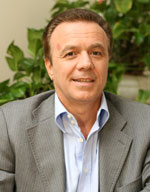 Today's post isn't specifically about raw foods. But, we wanted to post a few videos highlighting some interesting research by an Italian doctor named Tullio Simoncini, who just might be onto something HUGE! Dr. Simoncini treats certain cancer patients with ordinary sodium bicarbonate (baking soda), based on his premise that cancer is a fungal problem and that a solution of baking soda is anti-fungal. Naturally, he's been vilified by the medical establishment for making such a seemingly simplistic claim. But, what if he's right?
Here at Pure Jeevan, we're very much into health research -- not so much with an aim to cure any specific disease or ailment, but rather to understand ways in which our bodies can become what we like to call unbalanced, as well as the ways in which we might return our bodies to proper balance, when necessary. In this way, I suppose that we, like many in the natural health world, feel that the body is amazingly capable of healing itself (in many circumstances) as long as the body is able to find a favorable state from which it can properly do what it naturally wants to -- which is to return the body to an optimal state of health.
Medical doctors don't buy into this theory very much. ?However, it's certainly ironic how, where certain areas of standard medical practice are concerned, what I described above is exactly what doctors do. Take something like a broken bone, for example. A doctor does not normally attempt to surgically repair the bone itself. Rather, the standard and time-honored practice is to set the bone (say, with a cast), and then to let your body heal the break naturally, on its own, making those skeletal connections as only the imponderably complex, ever-evolving wisdom of the human body can facilitate. (True, doctors do often intervene these days with surgery for broken bones. But, their aim there is mainly to position the bones for proper healing, and/or to do things like insert pins in an attempt to improve functionality after healing. Either way, the procedure here still relies on the body's ability to eventually heal the problem.) Standard medical knowledge in this area is without question outstanding -- and this is why most people in the natural health world have little problem with going to see a medical doctor for emergency treatment.
Read more: Is Cancer a Fungus? Considering the Work of Italian Dr. Tullio Simoncini
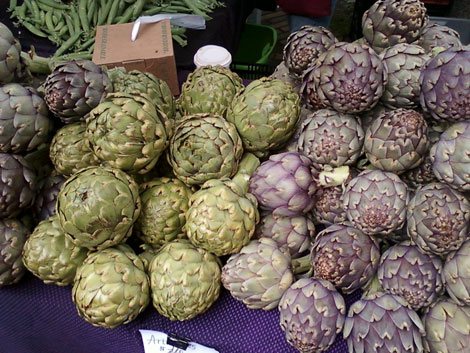
Here's a picture I took at Portland's Saturday Market last week. We've been pleasantly surprised to find that artichokes grow rather well here in the Pacific Northwest. We don't recall seeing them much back East, but many of our neighbors grow them (both for the artichokes and, I suspect, as ornamental plants).
I suspect that some raw foodists tend to overlook artichokes because they're so traditionally linked with the image of something steamed, stuffed with breadcrumbs, and drizzled in butter -- so, "cooked," "breaded," and "dairy" all together in one recipe! Being half Italian, I grew up eating them this way. My mother almost never said "artichoke"; she always called them an Italian word that sounded like "ga-GO-che-lee." ?She made them just a few times per year, and they were always a huge treat (and we'd often fight over the hearts -- by far the best part!).
If you've been following us for some time, you'll know that we are continually working on projects that will either serve our raw food community or educate others about the health benefits of a raw food lifestyle. If you are new here, or just getting to know us, you can read a summary of what we accomplished last year and a summary of the projects we're currently working on. We're serious about our goal to inspire others to learn about and embrace the raw food lifestyle and community. I've always been someone who helps others, who senses in what direction they are headed and then offers inspiration to keep them moving. I love the work we do as Pure Jeevan and it is extremely rewarding to receive so much gratitude from many of you. But, guess what? Sometimes I get tired!
Sure, some of you may be saying, "But, wait! People who eat raw foods are supposed to be power houses of energy -- able to continually keep active and never run out of steam." Well, that is very true. So, I take it back. I'm not really "tired" like I said -- my body is able to wake up in the morning, easily fall asleep in the evening, and go about its daily work without feeling like it's run down.However, I am feeling like I need a rest from all that I've been doing. Maybe I don't need to sleep hours and hours, because my body isn't truly tired. None of my being is truly tired -- my body, mind, spirit, and emotions are feeling great, actually.
However, I still feel like I need a break from my routine. On top of that, I've been feeling uncomfortable in the cold weather even more this year than I did last year. It hurts all the way down, deep inside my bones. I feel like it will take a lifetime to thaw from the cold I've been feeling here in Pittsburgh. The sun rarely shines, and the snow and ice are brutal on someone eating only raw foods. My instincts told me two years ago that it was time to move to a warmer, sunnier climate, but that hasn't happened yet (even though we are patiently working on it, as Jim pointed out in an earlier post).

I was sitting here today thinking about all of you, our lovely online friends who visit this blog. You follow what's going on with us, learn from us, find inspiration in the things we share, and even offer support to us in many ways.
Some of you reach out by leaving comments, many of you send emails, and a larger majority of you are quiet friends who haven't made contact with us, yet. Each and every one of you means so very much to me (and to Jim, too).
We don't keep this blog for ourselves; we keep it for all of you. It is our desire to share all that we've been through, and what we've learned, in order to help you with your own journey. Most of all, however, my personal desire is to inspire you to live the life you truly want to be living (in more ways than just through what you eat).

I was grocery shopping in Giant Eagle with a friend the other day; I was just there to keep her company. When we left the Nature's Basket area (where they sell organics and more natural items), I felt a strange feeling. I hadn't realized it, but over the past two years I stopped shopping in the other areas of the store! I told her that by the time we hit the packaged shelves of the Nature's Basket area, I'd already be done shopping and my cart would be filled. We had a good giggle and went on shopping.
Anyway, that has since brought my attention to the shopping carts of those around me. We do about 5% of our shopping in Giant Eagle (last minute things that we've run out of, that don't merit a trip to our Food Co Op), so lately I've found myself in Giant Eagle looking into the carts of those around me. I'm not judging anyone, I'm just curious. On average, just about everyone has a small bunch of bananas in their cart. There are the occasional carts with something like a cantaloupe, a bag of apples, and once I saw a single tomato and a bag of lettuce. The rest of the carts have been filled with packaged foods. There is next to no living food in the carts.
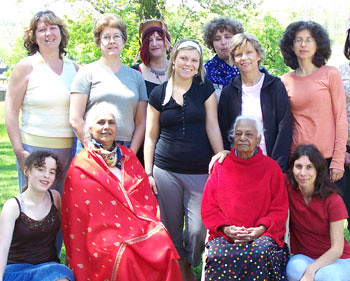
A partial group picture from the retreat.
The 3-Day Raw Food Spiritual Ashram Retreat was a success! All my time and effort that went into creating the event was well worth the experience. When Leela Mata and I discussed a possible raw food retreat about a year ago, I had no idea how to go about creating such an event. I have never done anything like this, so I approached it by asking myself: "What would I want if I was attending a raw food spiritual retreat " From there, I created a retreat that I would love to attend, myself. In fact, when it was completely organized and guests began signing up, I wished that an identical event existed that I really could take part in, as well!