Know Any Literary Animal Lovers?

Hi there PureJeevan readers! We wanted to let you know that Jim's new novel CHROO is available on Amazon. It's a crazy adventure involving a billionaire heiress, her Chihuahua BFF ("Chroo") and a host of human and animal characters. Find out more on Amazon! Here are some links:

After making a 'batch' of green smoothies, what is generally considered an appropriate serving size?
Thanks for the question, Gary!? I don't think I can give an across-the-board answer to fit everyone, since we're all so wonderfully different. The answer would have to take into consideration various factors, such as:

When we were heading out of town, I said that this trip might be a bit difficult on Jim because it's his first time being exposed to our friend Mamta's Indian food while he's 100% raw. I created some rich, delicious dishes to keep him satisfied, so that the temptation wouldn't overpower him. I expected no problems for myself, since I've been raw for more than three years and have been exposed to this temptation before without any problems.
Well, guess what? The cravings are here! You see, Mamta is THE BEST Indian food chef EVER. We've eaten literally thousands of Indian meals over the years, and even enjoyed it while touring India for nearly a month in the 1990s, but nothing has ever compared to Mamta's skill at creating the most delicious food on the planet. As usual, she sent home lots of food when we left this weekend -- this time all for KDcat, who is so very happy she's not eating 100% raw foods. I don't even know how many different dishes came home with us, but their aroma has been extremely tempting.

On this Thankful Thursday I am feeling especially thankful for the Internet. Without the Internet I wouldn't be able to learn as much as I've learned about raw foods in such a short period of time. The Internet has connected me with people from all over the world who are also interested in natural health and raw food living. I am part of a larger community, one that would never exist without the Internet.
So, today I am especially thankful for the Internet. What are you thankful for today?

Jim here again... What do you think of that montage of vintage cigarette advertisements ! Knowing what we now know about cigarettes, it's tough to believe that such ads could have existed only 50 years ago, but the campaigns were real. Did doctors actually see no harm in cigarettes? Were there no pulmonary specialists back then who thought that habitually inhaling smoke might not be such a healthy idea Who knows... ?As I like to believe when it comes to doctors, even though they're quite oblivious to the harmful effects that chemicals have on our bodies, they do seem to mean well (in their own deluded ways). So, I don't hold it against them so much as I now hold it against individuals to think for themselves and challenge healthcare practitioners.
In any case, whether or not there is an advertising campaign attached to a new consumer product, it stands to reason that when a product is introduced into the marketplace, manufacturers should have a responsibility to ensure that the product is safe, and consumers should likewise have a reasonable expectation that the product is safe. Only, it doesn't always work that way, does it?
In a recent post, I answered part of a message I received from Violet, one of our blog readers. Below is the continuation of my response to Violet (much briefer than my last one!).
Following my response to Violet is a response to Sarah, who has a fantastic raw food blog that I enjoy reading.
Violet's message continued:
Read more: Reader Questions: Raw Transition Support, Identify Peas


Q. Do you know of any nutritional protocol that would be beneficial for reducing or *gasp* even healing fibromyalgia using a high raw diet regimen
Do you feel that something like live blood testing, or mineral level testing would be beneficial? Wendy, after following your long ordeal with Lyme disease **Gentle Hugs to you** I believe you might be able to understand the pain, fatigue and depression that is involved while dealing with a chronic illness. ?I am looking forward to hearing more about your healing journey!
Sending love,? C.
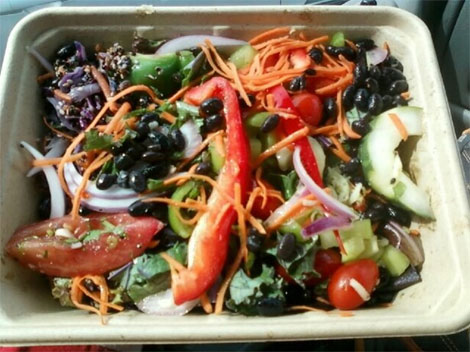
Jim here... As I hinted at last week, I decided to try changing things up a bit and seeing what I thought of it. The salad you see above included the first cooked food I've had in more than two years. If you look closely, you can see that I sprinkled on a few spoonfuls of black beans. Also, in the upper left corner, there's a small spoonful of quinoa. I don't want to give the wrong impression here: ?This blog will certainly remain a major go-to source for raw food nutrition information. It's just that, today, I want to talk about experimentation a little bit.
First, I think it's generally healthy to experiment with your diet -- especially when you get the sense that something isn't working in your current diet. The fact is, diet is a dynamic thing, not a static aspect of your life. It has to be this way because so many factors affect our physiology on a day-to-day basis. Off the top of my head, these include the facts that:
Read more: Experimentation: The 95% Raw Salad... A Good Idea or Not?

To keep all of you inspired while we are away, we've asked some
remarkable individuals to share their raw food stories with you. Enjoy!

For this week's Makin' It Monday, I'll share a super quick and yummy recipe I created. Since we have all of those delicious oranges, guess what the recipe is going to include? ;-)
ORANGE PUDDING

Since Pure Jeevan specializes in raw food weight loss, we receive a lot of questions about what is required in order to lose excess weight. Many individuals want to know if they need to go on a 100% raw food diet in order to release excess weight.
The answer is, "No, you do not need to switch to a 100% raw food diet in order to lose weight." If you're asking if a 100% raw food diet works better for losing weight than slowly transitioning and increasing your raw food intake, the answer is still, "No."
Mmmmmmmmm! ?I'm sitting here at my computer eating the Best Organic Fuji Apple Ever. Don't believe me? ?Here's a picture of the apple I'm eating right now:
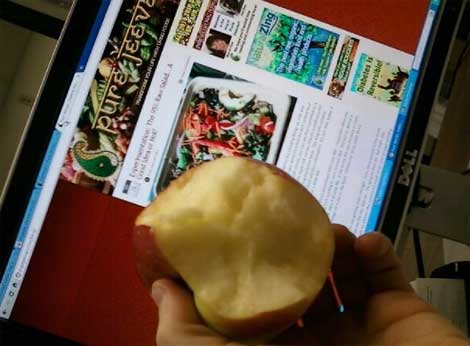
Looks dee-lish, right? ?(Okay, so maybe it's not the most appetizing pic in the world...) ?Anyway, one interesting thing about this apple is that I bought it (a whole big bag of them, actually) because it was so cheap. (I'm on a relatively tight budget these days.) ?But, if it was so cheap, how could it be so tasty? ?(And organic, too!) Well, that's where the basic law of supply and demand come in. Whenever a crop is at the peak of its season, the supply rises considerably. Instead of the store receiving X number of bushels of apples, they receive 5X or more. So, they slash prices to move that kind of volume.
Read more: Delicious Idea for Produce... Putting the Economics of Raw Foods to Work For You!