Know Any Literary Animal Lovers?

Hi there PureJeevan readers! We wanted to let you know that Jim's new novel CHROO is available on Amazon. It's a crazy adventure involving a billionaire heiress, her Chihuahua BFF ("Chroo") and a host of human and animal characters. Find out more on Amazon! Here are some links:

What a fun weekend we'll be having! We leave later today to visit some friends in Virginia. Sweet little Rhia (a niece's daughter) will be turning one year old and there will be a huge party for her. I'll be wearing a sari, there will be lots of Indian food to tempt me back to the cooked side of life (but, never fear, I am strong!), and we'll be staying up very late enjoying the party Saturday evening.
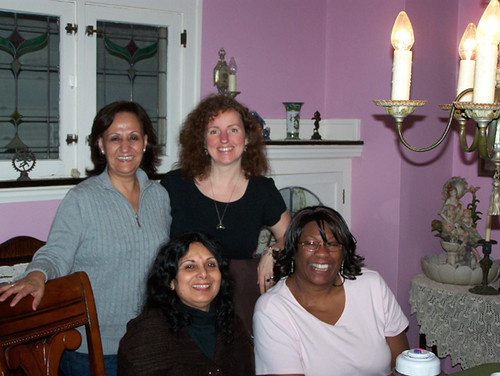
Mohtarama, Wendi, Mamta, Deborah
Jim here... Here's a compilation of vids from my little Flip camera, all taken over our weekend roadtrip to Washington, D.C. It's not all strictly raw-food related, but does include some raw tips. First up, you'll see our rawsomely packed food coolers. Between using ice and frozen fruits, everything kept cool just fine.
Early in the video, Wendi shares a handy tip for keeping your smoothies cool on the road. If you're going to drink your smoothies right away, you might have little concern for keeping a drink cold. However, we had eaten breakfast already and knew we wouldn't want to get into our smoothies for another hour or so after leaving. Frozen berries to the rescue! (Just make sure to hunt down a large glass bottle with an opening large enough to pour frozen berries into.)

Let's stay sharp by learning about brain power! Did you know that the less exercise your brain receives through reading, learning new things (like you do here on our blog!), playing games, and contemplating puzzles the more it is likely to become weak and not serve you well into your centenarian years? Scientists have been trying to figure out ways to improve the brain's function and have learned a lot, but are still uncertain what causes Alzheimer's Disease, or any other form of Dementia.
If you ve ever known someone who suffers with a loss of mental capabilities, you know how sad and sometimes scary that can be. Last week, Jim posted a blog that touched a bit on the subject of Alzheimer s Disease. He wrote in that article, ?I want better than just a small chance that I ll live healthfully for a full lifespan. I want to stack the aging deck in my favor. ?Eating a healthy, raw food diet is something Jim was hoping to use in order to stack the deck in his favor of a life free of memory loss and full of vibrant health.
Jim here... Until our home sells (SOON!!!) and Wendi and I launch ourselves into the world as full-time raw food teachers / lecturers / inspiration providers, I'm more or less stuck in the corporate world during the day. While much of what happens in this Dilbert-esque environment is, as many of you likely know, absolutely meaningless, there is nonetheless the occasional pearl of wisdom to be pried from the clammy jaws of the 9-to-5 world. I was, for example, just reminded of a story I heard at a seminar once. Not surprisingly, the seminar pertained to the art of money making. However, there's another more fulfilling message to it as well.
A large modern newspaper company still uses these ancient printing presses from the 1950s -- huge old monstrosities with enough belts, pulleys, and greasy gearboxes to make any modern-day steampunk enthusiast squeal with delight. One day, not long after the old press manager finally leaves the company, the main press breaks down. Manuals are consulted, technicians brought in, engineers asked to take a peek. No one can bring the beast back to life. But there's a woman on the Internet who specializes in these babies -- and, guess what, she's local! So, they call her in. She listens to their problem and says she can fix it, but it's going to run them $5,000.

Day 7: Happy Navratri! It's the final three days, and today begins the special day of focusing on the attributes of Goddess Saraswati, recognizing those same feminine qualities within ourselves, and drawing inspiration to continue growing and changing in the most wonderful ways.
 Saraswati has always held a place of honor in our home. When we traveled to India a very long time ago(*), we purchased a batik wall hanging of Goddess Saraswati and framed it. It's quite large and we've always hung it in places where we wanted to focus on the energy that she represents to Hindus: creativity (particularly in the areas of music and art) and knowledge/intelligence (usually linked with education and literature).

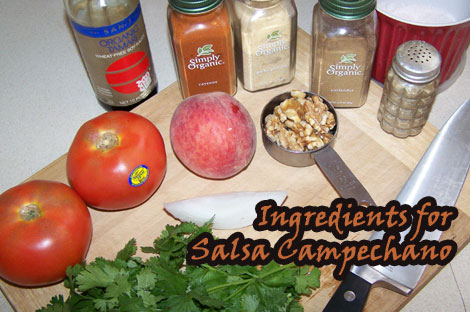
For today's Makin' It Monday feature, we'd like to present "Salsa Campechano." We'll have to admit, though, that we do not speak Spanish. So, we have to give some credit to Google's online language translator. When we went to name this recipe, Wendi suggested that this is a "manly" dish (since I created it). However, we didn't find the perfect Spanish word to fit the recipe.Then, considering the walnuts in the recipe, Wendi suggested that perhaps "hearty" was a better adjective. Google returned the Spanish word campechano for this, and we immediately thought: Yes!, that sounds just perfect!? So, here's an amazing recipe for you. It's a hearty salsa recipe, but I actually like to eat it as a soup.

Since Pure Jeevan specializes in raw food weight loss, we receive a lot of questions about what is required in order to lose excess weight. Many individuals want to know if they need to go on a 100% raw food diet in order to release excess weight.
The answer is, "No, you do not need to switch to a 100% raw food diet in order to lose weight." If you're asking if a 100% raw food diet works better for losing weight than slowly transitioning and increasing your raw food intake, the answer is still, "No."

Today, we thought we'd share another non-diet-oriented explanation of obesity. It's from Rhonda Byrne, author of the international multi-media phenomenon known as "The Secret," which provides readers with in-depth philosophical explanation and instruction with respect to the Law of Attraction.
Wendi and I have The Secret on CD, and often enjoy listening to it. I think, in fairness, we both have a few legitimate criticisms about certain aspects of it (and I'll share one or two, below). However, on the whole, many of the ideas within resonate deeply for us and we find much of the underlying message profoundly uplifting and empowering -- especially (for me) much of the discussion regarding maintaining a healthy, positive, optimistic attitude and practicing gratitude.

Jim here... Today Wendi is busy preparing for a multi-day activity that I'm sure she'll be writing about later this week. So, I thought I'd field a question we received recently (one directed specifically to me). We do receive a good deal of questions at our Raw Food Diet Question In-box (at Questions [at] PureJeevan.com), so feel free to send any in that you may have, and we'll definitely get to them all here in time. In any case, one reader writes:
As drawn as I am to a raw diet, being mostly cooked vegan right now, I can't help but come up against this each time: Since produce is, after all, mostly water, what did you eat while transitioning that didn't lead to shoving in lots of bread, potatoes, etc. Do you just eat lots and lots of, say, oranges, at one go? This has always been my raw downfall. I'm sure the answer is very simple.
Wow, this is a great question, and one with many possible answers! To begin, let's recognize that this isn't a question from a "SAD diet" eater. ?Being a vegan, alone, takes significant learning and (often) self-discipline to accomplish successfully. It's also, in my view, an excellent dietary and lifestyle choice for many people, regardless of whether they ever decide to try a raw foods diet. So, this question is rather advanced.

Jim here... As I may have mentioned a while ago, I joined a gym recently. I figured, with Wendi and Bailey living on the other side of the country, I might as well find something healthy to do with my alone time until I'm able to join them soon (aside from my seemingly never-ending quest to rid our household of 13 years of rampant accumulation). I joined on a whim, actually. There's a gym near my home called Planet Fitness. Honestly, I have no idea how they make money. A membership costs just $10/month -- and it's a Wal-Mart-sized place, too, absolutely packed with state of the art machines. (Actually, it's a franchise, so there could very well be one near you.)
In any case, it had been a while since I'd been inside an actual gym. I've certainly remained relatively active, of course. But being in a gym is a little different -- and certainly has its plusses and minuses. On the minus side, I've always kind of felt that, if you add up all of the time it generally takes to get (1) get ready to go to a gym, (2) drive there, and (3) drive home -- say, a half-hour, total, for those things -- then you could probably better invest that time in just going for a run for a half-hour, leaving straight from your home. From a time management standpoint, I'm not crazy about gym memberships (meaning not that physical exercise isn't worth the investment of time, but rather that there are ways to accomplish the same results in much less time).
Read more: Exercise As a Reminder of the Human Body's Amazing Efficiency
We have something special for today s Makin? It Monday! Remember Terilynn, the brilliant chef behind The Daily Raw Caf , whom we introduced you to not long ago? Well, this weekend she posted a recipe challenge open to anyone willing to participate. We here at Pure Jeevan are always up for an adventure, so thanks for the challenge, Terilynn!
The rules were simple: Use the list of possible ingredients, create a raw vegan food dish, and send pictures and information about your dish to The Daily Raw Caf . Here s the list for the challenge, with the items we didn t have available crossed out: