Know Any Literary Animal Lovers?

Hi there PureJeevan readers! We wanted to let you know that Jim's new novel CHROO is available on Amazon. It's a crazy adventure involving a billionaire heiress, her Chihuahua BFF ("Chroo") and a host of human and animal characters. Find out more on Amazon! Here are some links:

As many of you know, I'm more of an intuitive eater than anything else. I eat what I intuitively feel my body needs most of the time. Well, for the past two weeks what my body has been asking for is cauliflower. I went through a cauliflower stage sometime last year, and it seems I'm back to eating that lovely white flower veggie again!
At first I was making mashed cauliflower (like? mashed potatoes) and keeping the recipe very simple. I've made complex versions of the mashed cauliflower before, but I was really drawn to a more simple taste so all I was adding was some olive oil, salt, and a tiny bit of macadamia nuts. Yesterday, however, as I was cleaning the cauliflower (since my body was telling me it wanted more of it), I had a sense that I wanted something more vibrant, more fun than simple mashed cauliflower. So, I followed my intuition (picking up whatever I felt my body wanted to eat with the cauliflower) and here's what I created...
Can you believe it's mid-October already ? Here in Pittsburgh, for those lucky few who may have fig trees, that means harvest time! Well, almost. Take a look at this video we made about figs!
As stated in the video, we did a previous installment on figs in our Know Your Food series (which will definitely be returning once we finally sell our home and become full-time raw food inspiration providers!). Please visit that link for nutrition and other information on figs.

Here at Pure Jeevan we are preparing for our cross country tour to educate others about raw foods. This means we are paring down on a lot of things, donating a lot, selling some things, and pretty much not buying anything unless it's absolutely necessary. That's what we've been doing for almost two years now (we're waiting for the house to sell). Recently, however, I decided it was time to spend a little bit of money even if it wasn't absolutely necessary.
-
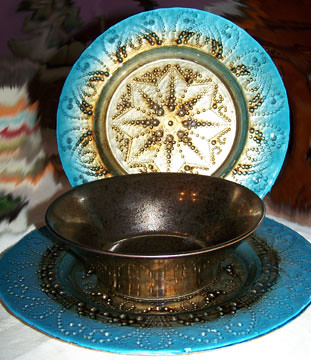
- Wendi's Dish Set
What did we buy? Dishes! Seems a bit strange to finally spend some money on something unnecessary and have it be dishes, right? Well, I had a few reasons for this purchase. The first is that when we are living in the RV, the space is going to be minimal. There won't be a lot of room for dishes, let alone much of anything else. Since there's not a lot of space to have dishes drying, we'll need to be washing, drying, and putting away immediately after use. That may not sound like a big deal, but when someone in the family decides to eat a few different things and leave the dirty dishes in the tiny RV sink, on the small counter, or somewhere else, it's going to really seem like a bigger mess than it is. So, to remedy this I thought it would be good for each of us to have our own dishes. That way we have a sense of responsibility for our own particular dishes--we know they are ours and we are responsible for taking care of them.
This is a recipe for the coconut shake that brought my cholesterol levels from very unhealthy down to extremely healthy within the span of one month!
Young Coconut Shake
Flesh and water from one young coconut
***** DISCLAIMER: As with all of our posts here at Pure Jeevan, and particularly those tagged with a new term, "Nadi Balance," please refer to the disclaimer that runs at the bottom of all Pure Jeevan pages. Wendi and Jim are health researchers, educators, and extreme self-experimenters, not doctors. ******
Nadi Balance: Part V

I don't have time to write a real blog post, but wanted to pass along this information for anyone who eats Halloween candy, or knows of others who do. Please note that I am not the kind of person to spread false warnings. I completely trust Mike Adams as a Health Reporter and all around wonderful person. He would not spread false news...he looks into every bit of information available before sharing what he's learned with everyone else.
Mike has issued a warning about Halloween Candy. Please go to his site to find out more about it: NaturalNews.com
?
I'll leave you with an old Halloween picture of me before I started eating raw foods. Halloween used to be the day I'd dress up and feel okay being myself, because I was in costume. It's funny to me that this year I feel no need to cover up in order to be myself. Halloween is still my favorite holiday, however!

As we mentioned in one of our first blog posts, Pure Jeevan met with Leela Mata at her Peaceful Valley Ashram to discuss the details for some 3-day Raw Food Spiritual Retreats for you during 2008! The details are finalized and we are proud to announce our first 3-Day Raw Food Spiritual Retreat, that will be held at the ashram from May 23-25, 2008. We've set this retreat up so that it's as affordable as possible. There's a significant savings if you sign up early, so be sure to check it out!
Some very special companies have delicious treats for those attending the retreat.

What's Valentine's Day without a little "Smooth Love," right ??Here's how we created this simple, creamy delicious, smoothie:
- Start with the water and flesh of one young coconut. We had one left over, still nice and fresh, from our recent trip to the Florida Keys (more raw food videos and posts coming soon from that trip!).
- Add three to four oranges, peeled (and de-seeded if necessary)
- Add two to three large bananas
- Add 12 ounces of frozen strawberries (or to taste)
- Add a small handful of raw almonds
- Add a bit of raw agave nectar or a few dates, if you have them.
Blend in your high-speed blender until smooth ... and share with a loved one! Happy Valentines Day, everyone!

Jim here... As I may have mentioned a while ago, I joined a gym recently. I figured, with Wendi and Bailey living on the other side of the country, I might as well find something healthy to do with my alone time until I'm able to join them soon (aside from my seemingly never-ending quest to rid our household of 13 years of rampant accumulation). I joined on a whim, actually. There's a gym near my home called Planet Fitness. Honestly, I have no idea how they make money. A membership costs just $10/month -- and it's a Wal-Mart-sized place, too, absolutely packed with state of the art machines. (Actually, it's a franchise, so there could very well be one near you.)
In any case, it had been a while since I'd been inside an actual gym. I've certainly remained relatively active, of course. But being in a gym is a little different -- and certainly has its plusses and minuses. On the minus side, I've always kind of felt that, if you add up all of the time it generally takes to get (1) get ready to go to a gym, (2) drive there, and (3) drive home -- say, a half-hour, total, for those things -- then you could probably better invest that time in just going for a run for a half-hour, leaving straight from your home. From a time management standpoint, I'm not crazy about gym memberships (meaning not that physical exercise isn't worth the investment of time, but rather that there are ways to accomplish the same results in much less time).
Read more: Exercise As a Reminder of the Human Body's Amazing Efficiency

Finally, some super news to share!? On Monday, after a l-o-n-g wait, Wendi finally had her appointment with a actual LLMD. (That stands for "Lyme Literate Medical Doctor."? If this and the news of Wendi's Lyme Disease is new to you, check out this post.)
I'll cut straight to the good part: Her prognosis is excellent! Yes, she's still in a world of pain and misery at the moment, but he believes (based on her blood work and her symptoms) that we've caught this early enought to fully eradicate the Lyme. (At least, that's how I understand it. I'm actually not clear on whether Lyme is ever 100% eradicated, or if it's just forced into dormancy or irrelevancy. Perhaps Wendi can clear that point up later.)

Last night I dreamed of meandering through an unfamiliar cityscape, following some lonely sidewalk next to a river at night, feeling particularly sad and miserable beneath dim yellow street lights. I wore a black suit, carried a highball glass, and was absolutely drunk!
Having crossed the river, I soon realized (even in my dream-drunken state) that I'd been wandering aimlessly. Feeling rather pathetic, I decided to walk back across the river and sober up in a casino that I knew was there. Drunk and depressed, I figured I'd just sit in front of a slot machine for a few hours.