Know Any Literary Animal Lovers?

Hi there PureJeevan readers! We wanted to let you know that Jim's new novel CHROO is available on Amazon. It's a crazy adventure involving a billionaire heiress, her Chihuahua BFF ("Chroo") and a host of human and animal characters. Find out more on Amazon! Here are some links:

In writing and researching our previous two posts, we came across a number of articles mentioning the benefits of chlorophyll for those who have been exposed to radiation. Nothing seemed to go so far as to call chlorophyll a cure-all. But, many sources cited clear benefits -- and it's great to read about potential preventative measures and treatments available through natural means. For example, the best source we found mentioned some specific studies:
 To help keep all of you inspired, we ve asked some
remarkable individuals to share their raw food stories with you. Enjoy!
My Story of Conquering the Myths of My 50+ Body
 I ve been eating 100% live/raw food for a little over eight months now, and I believe it all started? well.... hmmmm? let s see. Last summer I was determined to do something once and for all about the weight that I put on since I turned 50, six years ago (well, almost seven years now ). It seemed that no matter how much I exercised or how much I ate ? or didn t eat ? nothing stopped the onslaught of impending bulk. Each year added a few more pounds until I hardly recognized myself! What happened? Who was I? Where did this strange body come from? I decided I needed to take this foreign body by the horns and wrangle it back into submission. Actually, I was gentler than that, but the determination was there.
***** DISCLAIMER: As with all of our posts here at Pure Jeevan, and particularly those coming up over the next week and a half (which will all be tagged with a new term, "Nadi Balance"), please refer to the disclaimer that runs at the bottom of all Pure Jeevan Pages. Wendi and Jim are health researchers, educators, and extreme self-experimenters; not doctors. ******
Nadi Balance: Part III
 To summarize yesterday's post, even though this sounds dramatic, the truth is: Wendi was dying. The first doctor essentially sent her home saying there was nothing wrong. The second doctor confirmed she had Lyme disease, but was too late for his method of healing, since the Lyme had already become chronic at that point. He could only offer understanding of her situation and a trial and error method of conventional medications, which rarely (if ever) heal Lyme patients. A supplement that many raw nutrition gurus recommend as essential to health for all people was actually putting Wendi's body, already struggling with Lyme bacteria, into an extreme state of distress. And finally, our own knowledge of health, diet, and healing (even though extensive and accumulated over 30 years) wasn't adequate for healing Wendi's body of Lyme, either.
Rawbin Rescues Turtle
I had a fantastic time at the 2008 Green Festival in Washington, DC. My wonderful friend, Rawbin, picked me up last Thursday and we had a nice drive back to her place in Maryland. She lives in an almost magical setting with wooded areas, horses, a goat, chickens, dogs, and cats! KDcat will not want to leave when she visits Rawbin someday. Above is a video of Rawbin rescuing a turtle that was in the middle of the road near her home.
?To keep all of you inspired while we are away, we've asked some
remarkable individuals to share their raw food stories with you. Enjoy!
With this video, Pure Jeevan concludes coverage of the 2009 Raw Spirit East festival. We started off two Fridays ago covering raw food chefs, then moved on to raw lifestyle speakers and philosophers. The final piece of the gourmet raw pie would have to be the festival ambience, which is somewhat tougher to capture in a short video. But, I think this video does a reasonable job of conveying a lot of the scene "beyond the food." (But even if it doesn't, how many times do you get to see Charles Balcer hula-hooping on video )
Enjoy the video (and pics, below, too)!
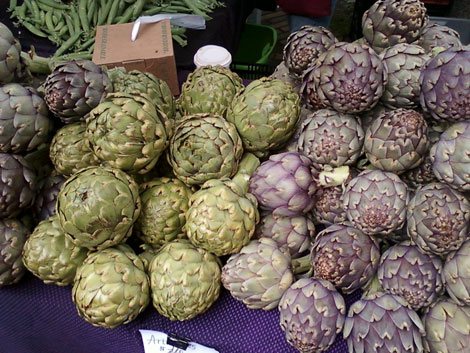
Here's a picture I took at Portland's Saturday Market last week. We've been pleasantly surprised to find that artichokes grow rather well here in the Pacific Northwest. We don't recall seeing them much back East, but many of our neighbors grow them (both for the artichokes and, I suspect, as ornamental plants).
I suspect that some raw foodists tend to overlook artichokes because they're so traditionally linked with the image of something steamed, stuffed with breadcrumbs, and drizzled in butter -- so, "cooked," "breaded," and "dairy" all together in one recipe! Being half Italian, I grew up eating them this way. My mother almost never said "artichoke"; she always called them an Italian word that sounded like "ga-GO-che-lee." ?She made them just a few times per year, and they were always a huge treat (and we'd often fight over the hearts -- by far the best part!).
Correction: I said "Lenuria" a number of times in this video, but it's actually Lunaria! In any case, we wanted to share some additional description for this plant. Here's a quick paragraph from Wikipedia:
Lunaria is a genus of flowering plants in the family Brassicaceae, native to central and southern Europe. It includes two species, Perennial honesty and Annual honesty. They are widely grown as ornamental plants in gardens, and have become naturalised in many temperate areas away from their native habitat. In the language of flowers, it means Sincerity and Forgetfulness. ...The common name "Honesty" arose in the 16th century, and it may be due to the translucent seed-pods which are like flattened pea-pods and borne on the plant through winter. In South-East Asia, it is called the "Money Plant," and in the United States as "Silver dollars," because its seed pods have the appearance of silver coins.

Here's another brief video from our travels. Since time for editing is limited, I think I'll just run some more of the shorter vids this week and then get into the longer, more in-depth interviews next week. So, this is a short, fun conversation I had with Steve, who tends the raw juice and smoothie bar at Cousin's Incredible Vitality raw restaurant in Chicago. Here's the vid:
Read more: Pure Jeevan Interviews Steve from Cousins Raw Restaurant in Chicago
In this video, Wendi talks with Leela Mata, spiritual leader of the Peaceful Valley Ashram, about her experiences with the raw food diet and a bit about a cob oven structure that was built on the ashram property. This is part 2 of a 5-part series featuring Peaceful Valley Ashram.
Read more: Leela Mata Discusses Her Experiences with Raw Foods
Rawbin brings healing laughter and an unusual gift to unwell Wendi Dee.
Are raw foodists invincible to the common cold? I have to admit that I kind of assumed that was the case. If it's true, at what point does the invincibility kick in? I've been raw for over three years (over two at 100%) and yet the past few days have found me overcome with sneezing, sore throat, runny nose, and fatigue.
My first thought, once my throat started to hurt, was: "Did I eat anything different recently that I'm reacting to in a negative way " But, nothing had changed.My diet is relatively clean, with the exception of the times when I consume too much nut dip. So, when the sneezing and runny nose were added to the sore throat, I knew something else was going on. I had to admit it: "I'm not invincible."