Know Any Literary Animal Lovers?

Hi there PureJeevan readers! We wanted to let you know that Jim's new novel CHROO is available on Amazon. It's a crazy adventure involving a billionaire heiress, her Chihuahua BFF ("Chroo") and a host of human and animal characters. Find out more on Amazon! Here are some links:

Last time on Raw Foods 101 we answered the question, "Why should you soak nuts / seeds before eating them."? Naturally, many readers then asked the next logical question, "How LONG should I soak them before eating " Great question!
Don't forget:? You're soaking the nuts and seeds to "wake them up" as would happen in nature. When seeds are soaked in the springtime rain, they wake up and begin to sprout. When this happens, the nutritional content of the nuts and seeds changes (they become an even greater powerhouse of nutrients).
Read more: Raw Foods 101: How Long Should You Soak Nuts / Seeds Before Eating Them?

I want to admit something to all of you: Sometimes I still cry because of how people treated me when I was obese. Because I stuffed all of my "negative" emotions deep inside my entire life, it's going to take some time to fully release them. I'm working on it, however, and making tremendous progress with healing myself on all levels. I'm not telling you these things so you'll feel sorry for me, however. I'm telling you because I am thankful for all the pain I endured. It shaped me (in more ways than just my physical appearance) into the person I am today.
Even though it sounds strange, and somehow wrong to feel this way, I'm thankful that I was obese. I'm thankful for all of the experiences during my life, even the extremely painful, traumatic ones. Maybe if I was a different kind of person I would wish that those things didn't happen to me. However, I am using those experiences in positive ways. They've helped me understand people even better, and to understand myself on a deeper level, as well. When people reach out to me it's not only because I'm an approachable person, it's because they sense that I understand them--and they're right. I DO understand them. I understand you. My experiences, coupled with my gift of empathy, help me relate to you in a way that maybe not everyone else is able to do.

Jim here... We're at an interesting juncture here at Pure Jeevan. For the moment, we're still living a little more "in the box" than we plan to in the near future. One example of this is my personal excitement about Fridays. Oh, I suppose Fridays will always seem special to me somehow. But after years of the corporate routine, Friday remains the most welcome weekday.
Friday signifies the end of the five-day stretch during which most people do whatever they happen to do to pay the bills, to keep (raw!) food on the table, and a roof over their heads. While I know of and admire many people for whom the work week is generally meaningful and rewarding, I suspect that the majority of people go through it simply for the money. Sure, many "like" their job (or, perhaps more aptly, "don't hate it"), but I have met too few who absolutely love their jobs. (Come to think of it, I've met quite a number who actually do hate their work!)
Read more: TGIF!, and a Recap of Major Pure Jeevan Activities
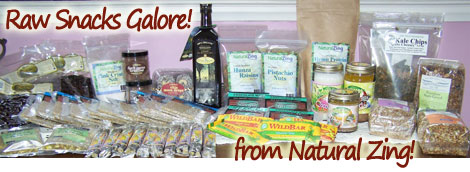
Well, Wendi and our daughter, KDcat, are headed out this evening on a train for their cross-country tour. They didn't seem so sad to leave ... maybe it's because of the bounty they're taking with them! Check it out in the banner above as well as the snapshots below! (I've included a list at the end of many of the products.)
Natural Zing has been Pure Jeevan's favorite online source for all of our raw food supplies. They have been very supportive of Pure Jeevan for over a year, and they continue to amaze us with their love and generosity. You'll be hearing more about Natural Zing during the tour, because they're Wendi and KDcat's official snack sponsors for the trip!

Yesterday, I posted a question on Facebook and was met with some wonderful responses. The question was essentially, "If you're a trying to run a health-conscious household, and if you truly believe that most sugary candy is actually damaging to people's health, then what should you give away to all of the little trick-or-treaters who visit on Halloween night "
I got some great responses! Raisins, fruit leathers, glow sticks, etc. Thanks to those responses, I went out and bought about 60 glow-stick bracelets (the kind that you snap and then they glow brightly for 6 horus or so). I think the kids will think these are neat, and will all want to wear them. I also picked up a bunch of small juice boxes with 100% juice in them. (They're pasteurized, of course, but at least it's not sugary junk.) So, between all of that, I think I'll make it through the night without getting egged.
This experiment isn't looking so great, right now. I'm gaining weight.

I've cut fat out of my diet until my evening meal. Here's what I've eaten over the past few days:
Sorry for the strange behavior of this site over the past few weeks, friends. As a former professional web programmer, and always a?bit of a mad hacker, I'm usually really great at keeping the web end of Pure Jeevan running very smoothly.
But, this is a Wordpress blog -- and so you have things like plugins and widgets and themes and updates, all interacting (and sometimes conflicting) with one another. I've noticed lately that this blog home page has developed all sorts of peculiar issues, not the least of which is a very slow-loading tendency.
Read more: Hopefully Pure Jeevan Loads a *Little* Faster Today!

To help keep all of you inspired, we ve asked some
remarkable individuals to share their raw food stories with you. Enjoy!

Isn't it high time we incorporate more Internet phenomena into our daily lives? Okay, maybe not everything (reminding myself that certain others aren't always amused when I say "BRB" instead of "I'll be right back.") But, I really do think there are some conceptual web ideas out there that could benefit us if applied more often.

??
As we have mentioned here and there, our home (affectionately called "The Luck House") is currently for sale. Once it sells, we will be hitting the road full-time, educating people all across the country about the benefits of the raw foods lifestyle. Until then, we're spending a good amount of time going through the motions of selling the place. It's a wonderful home!!!?
***** DISCLAIMER: As with all of our posts here at Pure Jeevan, and particularly those coming up over the next week and a half (which will all be tagged with a new term, "Nadi Balance"), please refer to the disclaimer that runs at the bottom of all Pure Jeevan Pages. Wendi and Jim are health researchers, educators, and extreme self-experimenters -- not doctors. ******
Nadi Balance: Part II
Even though this ground-breaking information we're sharing is not necessarily about Lyme disease, the story of Wendi's contracting, suffering, and healing from it is essential background information. So, we're going to talk about Lyme disease frequently here and in the next few posts, but know that the real, underlying story is about so much more than Lyme disease. (In fact, it's about overall health for everyone!)