Know Any Literary Animal Lovers?

Hi there PureJeevan readers! We wanted to let you know that Jim's new novel CHROO is available on Amazon. It's a crazy adventure involving a billionaire heiress, her Chihuahua BFF ("Chroo") and a host of human and animal characters. Find out more on Amazon! Here are some links:

To keep all of you inspired while we are away, we've asked some
remarkable individuals to share their raw food stories with you. Enjoy!
Just a quick notice that we've posted our December 2009 newsletter. Each month, we email a link to our newsletter to all Pure Jeevan family members. (If you're not receiving that, you're mising out on a ton of awesome raw inspiration and information. You can click here to sign up -- it's free!)
We'll be back tomorrow to continue our coverage of the Chicago raw food scene. As I've been saying for a few days now, you won't want to miss these great interviews!?

Hi there, Pure Jeevan family! ?Jim here... A few weeks ago, I'd been reading about Bibi McGill, the guitarist and musical director for Beyonce. It was a fascinating piece (linked to below, actually) and, to my complete surprise at the time, touched on her fairly serious interest in raw foods -- and, wouldn't you know, she also lives right here in sunny Portlandia!
Soon, I realized that I'd seen her name around town before -- and Wendi did, too! There are these absolutely addictive kale chips, you see... (We like to get them at our local food co-op from time to time because they're truly something special.) ?But, until recently, we didn't piece it all together -- that one person manages to produce this distinctive brand of raw snacks, teach yoga classes here in Stumptown, AND somehow also tour the entire globe as lead guitarist ?for world-class acts like Beyonce and Pink!
Angela Stokes, well known and loved by many in the Raw Food Community, was interviewed on CNN back in September. The story was so popular that it has been mentioned on CNN, again! So, I'm reposting my original blog entry about the interview, below, for anyone who missed the interview or this blog entry.
Below you can see the interview of Angela Stokes that originally ran on CNN:
Read more: Angela Stokes on CNN: Did A Raw Food Diet REALLY Help Her?

For my Fun-Filled Friday and this entire weekend, I'm going to do something fun that I rarely get to do. What is it? It's nothing...literally NOTHING! What's the fun in doing nothing? Well, to be honest I think it's impossible to do nothing. If you decide to stay in bed all weekend, doing nothing, you are really doing something--staying in bed all weekend. Right?
So, what will my nothing include? Who knows! That's the beauty of doing nothing---I have no preset plans, no expectations of myself or others, nothing at all! I have lots of things to do, of course, but I'm not doing any of them this weekend (no working on Pure Jeevan activities, no cleaning the house or doing laundry, no working on the computer, no organizing future plans/activities, no fancy meal preparations, etc.).

Let's have a bit of fun today here on the blog. All week long we've been focusing on brain health and minimizing our chances of developing memory loss as we age. So, how sharp is *your* brain right now? What can you remember as the key highlights of ways to increase memory, ways to eliminate memory loss? What else can you remember reading over the past week here on Pure Jeevan's blog about having a sharp mind?
Share your resp0nses in the comments (and don't read those left by others until you've left your own!).

I'm excited about something that one of my friends has been working on. Melissa is gifted in so many areas, one of which is wild edible identification. She recently told me she was working on something that would help a lot of people and I was excited about her new project. Well, now it's ready to be shared with everyone!
Take the time to meet...

Announcing: Pure Jeevan's Halloween Raw Pot Luck - A Costume Party for All Ages!!
When:? October 31, 2009, 6:00 p.m. - ? ?
Read more: Pure Jeevan's Raw Halloween Bash -- You're Invited!
What a fun weekend we'll be having! We leave later today to visit some friends in Virginia. Sweet little Rhia (a niece's daughter) will be turning one year old and there will be a huge party for her. I'll be wearing a sari, there will be lots of Indian food to tempt me back to the cooked side of life (but, never fear, I am strong!), and we'll be staying up very late enjoying the party Saturday evening.
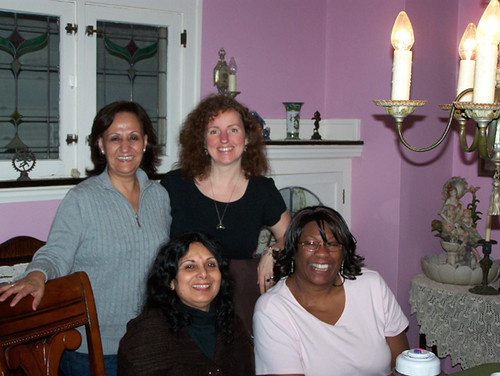
Mohtarama, Wendi, Mamta, Deborah
Thanks to everyone who has offered, so far, to help us out with our project (mentioned in yesterday's post). If anyone else thinks they'd like to help, we're looking for as many people as possible! We'll fill you in soon, just be sure to send us your email addresses if you haven't already done so. Thanks!
Here are more pictures of some of the foods we've been eating. Over the past year, we've pretty much been eating simple foods (except for the time I was preparing meals for the Raw Food Retreat). However, recently KDcat has been doing some extreme yo-yo eating between raw foods and packaged/unhealthy cooked foods. The back and forth has been causing her to experience a bit of a tummy upset. So, I've decided to make our meals a bit more exciting for her---so she'll possibly not feel so tempted by all of the colors and artificial flavors of the packaged "foods" she's been eating.
Talk about color...check out this salad I made earlier today:
A worker at our local Food Co Op was talking about making his own dehydrator. I mentioned that I saw a link to a site that told about how to create one and I'd share it with him. When I found the link, just now, I thought maybe some of you might be interested in checking it out, as well.
?The page isn't vegan-friendly (there is ground meat in the one picture), but if you've been wanting a dehydrator and don't want to spend the money on the more expensive ones...this might be a great option.