Know Any Literary Animal Lovers?

Hi there PureJeevan readers! We wanted to let you know that Jim's new novel CHROO is available on Amazon. It's a crazy adventure involving a billionaire heiress, her Chihuahua BFF ("Chroo") and a host of human and animal characters. Find out more on Amazon! Here are some links:
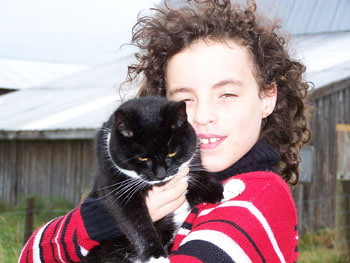
You rarely hear us talk about our daughter here on the blog. Some of you have noticed and asked questions about her through email. I'd like to tell you why we don't write about her very much, because there's something to be learned from it.
First, I usually don't like to write about people unless I get their permission. This is especially true when my daughter is concerned. I respect her privacy if she chooses for me to not share things about her life. Years ago when I knew I wanted to create the Pure Jeevan site, I talked with Jim and our daughter about it. I said it was something I felt drawn to do, that I felt it could help a lot of people, but I wanted it to be a family site if it's something they were interested in doing along with me. Jim agreed to help me at the time, but didn't fully embrace Pure Jeevan himself (now, however, he has become a very active part of this site and all of our projects). Our daughter, however, said from the very beginning that she didn't want any part of it.

 Day 8:
Let's focus on creativity for a bit. This is an area where many men have been comfortable expressing a feminine quality, especially when done through art and music. I say many, because we all know at least a few men who were raised to believe that a strong, powerful man doesn't spend his time with such frivolous things. Instead, he works hard to earn an income to support his family. In the past, and still sometimes today, creative men were viewed as weaker and less masculine, not practical and in control. The feminine quality of creativity was, however, encouraged in women who were afforded more time for such "frivolity."
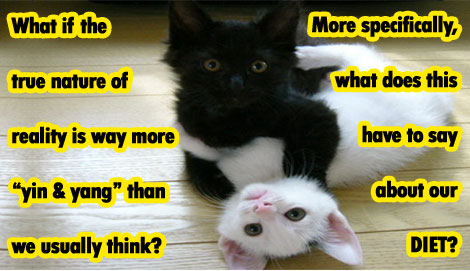
Jim here...As vegans and vegetarians, we're familiar with what we believe is quite a lot of misinformation regarding our lifestyle. However, we've done the research and, for example, know how we get our protein (always a concern received from others), know the stats on B12 deficiency (another concern often cited by mainstreamers), and know our answers to other issues such as where we get our minerals from and whether we consume processed foods and sugars. Bucking the mainstream conventional wisdom emergent from within a world dominated by the Standard American Diet, we live defiantly as healthy examples of our chosen path. But, is there any wiggle room as far as what is and isn't healthy (for us, and for everyone)? What about some of the things that everyone "knows" is bad for you? With questions like those in mind, here's something unusual -- a full post developed from a simple Facebook update. (You are friends with Wendi and me on Facebook, right ) Yesterday, I posted the following:
Think of something that you think is bad for you, and then go to Google & type in "benefits of [that thing]" and see if there is a web site that is promoting that thing. I just did this for "caffeine" and read some thought-provoking ideas (that might all be utter BS, but are interesting nonetheless).
Read more: If Science Can Prove Both Sides of an Issue, Then Which Is Correct?

While I was growing up in the Midwest, I had a rich uncle who lived out East in Philadelphia. I didn't know him very well at the time, but would often glean stories via the family grape vines of his business successes. After high school, I attended college in Northeastern Pennsylvania -- Wilkes University -- where, incidentally, I first met Wendi! :-)
Being out there, I got to visit my uncle from time to time, and dine with him and his family. ?Among other things, he was quite the gourmand. I'm not so sure what he'd have thought of raw foods, although I suspect he'd have appreciated the many gourmet efforts.
Jim here... again! Isn't that what all of the Oscar-nominated actors always say -- "It's an honor to be nominated"? Yes, I think that's the usual response. Who'd have ever thought that a raw foods blog would be saying the same thing ! Well, I'm happy to report that Wendi has received two such honors lately, in addition to being selected as an honoree among one blogger's nine "top favorite raw girls on the net." Let's take a look at these one by one, shall we?

First up is the "Best of Raw 2008" awards. Wendi was nominated in the category "Favorite Raw Vegan Educator for 2008." You can vote for her here until December 30 at midnight! Show your support; vote Wendi!
I have a need for hot food in winter to feel warm.
We hear this comment a lot from those trying to lose weight. Some joke that they thought their excess body fat would be keeping them warm, but they're still feeling cold and needing hot food in the winter months.
In the past, we've talked about reasons what's going on in the body when hot foods are consumed. Understanding this will help you realize that hot foods are actually not very good for our bodies. When we consume very hot foods, that heat is then inside our bodies, next to vital organs, while the body needs to maintain a temperature around 98.6 degrees. When we have temperatures higher than that right next to our vital organs, it must quickly work to remove that excess heat. It's the removal of this excess heat that causes us to feel warm. It's our bodies trying to stay in a healthy state. We are actually putting our bodies under stress when we do this (the same holds true for eating overly cold foods, like frozen desserts and icy drinks).


Our weekend is going to be filled with Spring cleaning. Many may not think of any type of cleaning as fun, but there's something special about Spring cleaning. Maybe it's because when we do Spring cleaning in our home, we tend to make it a family event. When we do things together as a family, even though there may be a little bickering here and there, but for the most part we have fun. There's something truly rewarding about working together as a team for something that is going to benefit everyone.

Wow, so much happened in Chicago that it's taking literally weeks to show it all to you!? But, hey, it's also a lot of fun to share this stuff. Wasn't that a great talk yesterday with Kathy and Danny Living !? If you haven't seen it, definitely scroll down and watch!
Here's another one for you. Meet Hatice Yavuz, co-owner along with Chef Mehmet Ak of Cousin's Incredible Vitality, another great raw destination in the Windy City. "Hatice" is a Turkish name, in case you're wondering. The "c" is pronounced like a "j" -- so, her name sounds like "huh-TEE-jay." Our interview with her ran a little long, so I'm going to have to break it into two parts. Here's part one:
Read more: Pure Jeevan Visits Cousin's I.V., Interviews Co-Owner Hatice Yavuz (Part 1)


This Thursday I want to give a special "Thank You" to Kevin Gianni. He was on my list for a Take the Time Tuesday introduction, but I didn't want to wait until then to tell you about him. I've been following Kevin's work on the Internet since he hosted The Raw Food World Summit last year. You can tell when you hear him speak that he's a genuinely nice, intelligent, caring person. He's honestly listening to what people are saying, trying to absorb the plethora of health information that's available. He asks a lot of interesting questions, too. He then takes what he has learned, condenses it, and shares the knowledge with the rest of the world. He does all of the hard work for us! For this, I wanted to give a special thanks to him.
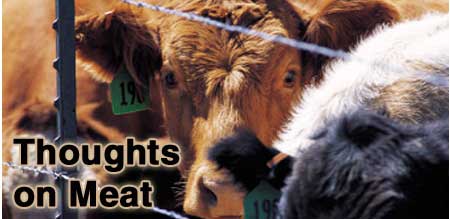
Jim here... Recently, a commenter on this blog, Lannette, mentioned being a cardiac rehab nurse. For some reason, reading this set my wheels spinning in various directions, among them onto the topic of meat consumption in the world. To begin, I'd like to recap something I'd said in response to her:
... it *astounds* me how people joke about heart health where I work. People around here routinely return from medical exams and actually adopt rather mischievous grins when they reveal how high their bad cholesterol levels are. It's like they're saying, "I know meat and dairy are bad for me, but I'm going to keep on eating it anyway. Isn't that funny ??!!!" Ummm, no. It's sad. They laugh it off as though there could be no possible future reckoning for them. It's reminiscent, IMHO, of Dr. Viktor Frankl's book "Man's Search for Meaning," in which he describes a psychological phenomenon he termed the "delusion of reprieve." For anyone unfamiliar w/ that, the term describes the phenomenon via which those faced with certain death (or near certain death) mentally construct some way out of it. They are deluded into believing that they'll have a reprieve from the inevitable. So, it's exactly the same to me -- these people see the heart attacks coming. They simply refuse to do anything about it, refuse to change their habits, deny what their blood work says to them. Why? Because they think "I'll be okay. Sure, this leads to heart disease in most people, but not in *me* because I'm a strong guy, I'm macho, I'm not as fat as some other person here, etc." Mostly, it's the meat, I think. It's got a powerful hold on our society...
So, today I wanted to write a little bit on the topic of meat consumption. This is an enormous issue, in my opinion. If you're reading this, it likely means you're already at least a vegetarian, so I do not need to quote you any saddening statistics on the horrors of the meat industry. In fact, before writing this, I decided to visit the PETA web site quickly in order to glean a few slaughterhouse facts. But, in no time, I became markedly depressed, so I'll largely avoid focusing on specific negative imagery here.
Jim here... Happy Sunday morning, everyone!? We don't normally post on weekends, but we're sharing this video as a special gift for my mom on Mother's Day.As Wendi likes to say, "Every day is mother's day!"? But, I do like to do something a little special for my own wonderful mom. So, check out this video of a recipe Wendi (mostly) and I created for her. If you remember my reaction to the soup we made recently, it may not surprise you to hear me say that this sauce is the "best #$%^&*^%! sauce I've ever tasted!"
We're typing up and formatting this recipe for Pure Jeevan family members (you know, those who subscribe to our mail list). So, once it's ready, we'll be adding it to the queue of mailings we sent out to keep everyone inspired. This recipe is a keeper!