Know Any Literary Animal Lovers?

Hi there PureJeevan readers! We wanted to let you know that Jim's new novel CHROO is available on Amazon. It's a crazy adventure involving a billionaire heiress, her Chihuahua BFF ("Chroo") and a host of human and animal characters. Find out more on Amazon! Here are some links:
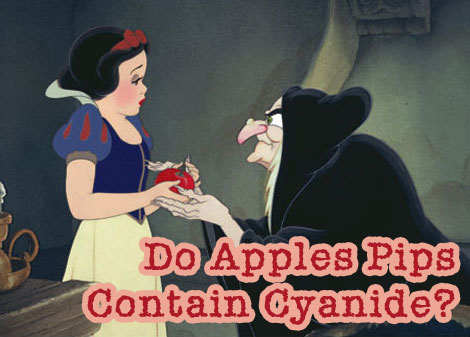
Jim here... A few months ago, I was in our local food co-op's juice bar. I'd ordered an apple juice and had cringed when I saw the barista chop up four Granny Smiths and nonchalantly toss the whole lot, seeds and all, into the juicer. That juice was for someone else. So, when my order came up, I politely requested that he cut the seeds out -- a request he reluctantly granted, although not without showing considerable annoyance. My thinking was: Hey, those seeds contain cyanide! Why would I want to consume that, even in small amounts
 But then... Have you ever known anyone who died from eating apple seeds? ?I know I haven't. Also, after mentioning this to a few people I know, I found that a number of them regularly ingest apple seeds. And, well, they're still living. So, is there any truth to the rumors? And, should we be concerned at all about this?
Read more: Should You Juice the *Whole* Apple, Seeds and All?
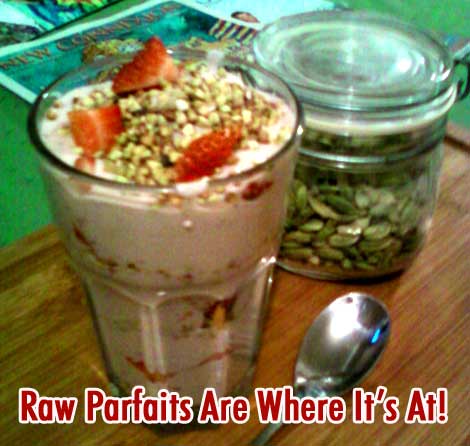
Above is a quick camera-phone pic I posted to our Facebook group lately. I did talk about making raw parfaits on that page, but want to talk a little more about them today, as it's just the perfect time to be talking about delicious raw parfaits (at least here in America, in any case, where many of the fresh berries you'll probably want are cheap and in season). I'll share a brief story about them, and then share my own basic recipe, and then we'll make some plans for MORE parfait talk really soon, okay?
I'm almost hesitant to talk about raw food parfaits here because, well, if the government found out how unbelievably healthy and ENJOYABLE parfaits are, I'm sure they'd make them illegal. But, I'll take a chance...
Leaving Sin City, our fearless raw travelers headed south to Arizona for all sorts of raw food adventures. First up was a trip to Prescott Valley to meet Abi and Eli. Let's take a peek into Wendi's travelogue again, shall we
 You probably haven't met our official tour guide yet. We call her Simone. She's a bit testy at times, but always gets us safely to our destination (although sometimes in rather roundabout ways). She added an extra one-time $89 fee to our trip budget, but we're very satisfied with her performance so far. You see, Simone is our trusty GPS unit!
Leaving Las Vegas, she guided us through the Hoover Dam area on our way to Arizona, a geographic area that I think would be better described as a "state of extremes." There, we experienced super hot, sunny days, freezing nights, snow outside even when it's sunny and hot, and also a bizarre experience we had in which some bananas actually froze and then nearly roasted all in the same day.
Read more: Arriving At Abi's Arizona Abode After Arduous Attempts
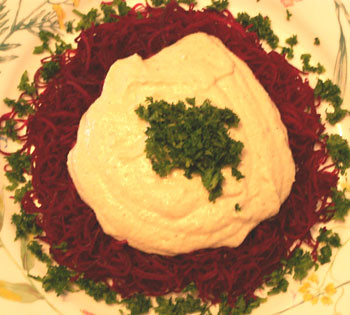
The mono meals ended and I did create that beet pasta with alfredo sauce that I was dreaming about. So, here's the recipe:
BEET PASTA
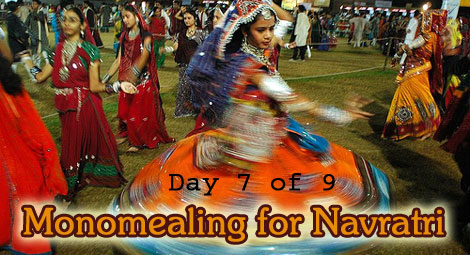
Day 7: Happy Navratri! It's the final three days, and today begins the special day of focusing on the attributes of Goddess Saraswati, recognizing those same feminine qualities within ourselves, and drawing inspiration to continue growing and changing in the most wonderful ways.
 Saraswati has always held a place of honor in our home. When we traveled to India a very long time ago(*), we purchased a batik wall hanging of Goddess Saraswati and framed it. It's quite large and we've always hung it in places where we wanted to focus on the energy that she represents to Hindus: creativity (particularly in the areas of music and art) and knowledge/intelligence (usually linked with education and literature).


Rita Romano, author of the widely available book Dining in the Raw and executive chef for many years at the Hippocrates Health Institute, is a true pioneer of the raw movement. We were thrilled to have the opportunity to visit with her and her two lovely Boston Terriers, Angel and Oreo. Here's PART TWO of our talk with her:
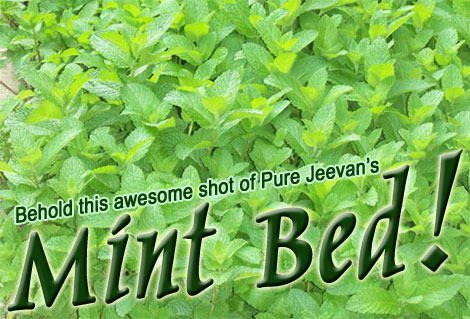
I wrote on Monday that today (Thursday), we would be discussing mint here -- specifically, harvesting some late-remaining mint from our mint bed (shown above in all its glory) and making something with it. I failed, however, to take into account that it's been getting darker earlier and earlier these days. By the time I was able to get outside and talk about mint, it was just too dark.
So, I thought I'd forego the video, and just write up some minty facts to freshen up your Thursday. To begin, I would highly encourage anyone who is new to gardening, and wants some early success, to experiment with mint (including spearmint, peppermint, and the various varietals available here and there). I can almost guarantee that you'll have some wild (and I do mean wild!) success, and will soon enjoy more mint than the law allows. It's so easily grown, and spreads around so easily (via its root system), that it would almost be considered invasive if it weren't so darned desirable and fragrant. (It's tough to walk past a mint bed without snatching up a leaf, rolling it between your fingers, and inhaling the scent deeply.)
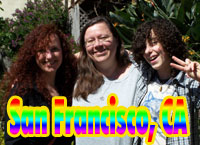 Wow, I'm having a tough time keeping up with our fearless travelers! I thought I'd break their San Francisco adventures up into FOUR smaller posts made from Wendi's personal travelogue. I'll try to address everything they did chronoligically. There will be a video in this posts, videos in the next post, and a picture set at the end! Here's what she had to say about their first stop in Frisco:
For our San Francisco/Berkeley visit, we first met up with a college friend, Pete Guinosso, at Cafe Gratitude. It was fun catching up, and Pete treated KDcat and I to our meals. While at the table, I labeled Pete as the "Quote Man" because he had a fantastic book of quotes he has been collecting. He periodically read from it as our conversations brought specific quotes to mind. It was a beautiful collection of poems, which Pete said is his second book and is filling up quickly.
Cafe Gratitude lived up to its reputation of having a great vibe with pleasant servers and fantastic raw foods. I wondered, however, why there isn't a dish called "I am Love." (There is a drink called "I am Loved," but I was interested in one that claimed I AM Love. Maybe they'll come up with one for my next visit!) After leaving Cafe Gratitude, I have to admit I wasn't overly grateful to find a $40 parking ticket waiting on the rental car. OUCH! We kept the car parked there (since it was already ticketed), and Pete showed us around the Berkeley shopping area. It was a fun stroll on a beautiful sunny, California day.
Here's a basic recipe that can be used to create any nut milk!
Nut Milk
1 cup of nuts or seeds?
Jim here... Thought I'd cross-post a discussion I put up on Give It To Me Raw yesterday.

Recently, I saw an article advocating a ban on banana consumption based on the premise that, if you don't live in the tropics, you have no business eating tropical fruit. Pointing to transportation costs and the related environmental impact of such transportation, the article argues that, by eating bananas, you're contributing to the destruction of the environment.

For the past twelve years I've been doing some monthly freelance work for a nonprofit company. I've done other work in addition to the work for this company, but for the past few years I've solely been working with them. The work is sweet---straight-forward desktop publishing for a legal advertising publication. I don't have to read, write, edit, research, or anything else---simply format the pages. The pay is great, too!
Well, I just received a call a few minutes ago notifying me that the publication will no longer be printed. I'm overjoyed for the trees---I wish all publications would go digital. However, since it's going digital, they won't be needing my services much longer.