Know Any Literary Animal Lovers?

Hi there PureJeevan readers! We wanted to let you know that Jim's new novel CHROO is available on Amazon. It's a crazy adventure involving a billionaire heiress, her Chihuahua BFF ("Chroo") and a host of human and animal characters. Find out more on Amazon! Here are some links:
Some of you have noticed that we've seemed a bit silent, or asleep, here at Pure Jeevan. We haven't abandoned our blog or our readers, though! For the next two weeks, it may continue to look like we are sleeping, but in reality we are doing anything but that! :-)
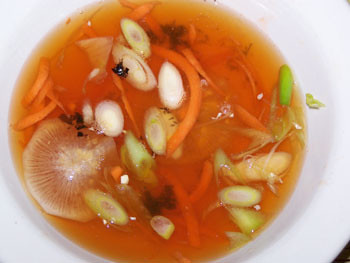
Here are some pictures of some recent meals we've been testing in our kitchen...
 Jim here... Wow, what a great week it's been here at Pure Jeevan, focusing on diabetes for five straight days!? To cap it off, I have some fun news to share:? Tomorrow is Wendi's birthday!? And, guess what ? When I asked her what she wanted to do to celebrate this year, she said she'd like to devote her special day to spreading the word about the Movement ot Reverse Diabetes Naturally. So, we made some calls and sent out some press releases.
A few venues were enthusiastically receptive, so we're hitting the streets tomorrow -- celebrating Wendi's birthday by handing out diabetes awareness literature! Here's the press release I sent to the media, which tells where we'll be. If you're from Pittsburgh, we hope you'll stop by to say hello and/or ask questions about natural diabetes reversal and of course raw foods!
= = = = = = = = = =

Welcome to Pure Jeevan's "Juice-a-Day Jamboree"! You're probably wondering, "What IS Pure Jeevan's Juice-a-Day Jamboree, anyway "? Well, it's simple:? It's an ongoing, informal, loosely organized "event" centered around juicing. Think of it as an interim step between (1) any kind of diet or lifestyle, from SAD to full-on raw, that does not include much regular juice, and (2) an all out juice feast where that's ALL you'd consume for a period of time. Basically, we're saying, "Let's just make this simple and accessible for everyone. Let's just make a goal to simply drink more fresh juice!"
Wendi and I have been thinking a lot about incorporating more juicing into our lives lately (which is something we've done off and on over the years but never stuck with long-term). One thing holding us back from doing it more often is the time requirement. When we juice, it usually takes a half hour or so from start to finish. I know it doesn't seem that complicated, but I suppose it's just the whole process of setting up the juicer, washing and peeling the produce, juicing it, setting the juice aside while we clean the juicer, doling out the juice into glasses, cleaning up the mini-mess that makes, and then sitting down to actually enjoy the juice.
"... a warrior's life is not about imagined perfection or victory; it is about love. Love is a warrior's sword; wherever it cuts, it gives life, not death."
~ Dan Millman, The Way of the Peaceful Warrior
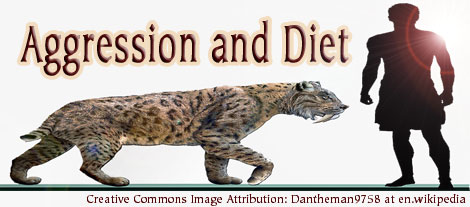
During some "highway philosophization" (my term for pondering everything and anything while driving) this afternoon, I eventually began to think rather deeply about human aggression, and specifically about how people hurt other people. Mainly, I was thinking about individual aggreession, although, as a group, humans are unfortunately rather prone to it.Wikipedia maintains a list of ongoing conflicts (i.e., wars), in fact. According to that page, there are seven major wars happenning right now and 15 additional significant ones. Of course, there are scores of unlisted ones ongoing as well, most of which the average person has never heard about.
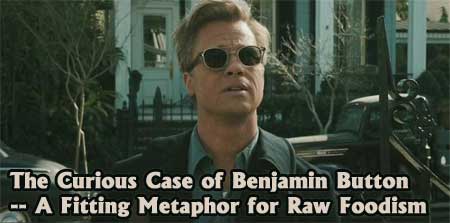
Jim here... It's not often that we're able to recommend a movie that's perfectly relevant to the raw food lifestyle. But, if you're a raw vegan and haven't seen The Curious Case of Benjamin Button, we highly recommend this film. Not only is it wonderful, but it's also, for much of the film, a nice metaphor for living the raw foods lifestyle.

Want to have a little bit of fun today here on the blog? We'd love to hear your list of favorite foods for each color of the rainbow! I wonder how many of us will have similar fruits and vegetables on our lists, and how many of us will come up with vegetables and fruits that others have overlooked?

Q: How Long Do Smoothies Last?
I responded to a similar question a while ago in an online forum. This issue comes up a lot, acually, so I figured I'd provide our response here on the blog rather than simply through an email reply. Here's that response, reworked a bit for our blog:
Optimally, I suppose we'd all just eat things whole, most of the time, instead of blending/juicing ...
We're heading out of town again! This time we'll be visiting Leela Mata at her Peaceful Valley Ashram, the location of the first raw food spiritual retreat I held last year.
Here's a video I took of Leela Mata last year:
?
This is a recipe for the coconut shake that brought my cholesterol levels from very unhealthy down to extremely healthy within the span of one month!
Young Coconut Shake
Flesh and water from one young coconut
Here's a basic recipe that can be used to create any nut milk!
Nut Milk
1 cup of nuts or seeds?
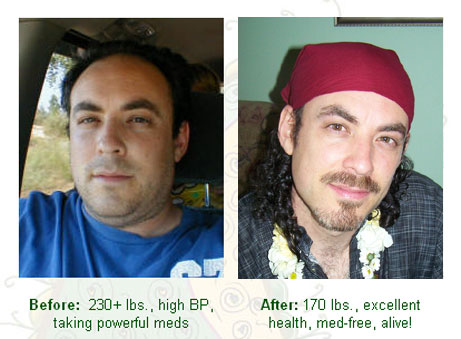
Jim here... Sorry for being away for so long. We've got SO much going on these days, it's mind-boggling! More on that later, as I have something in mind already for today...I should start by clarifying that I've been basically raw for almost 4 years now (high-raw, you might say). During the first nearly-two years, I still ate meat from time to time. Actually, I still ate (and drank) almost everything from time to time -- sugars, processed foods, alcohol, you name it -- only less than I did before, and within the context of a dietary intake consisting of a significantly higher percentage of living foods. In those early years, I'd estimate I was averaging 75-90% raw. Not bad ... I definitely experienced improvements in my health!
 The big change in consciousness didn't follow until two years ago. (This is an interesting point because, as you can see, I wasn't "ready" for a bigger change for two years into eating a lot of raw foods!) I suppose the difference was that, during the early years, I was pretty much raw by default rather than by conscious decision. As Jules said in Pulp Fiction, "... my girlfriend's a vegetarian. ?Which more or less makes me a vegetarian..." Yeah, that was my case back then, too, although I certainly grew into it (and am thankful that I did).
Read more: Reflecting on Two Years of an Exclusively Raw Die