Know Any Literary Animal Lovers?

Hi there PureJeevan readers! We wanted to let you know that Jim's new novel CHROO is available on Amazon. It's a crazy adventure involving a billionaire heiress, her Chihuahua BFF ("Chroo") and a host of human and animal characters. Find out more on Amazon! Here are some links:

I have enjoyed including information about new people, companies, and sites here in our blog for you to meet each Tuesday. Today, however, I want to do something a little bit different. Instead of someone or something being introduced to you, I'd love for YOU to introduce yourself to ME!
Take the time for ME to meet...

Man must cease attributing his problems to his environment, and learn again to exercise his will - his personal responsibility. ~Albert Einstein.
Jim here with another wonderful edition of Weird Wednesday. Here's something I find a little weird about food (and, I apologize in advance if this comes off a little preachy).
See, I work in an office and sit rather close to the corporate kitchenette. Routinely, people bring in junk food to set out for everyone -- cookies, donuts, cakes, pastries, pies, candy bars, nut rolls, cheesecakes, summer sausages, cheese cubes, fondues, etc. The thought seems to be that, in putting these things out for everyone, you're showing you care for them.Offering large servings of concentrated fats and refined sugar is viewed as a favor, as an altruistic service for your fellow coworkers. But this odd fact isn't even the weird aspect of my post (although, now that I think of it, that is pretty weird).
In Part 5 of this 5-Part series, Wendi talks with Leela Mata about meditation and diet. After discussing what meditation is and why people practice it, Mata Ji talks about diet and its effects on the mind. She then gives a brief explanation of how to meditate for those who are new to the practice, and demonstrates how to use a simple mantra (word or phrase) to aid in entering a meditative state.
I received an email from one of our lovely Pure Jeevan family members. Joanne is subscribed to our mailings and she received the ice cream cake recipe I had created for Jim back in January. Well, take a look at what she did with the recipe! It's LOVEly!

Hi Wendi!I took Jim's birthday cake recipe to the next level.

A while ago, I received an email asking whether I had any thoughts on how old or young a person needs to be in order to benefit from a raw food diet. Yes. Yes, I do have thoughts on that! Lots of thoughts! ... Here goes:
The easy answer, of course, is that people of ALL ages can (and should) benefit from raw foods. I can assert with confidence that, for most people, increasing your intake of raw fruits and vegetables will likely bring about positive changes to your health, regardless of your age, dietary habits, or current state of health. (Naturally, reducing or eliminating the "bad" things is also paramount.)
Thanks to everyone who has offered, so far, to help us out with our project (mentioned in yesterday's post). If anyone else thinks they'd like to help, we're looking for as many people as possible! We'll fill you in soon, just be sure to send us your email addresses if you haven't already done so. Thanks!
Here are more pictures of some of the foods we've been eating. Over the past year, we've pretty much been eating simple foods (except for the time I was preparing meals for the Raw Food Retreat). However, recently KDcat has been doing some extreme yo-yo eating between raw foods and packaged/unhealthy cooked foods. The back and forth has been causing her to experience a bit of a tummy upset. So, I've decided to make our meals a bit more exciting for her---so she'll possibly not feel so tempted by all of the colors and artificial flavors of the packaged "foods" she's been eating.
Talk about color...check out this salad I made earlier today:
Rawbin Rescues Turtle
I had a fantastic time at the 2008 Green Festival in Washington, DC. My wonderful friend, Rawbin, picked me up last Thursday and we had a nice drive back to her place in Maryland. She lives in an almost magical setting with wooded areas, horses, a goat, chickens, dogs, and cats! KDcat will not want to leave when she visits Rawbin someday. Above is a video of Rawbin rescuing a turtle that was in the middle of the road near her home.

Jim here... A few months ago, I was in our local food co-op's juice bar. I'd ordered an apple juice and had cringed when I saw the barista chop up four Granny Smiths and nonchalantly toss the whole lot, seeds and all, into the juicer. That juice was for someone else. So, when my order came up, I politely requested that he cut the seeds out -- a request he reluctantly granted, although not without showing considerable annoyance. My thinking was: Hey, those seeds contain cyanide! Why would I want to consume that, even in small amounts
 But then... Have you ever known anyone who died from eating apple seeds? ?I know I haven't. Also, after mentioning this to a few people I know, I found that a number of them regularly ingest apple seeds. And, well, they're still living. So, is there any truth to the rumors? And, should we be concerned at all about this?
Read more: Should You Juice the *Whole* Apple, Seeds and All?
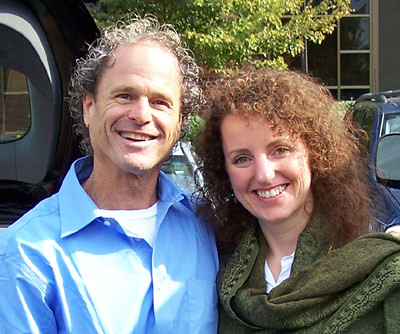
I met Dr. Doug Graham in person at the Raw Spirit Festival. He has a soft, gentle voice but his message is anything but soft. He's straight-forward about diet and health being intimately related. Dr. D. invited me to be his guest this past Saturday at a doctors' convention where he boldly stated to his audience of doctors: "I'm probably not going to make you all that happy with the things I'm going to tell you."
There he was, standing in front of a room of doctors who have taken an oath to harm none. These doctors were there to learn about health and nutrition, but I don't think they had any idea about what they were going to learn from Dr. D. "What I say may fly in the face of what you've been taught," Dr. D. admitted. Many of the doctors leaned forward a bit, eyes and ears a bit more open at the thought of hearing something radical.

A month has gone by since my last health update. At this point, I consider myself healed of lyme disease! In the past I asked the lyme specialist doctor if there's a way to test to see for certain the lyme is gone, but he said there isn't. So, I go on my inner wisdom, which tells me that it's gone and now I simply need to continue healing from all that the lyme brought with it.
We're still not comfortable sharing what we've been learning and doing to help move my body into an even healthier state, but it's obviously working. I've been able to go back to daily living, for the most part, without much assistance at all. I've organized the house again (Jim and KDcaT were busy caring for me and the house wasn't the top priority for the past half a year), caught up on all of the laundry, responded to all of my email that had been piling up, and I've been able to be more social again. The biggest improvements are that I can now prepare my own food without experiencing any pain, and I can dress myself with only minimal assistance at times! BIG improvements!