Know Any Literary Animal Lovers?

Hi there PureJeevan readers! We wanted to let you know that Jim's new novel CHROO is available on Amazon. It's a crazy adventure involving a billionaire heiress, her Chihuahua BFF ("Chroo") and a host of human and animal characters. Find out more on Amazon! Here are some links:

How does the following menu* sound for your Thanksgiving meal
Nut Loaf, Apple un-stuffing, Mac Mushroom gravy,

Next weekend I'll be at the Green Festival in Washington, DC. helping Natural Zing at their vendor booth (I'm completely in love with Natural Zing because of their honest business ethics and commitment to having the highest quality products available---and the president is a truly beautiful individual). My dear friend RawBin will be picking me up next Thursday for a RAWsome weekend and I'll fly back on Monday!
Here's a list of some Green Festival facts from their Web site:
Jim here... Until our home sells (SOON!!!) and Wendi and I launch ourselves into the world as full-time raw food teachers / lecturers / inspiration providers, I'm more or less stuck in the corporate world during the day. While much of what happens in this Dilbert-esque environment is, as many of you likely know, absolutely meaningless, there is nonetheless the occasional pearl of wisdom to be pried from the clammy jaws of the 9-to-5 world. I was, for example, just reminded of a story I heard at a seminar once. Not surprisingly, the seminar pertained to the art of money making. However, there's another more fulfilling message to it as well.
A large modern newspaper company still uses these ancient printing presses from the 1950s -- huge old monstrosities with enough belts, pulleys, and greasy gearboxes to make any modern-day steampunk enthusiast squeal with delight. One day, not long after the old press manager finally leaves the company, the main press breaks down. Manuals are consulted, technicians brought in, engineers asked to take a peek. No one can bring the beast back to life. But there's a woman on the Internet who specializes in these babies -- and, guess what, she's local! So, they call her in. She listens to their problem and says she can fix it, but it's going to run them $5,000.

Today we welcome Melissa Sokulski from BirchCenter.com and FoodUnderFoot.com for another episode of Pure Jeevan's Makin' It Monday "Guest Raw Chef" edition. In this episode, Melissa demonstrates how to make raw tortillas (this recipe uses a dehydrator). You'll be amazed at how pliable these tortillas are!!
Read more: Melissa Makes Raw Tortillas on Makin' It Monday "Guest Raw Chef" Edition
All this week we're continuing to feature a variety of answers to the question "Are Raw Foodists Crazy " from various friends of Pure Jeevan. If you're just now tuning in, please read the back story and introduction to this, as posted on Monday.But, for now, let's continue with posting the rest of the excellent responses sent in! Enjoy!! :-)
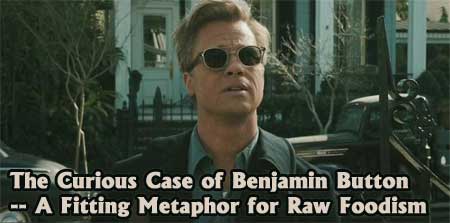
Jim here... It's not often that we're able to recommend a movie that's perfectly relevant to the raw food lifestyle. But, if you're a raw vegan and haven't seen The Curious Case of Benjamin Button, we highly recommend this film. Not only is it wonderful, but it's also, for much of the film, a nice metaphor for living the raw foods lifestyle.

Pizza Delivery at Pure Jeevan s home ! Yep, and it s not raw pizza, either. Maybe sometime in the not-so-distant future we ll be able to order delicious, life-giving raw pizzas for delivery to our home, but that time hasn t come. Even if it was possible today, I have a feeling we d still be ordering the greasy pizza that s going to be arriving here later today.
 You see, today is KDcat s 14th birthday. As much as she knows about health, nutrition, and the harms of consuming dairy, she has made a decision that she wants to order a pizza for her birthday and have it delivered. When she told me of her birthday wish, a very big part of me wanted to review how unhealthy such food is, but the other part didn t want to bring guilt to her decision of eating pizza on her birthday. I know she completely understands about foods and health, especially about how harmful dairy can be for her body. She was determined to have pizza, so I d rather she enjoy it than to eat while feeling guilty about it the entire time.
In Part 5 of this 5-Part series, Wendi talks with Leela Mata about meditation and diet. After discussing what meditation is and why people practice it, Mata Ji talks about diet and its effects on the mind. She then gives a brief explanation of how to meditate for those who are new to the practice, and demonstrates how to use a simple mantra (word or phrase) to aid in entering a meditative state.

In a previous Take the Time Tuesday entry, we introduced you to three fantastic raw food snack companies who have offered to donate samples of their products for our upcoming retreat. If you haven't heard about the 3-Day Raw Food Spiritual Retreat, yet, there is still some space for you to join us from May 23-25, 2008! We ve set this retreat up so that it s as affordable as possible. There s a significant savings if you sign up early, too, so be sure to check it out!
Each individual attending the retreat will receive a gift basket filled with delicious raw food treats from some truly fantastic companies. Keep an eye on the retreat page to see other companies that will be sharing delicious raw food snacks with those attending the retreat! Today, we'd like you to...
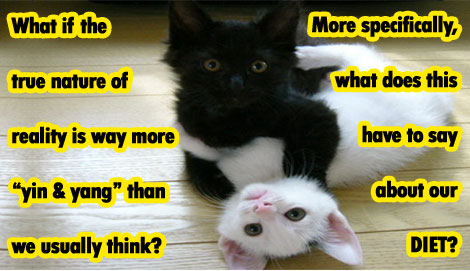
Jim here...As vegans and vegetarians, we're familiar with what we believe is quite a lot of misinformation regarding our lifestyle. However, we've done the research and, for example, know how we get our protein (always a concern received from others), know the stats on B12 deficiency (another concern often cited by mainstreamers), and know our answers to other issues such as where we get our minerals from and whether we consume processed foods and sugars. Bucking the mainstream conventional wisdom emergent from within a world dominated by the Standard American Diet, we live defiantly as healthy examples of our chosen path. But, is there any wiggle room as far as what is and isn't healthy (for us, and for everyone)? What about some of the things that everyone "knows" is bad for you? With questions like those in mind, here's something unusual -- a full post developed from a simple Facebook update. (You are friends with Wendi and me on Facebook, right ) Yesterday, I posted the following:
Think of something that you think is bad for you, and then go to Google & type in "benefits of [that thing]" and see if there is a web site that is promoting that thing. I just did this for "caffeine" and read some thought-provoking ideas (that might all be utter BS, but are interesting nonetheless).
Read more: If Science Can Prove Both Sides of an Issue, Then Which Is Correct?

A month has gone by since my last health update. At this point, I consider myself healed of lyme disease! In the past I asked the lyme specialist doctor if there's a way to test to see for certain the lyme is gone, but he said there isn't. So, I go on my inner wisdom, which tells me that it's gone and now I simply need to continue healing from all that the lyme brought with it.
We're still not comfortable sharing what we've been learning and doing to help move my body into an even healthier state, but it's obviously working. I've been able to go back to daily living, for the most part, without much assistance at all. I've organized the house again (Jim and KDcaT were busy caring for me and the house wasn't the top priority for the past half a year), caught up on all of the laundry, responded to all of my email that had been piling up, and I've been able to be more social again. The biggest improvements are that I can now prepare my own food without experiencing any pain, and I can dress myself with only minimal assistance at times! BIG improvements!