Know Any Literary Animal Lovers?

Hi there PureJeevan readers! We wanted to let you know that Jim's new novel CHROO is available on Amazon. It's a crazy adventure involving a billionaire heiress, her Chihuahua BFF ("Chroo") and a host of human and animal characters. Find out more on Amazon! Here are some links:

When it comes to healthy eating, most of us know what is and isn't healthy for our bodies. Sure, we've been a bit confused by what the media and our government tells us, but overall I think we can all confidently say we know that consuming fresh fruits and vegetables is going to be a healthier choice than eating a McDonald's hamburger and fries. Right
But, what do we do when we're dealing with stress in our lives? What if when we're stressed we instantly head to McDonald's to eat the burger and fries we know aren't healthy for us? Or what if we consume large quantities of cakes, candies, or ice cream when we're overcome with stress
Jim here... Wow, it's May 1st already! May is an exciting month for me because that's usually when my running kicks in more regularly. There's nothing like hitting the pavement and being in motion, MP3 player in hand. Whether it's an intense half hour of intervals powered by the Foo Fighters, or a longer moving-meditative outing accompanied by Michael Hedges, I do enjoy being out there (even if I'm distracted now and again when my canine running companion? -- aka "the Jooge" -- chases after something she shouldn't)!
But, as I was getting at:? Ever since I lost the weight, I simply can't abide cold. I've heard many raw foodies talk about this phenomenon, and have heard numerous explanations for it. My suspicion is that all of the "why raw foodies are always cold" theories are partly correct -- or, better put, that the theories cumulatively contribute to our slightly lowered body temperature.

Today, for Take the Time Tuesday, I'd like to introduce you to an online social networking Web site for those with similar interests to get together, meet, and hang out in the physical world. If you haven't already heard about it, check it out!
Take the time to meet....
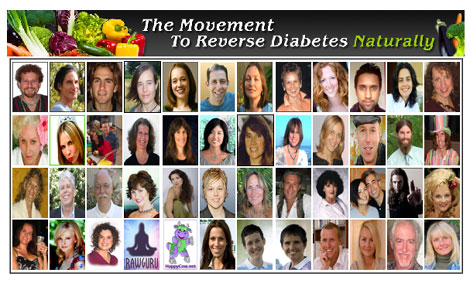
A few weeks ago, we hosted a Diabetes Awareness week here at Pure Jeevan. This was our contribution to the larger Reversing Diabetes Naturally movement that we blogged about. We wanted to let you know that the package of bonus materials offered to people who purchase the Simply Raw DVD is quite amazing! (See this post for details.) We reviewed all of the materials ourselves, and it's just a ton of great information.
The original deadline for receiving the free bonus materials was the end of April. However, the deadline has been extended through Friday, May 8. So, if you know anyone who has diabetes who could benefit from either the ?Simply Raw? documentary and/or the companion film, ?The Ultimate Enyclopedia of the Raw Food Listyle," simply point them to http://tinyurl.com/pj-diabetes.
Read more: Two Days Left for Raw Food Bonus Materials for RDN Movement
Jim here... A health-conscious friend of mine was feeling sick today. And, while I certainly do not advocate harping on the sick, I did have a very mild discussion with her when she phoned me for some advice. I asked, "Do you know what cognitive dissonance is "
"I'm not sure," she replied.


On this lovely Valentine's Day, I am focusing on how thankful I am for LOVE! I'm not into the whole this-is-the-day-you-are-supposed-to-show-love thing, though. I think love is something that should always be around, felt, and shared. Every day is a new day to express the love you have in so many varied ways, why hold it back for one special day a year?

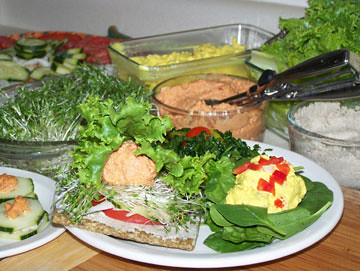
I'm still working on the dishes that will be served at the upcoming 3-Day Raw Food Spiritual Ashram Retreat (only 2 spots left!). Today, I worked on the Sandwich Fixin's that will be served for lunch on one of the retreat days.
Recently, we were asked how to balance meals when one individual is an under-weight-open-to-raw-semi-carnivore and the other is overweight and feels the need to be on a raw food diet to lose weight and regain health.
Many of you reading this will agree: It's wonderful that the partner is open to the raw food diet! That's going to make life so much easier. Many on the raw food path lack a supportive partner, and that's an issue we've discussed in the past here on the blog and will continue to address in the future.
You thought our "Know Your Food" series was dead ?!!? (Or, if you're a new reader, maybe you don't know what "Know Your Food" is yet!) Well, we've been poking around in the archives this week and discovered THREE lost episodes. This is HUGE... It's like one of those stories you hear every few years about some rare Hollywood film being discovered in a vault somewhere (laughing so hard)!
Over the next week or two, we'll be posting these three episodes. Today's episode is PUMPKIN, starring Wendi and her guest Ella (daughter of Melissa and Dave, who run the FoodUnderFoot blog we linked to recently). Once these missing episodes have been aired, this will usher in the dawn of a never-before seen level of production values for the Know Your Food series. The new stuff will totally win every major award available to YouTubers (continues laughing...).
Sure, we know pumpkins aren't in season right now. However, this video is sweet because of our special guest. So, enjoy the Pumpkin episode:
Here's a video demonstrating a technique for making super-fast, vibrantly beautiful, tasty salads! If you frequently find yourself in a rush, but also want a healthy meal, definitely check out this mandoline technique. (Further commentary below, after the video...)
Today we thought we'd introduce you to a common wild edible known as Purple Deadnettle (or, more dramatically, the Purple Archangel). Watch the video and let us know if it grows in your area, and if you've tasted it!