Know Any Literary Animal Lovers?

Hi there PureJeevan readers! We wanted to let you know that Jim's new novel CHROO is available on Amazon. It's a crazy adventure involving a billionaire heiress, her Chihuahua BFF ("Chroo") and a host of human and animal characters. Find out more on Amazon! Here are some links:
Jim here... During one of our marathon sessions at a Border's book store, I recall reading somewhere about the notion of a fruit's "intention" to be eaten. It's been a few years since I've read that, but I immediately resonated with the notion that many fruits, nuts, vegetables, and seeds are actually evolved to be eaten by other living beings and, therefore, to consume them (or their fruits and seeds) is to participate in a wonderfully nonviolent act that is in perfect harmony with a kind of primordial Earthen symbiosis. Whether these plants, vines, trees, etc. feel a conscious intention to have their fruit eaten by others is a matter of metaphysical conjecture. But, within the context of discussing vegetarianism, the argument is certainly relevant and fairly strong.
 If you walk up to a farm animal, it may be impossible to estimate what's going through its mind, but I feel intuitively that it isn't, "Please kill me and eat my flesh." In other words, there's no "intention" present in that scenario. On the other hand, it's very easy to imagine that a tree produces fruit, knowingly or not, in order to produce offspring. Throughout the entire evolution of that tree, part of that reproductive process has involved animals (including humans) eating the fruit and then "redistributing" (which is a nice way of putting it, I suppose) the seeds naturally.
Today, we thought we'd share another non-diet-oriented explanation of obesity. It's from Rhonda Byrne, author of the international multi-media phenomenon known as "The Secret," which provides readers with in-depth philosophical explanation and instruction with respect to the Law of Attraction.
Wendi and I have The Secret on CD, and often enjoy listening to it. I think, in fairness, we both have a few legitimate criticisms about certain aspects of it (and I'll share one or two, below). However, on the whole, many of the ideas within resonate deeply for us and we find much of the underlying message profoundly uplifting and empowering -- especially (for me) much of the discussion regarding maintaining a healthy, positive, optimistic attitude and practicing gratitude.
Well, I hope we're finally approaching the true end-game of our whole move. We now have our home listed with a new realtor (no longer going it alone as a "for sale by owner" scenario), so we're hoping that a renewed effort (and a lower price) will attract a buyer. The market seems to be perking back up a little as well, which certainly can't hurt anything.
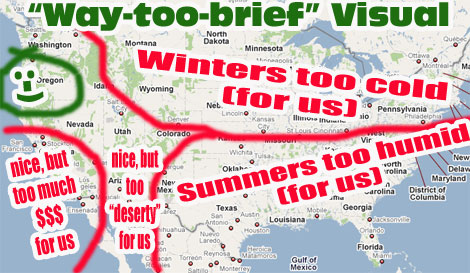
Thanks to everyone who sent in suggestions for places we should consider moving to. I assure you that we researched each and every one to an almost ridiculous degree. There are more amazing places to live than we ever knew, and we were delighted to learn about some areas with which we weren't very familiar -- funky little enclaves in Texas, Tennessee, New Mexico, etc. I think we've hinted as to our inclinations before, but I can tell you that, after so many months of intense deliberation, we believe the best domestic home for Pure Jeevan is probably in Oregon.

It's time for another "Makin' It Monday" installment!? This time, Pittsburgh raw foodies Joe Prostko and Tracey Anne Miller (along with videographer Heather) demonstrate their "Turbo Tornado Superfood Solution," which has (as you'll see) a *ton* of superfood ingredients. Take a look:
Read more: Makin' It Monday: Turbo Tornado Superfood Solution
All this week we're continuing to feature a variety of answers to the question "Are Raw Foodists Crazy " from various friends of Pure Jeevan. If you're just now tuning in, please read the back story and introduction to this, as posted on Monday.But, for now, let's continue with posting the rest of the excellent responses sent in! Enjoy!! :-)

As promised, here's another question I'd like to openly address here instead of via Wendi's email system. This one also comes up from time to time, and I told this person to watch out for my two cents on this issue. So, here it is. The reader asks:
... During your transtioning to a raw food diet & the loss of so much weight, what if any exercising were you doing along the way

Here's some coconutty video footage from our Florida Keys excursion. First up is some footage of Randesh, from www.TheGuana.com, who obtains fresh coconuts for Charlie Wilson's Key West restaurant, Help Yourself (see yesterday's blog post).Notice that Randesh uses a proper piece of equipment -- a large machete (or cutlass) -- which makes short, easy work of opening these precious gifts of nature! In the video footage following that, you'll see how comically difficult it is to open a young coconut when you lack the proper equipment. We actually went out looking for a machete, but could only find a large chef's knife at a local K-Mart. Yep, they were sold out of machetes! (Ironically, the chef's knife -- the heaviest one the store had -- cost about $17, while plain old machetes run just $10 or so at most hardware stores. Next time we'll keep looking...)

Today is Wendi's Birthday, so please join me in wishing her all the best for the coming year! Since this was our first year in Portland, just an hour-and-a-half's drive to the Pacific, I'd known for ages what we were going to do to celebrate Wendi's birthday -- a picnic at the beach, of course!
A few days ago, the weather reports for the central Oregon coast cities unanimously agreed: Rain! ?But, after living here for a few months, one learns that a forecast of rain *never* means that it's going to rain all day long. Rather, it just means that it'll likely rain at some point, or at many points, in a given day. The rest of the time, it could very well be perfectly sunny outside!
Read more: What Are Negative Ions, And Are They Beneficial to Human Health?
Jim here... Wow, it's May 1st already! May is an exciting month for me because that's usually when my running kicks in more regularly. There's nothing like hitting the pavement and being in motion, MP3 player in hand. Whether it's an intense half hour of intervals powered by the Foo Fighters, or a longer moving-meditative outing accompanied by Michael Hedges, I do enjoy being out there (even if I'm distracted now and again when my canine running companion? -- aka "the Jooge" -- chases after something she shouldn't)!
But, as I was getting at:? Ever since I lost the weight, I simply can't abide cold. I've heard many raw foodies talk about this phenomenon, and have heard numerous explanations for it. My suspicion is that all of the "why raw foodies are always cold" theories are partly correct -- or, better put, that the theories cumulatively contribute to our slightly lowered body temperature.
Jim here... Here's a compilation of vids from my little Flip camera, all taken over our weekend roadtrip to Washington, D.C. It's not all strictly raw-food related, but does include some raw tips. First up, you'll see our rawsomely packed food coolers. Between using ice and frozen fruits, everything kept cool just fine.
Early in the video, Wendi shares a handy tip for keeping your smoothies cool on the road. If you're going to drink your smoothies right away, you might have little concern for keeping a drink cold. However, we had eaten breakfast already and knew we wouldn't want to get into our smoothies for another hour or so after leaving. Frozen berries to the rescue! (Just make sure to hunt down a large glass bottle with an opening large enough to pour frozen berries into.)

Rita Romano, author of the widely available book Dining in the Raw and executive chef for many years at the Hippocrates Health Institute, is a true pioneer of the raw movement. We were thrilled to have the opportunity to visit with her and her two lovely Boston Terriers, Angel and Oreo. Here's PART TWO of our talk with her: