Know Any Literary Animal Lovers?

Hi there PureJeevan readers! We wanted to let you know that Jim's new novel CHROO is available on Amazon. It's a crazy adventure involving a billionaire heiress, her Chihuahua BFF ("Chroo") and a host of human and animal characters. Find out more on Amazon! Here are some links:

Today, we're going to show you haw to make some tasty brownies. Best of all, this recipe takes only a few minutes. Let's get to it!
First, throw a couple of big handfulls of raisins into your food processor.

The way your smile just beams
The way you sing off-key
Correction: I said "Lenuria" a number of times in this video, but it's actually Lunaria! In any case, we wanted to share some additional description for this plant. Here's a quick paragraph from Wikipedia:
Lunaria is a genus of flowering plants in the family Brassicaceae, native to central and southern Europe. It includes two species, Perennial honesty and Annual honesty. They are widely grown as ornamental plants in gardens, and have become naturalised in many temperate areas away from their native habitat. In the language of flowers, it means Sincerity and Forgetfulness. ...The common name "Honesty" arose in the 16th century, and it may be due to the translucent seed-pods which are like flattened pea-pods and borne on the plant through winter. In South-East Asia, it is called the "Money Plant," and in the United States as "Silver dollars," because its seed pods have the appearance of silver coins.

If you are in the Pittsburgh area this weekend, you are in for a real treat! Rhio will be visiting with us and she'll also be meeting with others during her two-part presentation for the Pittsburgh Raw Food Meetup on Saturday.You don't have to be a member of the meetup to enjoy this presentation. Below is information about the event you won't want to miss!
Two-Part Presentation by Rhio includes Dinner

Today we're running another installment of our "Thankful Thursday" series. This time, we're especially thankful ... for YOU, the Pure Jeevan family! Who'd have thought, less than two years ago when launching this blog, that we'd make thousands of connections with others looking for inspiration on their raw food journey !!? It's simply astounding -- and we're still actually "just getting started."
As always, we're thrilled to provide information and inspiration. It's counter-intuitive, when you really consider it; "raw foods" may be just two simple words, yet there always seems to be more and more to talk about, more people to interview, more success stories to highlight, more recipes to contribute, more tips and tricks to share, more personal reflections to offer.
Read more: Thankful Thursday: Pure Jeevan Asks for Your Help!

On this lovely Valentine's Day, I am focusing on how thankful I am for LOVE! I'm not into the whole this-is-the-day-you-are-supposed-to-show-love thing, though. I think love is something that should always be around, felt, and shared. Every day is a new day to express the love you have in so many varied ways, why hold it back for one special day a year?

Jim here... Just a brief, fun post for the weekend... We just saw the movie Scott Pilgrim vs. the World a few days ago. ?It's a great movie, for many reasons. But, vegans will get a real kick out of one scene involving a character named Todd Ingram, who has super powers. ?Why? ?... Because he's a vegan! ?We won't spoil the scene, though. But, if you're a vegan, or know a lot of vegans, you should get a pretty good laugh from this! I think they nearly had to throw Wendi and me out of the theater, as we were laughing so hard (especially Wendi). ?Enjoy. :-)
Jim here... We know a lot of people who exist on a high-raw lifestyle, and many others who aspire to eat a 100% live food diet. I don't believe there is an exact threshold that makes one a "raw foodist." That term is more or less just a general description you might use about yourself or anyone. Aside from the labels, though... If you want to talk about recommended levels of raw intake for optimal health, quite a number of web sites and health books seem to recommend shooting for around 80% of one's intake to be raw, with a careful eye on the other 20%. We certainly agree with that as a good starting goal, adjusting upward or downward as you gain feedback from your body.
Of course, most of the people who do follow a high-raw diet are usually by definition highly health-conscious about any non-raw foods they eat. I've yet to meet, for example, a raw foodist who occasionally eats Burger King Double-Whoppers ?(although, I'm sure that seemingly odd combination must exist somewhere).

As I write this, Wendi and KDcat have been en route to Portland for 39+ hours so far (including a long layover in Chicago)! Looks like they still have another 22 or so hours to go. What a monumental trip, eh ! Cross-country travel by rail really gives you a better appreciation for the distance, as compared with air travel or even highway travel. Imagine what it must have been like in the covered-wagon days!
 So far, reports from the train have been not so wonderful. KDcat seems to be having a good time roaming around socializing. But, Wendi's experiencing some major motion sickness. Oddly, we never anticipated this problem -- which is incredible, as we spent more than a month planning this trip! But, it just goes to show you that you cannot anticipate everything in life!
 Yesterday was a ton of fun, wasn't it? Sam loves all of the comments, so if you haven't viewed her video, please do -- and let her know how much you enjoyed it!? For today, we just wanted to announce the addition of a permanent new button along the right sidebar of our blog. As you can see, it links to this post from a few weeks back when we first announced a call for guest raw chefs. There, you'll find the details on hosting a segment of Makin' It Monday, just like Sam did.
By the way, just last week, we passed a noteworthy milestone that we didn't mention -- our 500th blog post here at Pure Jeevan. That's a lot of raw foods coverage, right ! Well, we're really still getting started when it comes to the level of information and inspiration we're planning for Pure Jeevan -- so it's great to add new features like this now, as we're able to. Of course, once our home sells and we're finally able to move on to the next phase of our lives, we envision Pure Jeevan exploding with more content than ever before. What fun it'll be to be able to devote ourselves full-time to spreading the word about raw foods!
Original Comments
Below, we have included the original comments from this blog post. Additional comments may be made via Facebook, below.
Read more: Be Part of Pure Jeevan's Makin' It Monday Video Series!
If you like raw cauliflower and fresh mint, I recommend you try this dish! Jim and KDcat don't like raw cauliflower much, so this dish wasn't a big hit with them. I, however, consumed the entire dish before the end of the day! I LOVED it!
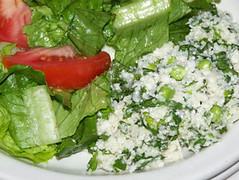
Read more: Makin' It Monday: Refreshing Cauliflower Mint Salad